
For those who have managed to tune out the daily market drama and focus on living their lives, the detachment is often an enviable trait. However, understanding the context of the current financial landscape reveals a familiar narrative. Investors today worry that while AI is undeniably a major technological advancement, the surrounding market mania is moving too fast and reaching too high. This sentiment sparks fears of a repeat, or an even larger version, of the dot-com crash of the early 2000s—an era that shaped the early career of prominent financial commentators and pushed many toward the path of early retirement, even as the subsequent downturn threatened jobs and financial stability.

As questions surrounding this investment cycle continue to circulate, financial educators and long-term retirees are increasingly addressing the phenomenon in public forums, examining whether current market pressures will genuinely derail retirement plans.
Will the AI Bubble Ruin Our Retirement?
Having spent over two decades in retirement, many long-term financial independence advocates have grown comfortable with the concept of post-work life. Yet, a fundamental question often resurfaces from concerned peers: How can anyone remain retired and sleep soundly at night with everything happening in the world?

If one closely follows the daily news cycle, the list of anxieties is long. Modern headlines are dominated by geopolitical tensions, shifting political landscapes, persistent inflation eroding purchasing power, the looming AI bubble, towering national debt levels, and ongoing international conflicts that threaten broader stability.
Interestingly, these exact concerns are not entirely new. Similar questions were posed to retirees two decades ago, in 2006. Back then, society wrestled with its own set of formidable worries. The geopolitical sphere was defined by different leaders and conflicts in the Middle East. Observers fretted over national debt, inflation, and an overvalued housing market that ultimately inflated into the housing bubble. Instead of artificial intelligence taking away domestic jobs, the prevailing fear was widespread economic outsourcing to overseas markets like India and China. There was also a fierce debate over "Peak Oil," with many predicting societal doom as fossil fuel consumption outpaced perceived supplies—an outcome that was ultimately upended by subsequent technological and extraction advancements.

Following the intense anxieties of 2006, the global financial system did indeed experience the Great Financial Crisis, driven by irrational exuberance in real estate and excessive financial leverage. It was the most severe economic downturn since the Great Depression. Yet, when viewed through the lens of a multi-decade horizon, even that historic crash appears as a temporary dip in a broader upward trajectory. Broad market indices ultimately recovered and expanded significantly over the ensuing twenty years, absorbing subsequent shocks such as the market downturn during the COVID-19 pandemic in 2020.
At the same time, global metrics demonstrated substantial broad progress. Over a twenty-year period, the proportion of the global population living in extreme poverty dropped significantly, while infant mortality rates were drastically reduced. Clean energy technologies matured, with solar energy generation scaling up dramatically as panel costs plummeted, making solar a dominant source of new power generation capacity. Simultaneously, electric vehicle adoption transitioned from a theoretical concept to a substantial share of global automotive sales.

These historical comparisons raise a fundamental question: Is the current economic environment genuinely different this time? Skeptics point to the expanding United States national debt, the unprecedented scale of the AI valuation boom, or theoretical concerns regarding advanced machine intelligence. While the financial media frequently amplifies these scary narratives, critics of fear-mongering point out a core oversight: true economic prosperity does not originate from financial systems or stock market tickers, which are ultimately numerical representations on computer screens. Instead, prosperity stems fundamentally from human productivity.
Productivity, Prosperity, and the Nature of Fear
The underlying mechanics of capitalism are inherently choppy, characterized by wild swings and market corrections. Beneath the volatility, however, real people perform real work and develop genuine innovations. The financial system itself is a human invention; if a market system faces severe disruption due to mathematical corrections, human societies possess the capacity to restructure financial frameworks and resume productive output, a mechanism utilized successfully during past crises.

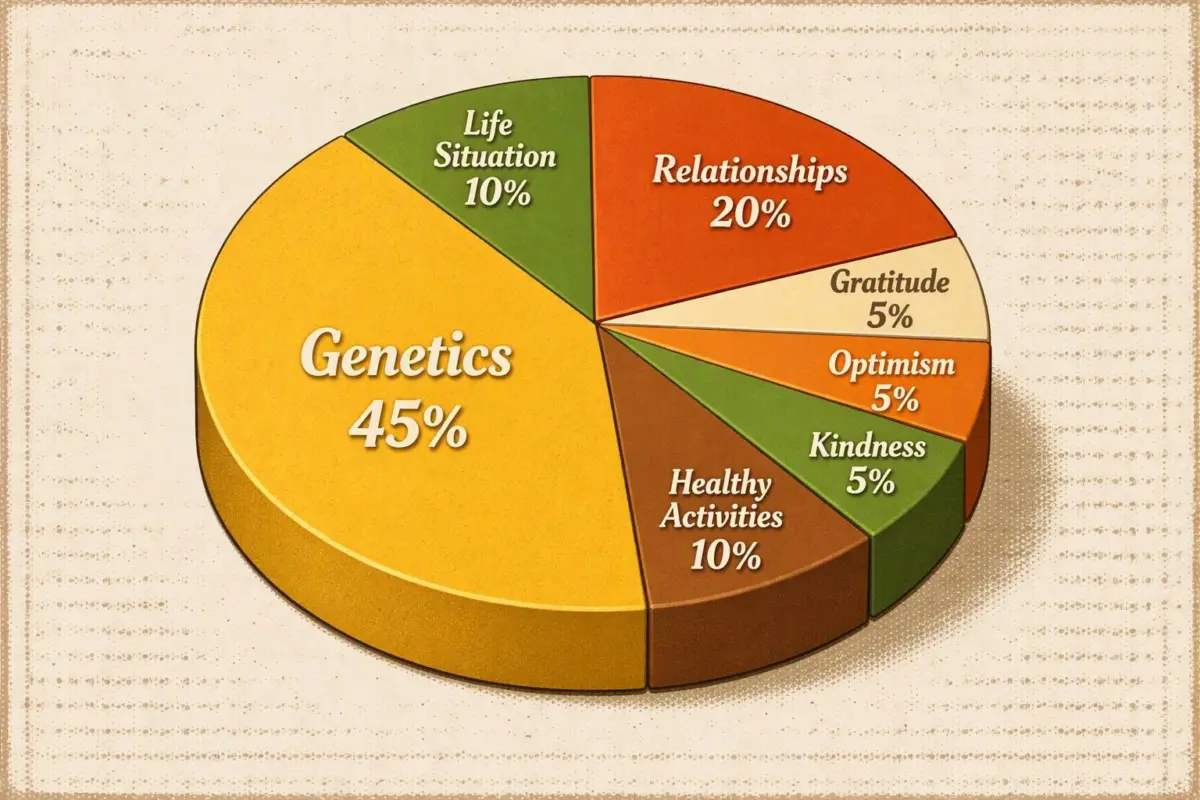
Standard of living, economic growth, and the viability of early retirement are driven by productivity rather than short-term market sentiment. Furthermore, once societies achieve a certain baseline standard of living, human happiness tends to plateau along financial dimensions. Beyond meeting fundamental material requirements, long-term satisfaction relies more heavily on personal relationships, health, a philosophy of optimism, and daily lifestyle choices rather than the accumulation of additional wealth.
Despite these rational foundations, widespread anxiety persists, often rooted in human evolutionary biology. As a species, humans function largely as danger-detection mechanisms. This background fear evolved as a protective trait against genuine physical threats. However, when immediate physical dangers are resolved, the human mind frequently continues scanning the environment for new sources of worry, shifting the goalposts from physical survival to resource scarcity, social belonging, and eventually abstract financial concerns like tax optimization and estate management.

Combating this pervasive fear requires self-awareness and rational evaluation. Examining personal history—such as childhood experiences shaped by parental scarcity mindsets or past trauma—can clarify why certain financial anxieties persist independently of present economic realities. Identifying specific worst-case scenarios often reveals that perceived catastrophes are far less devastating in practice than anticipated. Taking concrete action transforms the unfamiliar into the familiar, building resilience and the capability to adapt to shifting circumstances.
Embracing Technology as an Experiment
Reframing major societal shifts through the lens of experimentation can significantly alter how new technologies are perceived. Rather than yielding to doom-scrolling and apprehension, approaching developments like the artificial intelligence boom as a grand technological experiment allows for a more objective evaluation of potential outcomes.

Artificial intelligence functions fundamentally as a powerful cognitive tool capable of dramatically enhancing efficiency and productivity. Much like the introduction of past transformative technologies—such as the internet or mobile computing—AI accelerates existing workflows while inevitably displacing certain routine administrative and entry-level tasks. Historically, such technological leaps simultaneously reduce service costs, drive down consumer prices, and spark the creation of entirely new industries and economic sectors.
While productivity gains tend to concentrate economic rewards among business owners and shareholders, these technologies remain accessible tools that offer opportunities for adaptation and growth. Ultimately, whether individuals view advancements like artificial intelligence with paralyzing fear or as an invitation to continuous learning depends largely on how they choose to engage with an evolving world. By recognizing fear as an internal emotional response rather than an objective reflection of external reality, individuals can better navigate economic uncertainty and focus on productive, intentional living.