
That particular market cycle holds a unique place in the history of internet financial commentary. It was the boom that helped jump-start early careers and clear the path toward early retirement for many, even if the subsequent crash nearly derailed employment and legal residency applications at the time. As questions mount regarding the sustainability of the current investment cycle, seasoned financial observers are once again being pressed for answers. Addressing these concerns through recent public talks—such as those delivered at Camp FI Midwest and upcoming appearances at the Bogleheads conference—analysts are encouraging a broader perspective on market volatility, human psychology, and the true drivers of long-term prosperity.

Looking Back at Two Decades of Market Worries
Hitting more than two decades of retirement brings a certain level of comfort with market fluctuations, yet it is easy to forget how deeply anxious people can be about the state of the world. Conversations with peers often reveal a persistent undercurrent of dread regarding the future. Friends and observers frequently question how anyone can remain comfortably retired and sleep peacefully at night given the geopolitical tensions, economic pressures, and technological disruptions dominating the news cycle.
A catalog of modern worries typically includes volatile political leaders menacing the global stage, persistent inflation eroding purchasing power, towering national debt levels, and ongoing conflicts in the Middle East and Eastern Europe that threaten to spark broader devastation. Yet, remarkably, these exact anxieties echo those expressed more than twenty years ago. Back in 2006, the headlines were dominated by different leaders, different military conflicts in the Middle East, national debt concerns, and anxieties over inflation and overvalued housing markets rather than artificial intelligence. Concerns centered on the potential outsourcing of domestic jobs to emerging economies like India and China, alongside fierce debates over "peak oil" and whether finite fossil fuel supplies would ultimately doom modern civilization.

Instead of total destruction, the subsequent two decades unfolded with a mix of severe crises and remarkable progress. The global financial system did indeed endure the Great Financial Crisis, driven by irrational exuberance over real estate prices and excessive leverage within mortgage-backed securities. It marked the most severe economic downturn since the Great Depression, later followed by pandemic-induced market shocks. Yet, viewed through the lens of a twenty-year horizon, those monumental crashes appear as minor dips in a remarkably resilient upward trajectory. A hypothetical long-term investment made during those turbulent years would have grown substantially over time.
Beyond the stock market, the broader world experienced significant improvements across several key metrics. The global proportion of people living in extreme poverty dropped dramatically over a twenty-year span, while infant mortality rates were cut in half. Clean energy adoption surged as the cost of solar panels plummeted, allowing solar power to become a dominant source of new electrical generation capacity worldwide. Simultaneously, electric vehicle sales climbed from near zero to significant market shares across the globe. These developments suggest that focusing energy on an uncertain and frightening future is often far less productive than recognizing long-term trends of human innovation and adaptation.

Prosperity, Productivity, and the Human Experience
Financial media outlets frequently spin alarming narratives about impending economic doom, but these warnings often overlook a fundamental reality: true economic prosperity does not originate from the financial system or the stock market, which are ultimately human constructs built on numbers stored in computers. Genuine prosperity stems directly from productivity.
The underlying engine of capitalism remains consistently choppy and prone to wild swings, but beneath the surface volatility, real people continue to perform real work and invent practical solutions. If a financial system breaks down because participants lose faith in arbitrary numbers, society has historically demonstrated the capacity to establish new frameworks and resume productive labor. The foundational tools that drive human ingenuity, standard of living, and economic growth remain intact regardless of short-term market corrections.

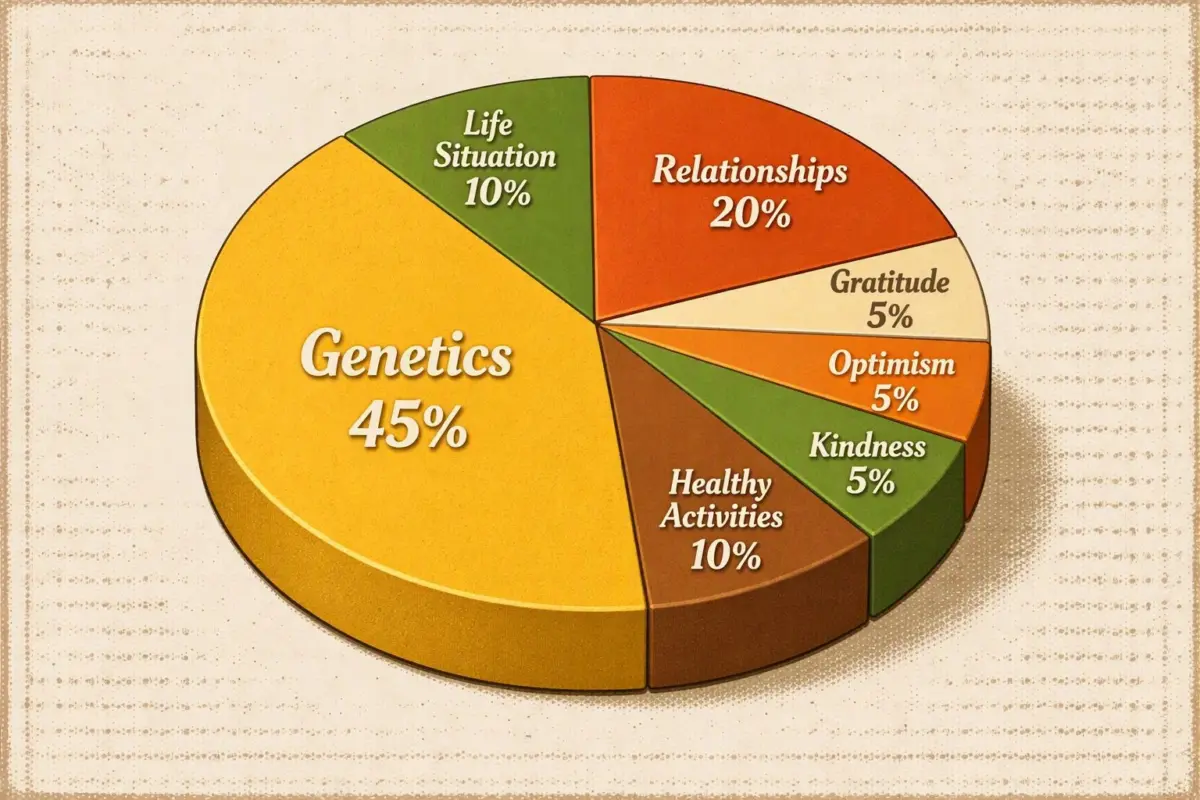
Beyond economic productivity, human happiness tends to stabilize once basic material needs are met. In developed nations, societies surpassed those minimum physical requirements decades ago. Consequently, overall life satisfaction depends heavily on factors outside of pure wealth accumulation. Psychological research and observation suggest that non-financial elements—such as strong personal relationships, the practice of gratitude, optimism, physical health, and outdoor activity—play a far greater role in determining individual happiness.
Understanding and Overcoming the Psychology of Fear
Despite historical evidence demonstrating long-term resilience, many individuals remain consumed by anxiety about an unknown future. This persistent fear is deeply rooted in human evolution. As a species, humans function essentially as danger-detection machinery. While this trait successfully protected early humans from predators and disease, modern environments lack those immediate physical threats, causing the brain to continually search for new targets of worry.

When scarcity and physical survival risks are resolved, anxiety often shifts toward social acceptance, financial comparisons, and eventually hyper-specific concerns like tax strategies, estate planning, and government-mandated retirement account distributions. However, individuals possess the rational capacity to recognize and push back against this irrational fear.
Understanding personal history is a crucial first step in dismantling chronic anxiety. Financial scarcity mindsets are often passed down through generations, shaped by childhood experiences or family histories marked by economic depressions and past trauma. Identifying the root causes of these emotional responses helps separate past conditioning from an objective assessment of the present.

Once specific fears are identified, taking deliberate action serves as an effective antidote. Action transforms the unfamiliar into the familiar, building the resilience and confidence necessary to adapt to any new circumstance. Furthermore, intentionally reducing exposure to sensationalized daily news diets helps prevent the constant intake of fear-inducing narratives. Replacing fear-mongering influences with optimistic, productive peers creates an environment focused on constructive living rather than perpetual anxiety.
Adopting an experimental mindset toward major life transitions—whether changing jobs, relocating, or entering retirement—helps reframe uncertainty as an opportunity for discovery rather than a threat to survival.

Artificial Intelligence as a Cognitive Tool
The current anxieties surrounding artificial intelligence mirror past technophobia, yet framing the technology through an economic lens reveals a different picture. Artificial intelligence can be understood not as an existential threat, but as a sophisticated form of cognitive tool—akin to a cognitive nail gun designed to enhance human efficiency.
While technological advancements inevitably boost productivity, they also displace specific categories of labor, impacting entry-level office roles, administrative tasks, and eventually transportation sectors. Historically, however, such disruptions have consistently lowered the cost of essential services while catalysing entirely new industries, much like the widespread adoption of the internet and mobile smartphones. While the economic rewards of these innovations often concentrate among capital owners and shareholders, the broader technology functions as another tool providing opportunities for adaptation.

Ultimately, navigating rapid technological and economic shifts comes down to individual perspective. Rather than succumbing to cyclical panics, viewing change as a call for continuous learning and personal resilience allows individuals to move past apprehension and engage constructively with the future.