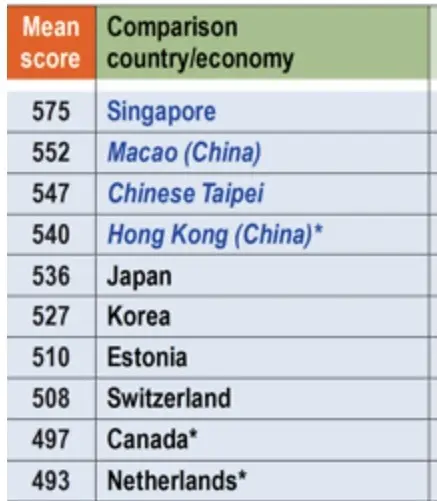
The empirical data on this question are remarkably clear. When examining the rankings for mathematics from the Programme for International Student Assessment (PISA)—an authoritative international organization that evaluates and compares educational performance globally—one has to travel deep down the list before encountering a Western nation. The top tier of mathematical proficiency is dominated entirely by East Asian educational systems.
Furthermore, this picture of dominance does not even include mainland China in the primary comparative data set for this specific cycle. Yet, looking back at historical benchmarks from 2018, China’s major metropolitan areas of Beijing, Shanghai, Jiangsu, and Zhejiang actually outpaced even Singapore, which routinely sits near the absolute summit of global education metrics.
The academic dominance is not confined to mathematics alone. East Asian countries also claim an overwhelming majority of the top spots in reading proficiency, capturing four of the top five positions globally. This achievement is all the more striking when contextualized linguistically. Writing systems based on complex characters, such as those utilized in Japan and China, are objectively much harder to learn and master than the alphabetic systems that form the foundation of most European languages.
Naturally, the most obvious answer to the enduring question of East Asian scholastic performance points toward culture. Of the six East Asian countries that top the PISA rankings in mathematics, all but Japan exceed the Organization for Economic Co-operation and Development (OECD) average for weekly hours spent in formal classwork. When including the combined Chinese urban centers of Beijing, Shanghai, Jiangsu, and Zhejiang, three jurisdictions rank firmly in the top seven worldwide for total hours dedicated to studying. Beyond the regular school day, countless students in these high-performing countries attend evening "cram" schools—known widely as hagwons, cram schools, or juku—long after their standard classes have concluded for the evening.
Whether all this intensive studying represents a net positive development remains a deeply complicated and fiercely debated question. On one hand, an intensely competitive academic culture inevitably removes opportunities for children to play, socialize, and explore other dimensions of childhood. To the extent that heavily specialized academic knowledge holds little direct utility for many modern jobs, this rigorous educational approach may function as a societal drag, acting as a net-negative economic force.
On the other hand, it is difficult to ignore the incredible economic performance of East Asian economies, most notably the Four Asian Tigers consisting of Hong Kong, Singapore, South Korea, and Taiwan. Their phenomenal rise, particularly in high-technology manufacturing and advanced services, strongly suggests that an intense societal focus on mathematics and science yields tangible, massive payoffs.
While debating the relative merits of different educational cultures is an engaging intellectual exercise—including examining notable internal variances within East Asia, such as Japan’s outlier status of achieving high grades with comparatively fewer hours of formal studying—the deeper inquiry centers on the historical origins of these cultures. Why did such a uniquely powerful emphasis on educational attainment take root in East Asia in the first place?
The Keju: 1,300 Years of Studying
One compelling explanation for this enduring cultural emphasis on education traces back to the profound, long-lasting influence of the Chinese civil service examinations, historically known as the keju. While Western Europe was in the nascent stages of developing feudalism, the Chinese imperial state was already being staffed by a sophisticated meritocratic bureaucracy drawn from graduates of some of the most grueling and competitive examinations the world has ever witnessed.
To understand the mechanics of this historical phenomenon, scholars often turn to Ichisada Miyazaki’s seminal book, China’s Examination Hell, which details the immense benefits alongside the severe human costs generated by the system.
Initiated during the Sui dynasty in 605 CE, the civil service examinations were originally conceived as a political mechanism to bypass the powerful aristocratic families that wielded overwhelming control over the imperial government. In theory, the exams were designed to be open to all men. Any male citizen, ranging from the pampered son of a noble family down to a humble peasant commoner, was permitted to participate. In practice, however, the staggering financial burdens required to fund years of uninterrupted study meant that very few outside of the already well-off could realistically pursue the path.
Despite these socioeconomic barriers, the system introduced a vital degree of social mobility, legitimized imperial rule, and successfully centralized political power across a massive empire. For these reasons, despite turbulent dynastic changes and even foreign conquests, the system persisted for thirteen centuries before finally being abolished in the waning days of the Qing dynasty.
The institutional gravity of the exams was so absolute that even historical rebels bowed to its psychological weight. Hong Xiuquan, who after failing multiple times to become a licentiate suffered a nervous breakdown, came to believe he was the younger brother of Jesus Christ, and ultimately launched a devastating civil war that cost tens of millions of lives, nevertheless established his own version of the examination system in the territories he controlled. Even for those who personally suffered under its crushing weight, the exams were viewed as an absolute essential pillar of governance.
What Was it Like Taking the Exams?
Miyazaki’s historical account is gripping not merely for its description of a multi-layered examination apparatus centered on the rigorous memorization of the Chinese classics, but for its vivid portrayals of the grueling psychological and physical reality experienced by the test-takers themselves.
At the height of their institutional complexity during the late Qing dynasty, the examinations were divided into three major tiers: provincial, metropolitan, and palace examinations.
The provincial examinations, held triennially despite being colloquially termed annual, required participants to be locked inside tiny, isolated cells within massive, labyrinthian examination halls for three continuous days. Each candidate was provided with three simple wooden boards: one functioning as a bed, one as a bench, and one as a writing surface. Because these vast halls sat empty for long stretches of time, they were frequently dilapidated, forcing students to desperately shelter their precious exam sheets from leaking rain.
Candidates facing the provincial exams endured not only harsh physical deprivations, but also psychological torment rooted in the supernatural. It was widely believed within the culture of the time that unseen ghosts actively punished individuals guilty of hidden moral transgressions during this critical stage. Seducers and swindlers lived in terror of being haunted, with historical anecdotes recording numerous instances where overwhelming guilty consciences drove candidates to suicide or nervous breakdowns during their three days of strict solitary confinement.
In other instances, karmic retribution operated through frustratingly mundane accidents. A past moral transgression might result in lamp oil accidentally spilling across a candidate’s meticulously written answer sheets—a technical violation that led invariably to immediate failure. It was culturally accepted that any apparent unfairness in the exam results stemmed not from simple bad luck, but from concealed crimes and evil deeds being judged directly from the heavens.
The few individuals who successfully navigated this grueling gauntlet then made the long and expensive journey to the capital for the metropolitan examinations. In the early centuries of the keju, these served as the final stage of a scholar’s journey, after which passing practically guaranteed a lucrative and prestigious position within the Chinese bureaucracy.
However, the deep loyalty that test-takers naturally owed to their individual examiners created dangerous political factions within the government apparatus. Much like modern academic researchers who often owe the trajectory of their careers to prominent doctoral advisors, imperial scholars felt lifelong allegiance to the examiners who passed them. To prevent this patronage network from undermining the absolute authority of the crown, palace exams judged directly by the emperor himself were eventually instituted. In theory, this ensured that successful graduates owed their gratitude not to an intermediate bureaucrat, but directly to the emperor.
Given the enormous incentives for corruption within such a high-stakes system, the state implemented extraordinary safeguards to combat cheating and favoritism. Exam takers were thoroughly searched for smuggled crib notes and hidden texts. Examiners were granted access only to a candidate’s anonymous seat number rather than their name, and during the higher-level examinations, answer sheets were painstakingly hand-copied by independent scribes to ensure that distinguishing handwriting styles could not reveal a test-taker’s identity.
When occasional corruption scandals did emerge, they generated such fierce public backlash that the regime maintained a strict facade of institutional integrity. Examiners caught participating in schemes to undermine the process faced severe punishments, including exile or execution.
The sheer competitiveness of the process was staggering. Before entering the provincial examination, a local qualifying exam had to be passed simply to gain entry into the system, boasting a notoriously brutal pass rate of roughly 1 to 2 percent. Provincial exams featured a pass rate of approximately 5 percent, while metropolitan exams hovered between 15 and 20 percent. Although very few candidates failed the final palace exams—which functioned more as a ceremonial ranking exercise than a substantive elimination test—the specific rank achieved dictated the trajectory of an official’s entire career. Out of potentially one hundred thousand initial applicants, perhaps only a dozen individuals ultimately saw their lifelong dreams realized as elite graduates of the palace exams, known as the jinshi.
Unlike modern university systems where key educational bottlenecks occur during youth, the journey of studying for and taking the imperial exams often spanned decades. It was entirely commonplace for newly minted graduates to be elderly men with grey hair. Some aged candidates were even granted honorary status automatically, earning their jinshi credentials simply as a recognition of endurance, well past the age when they could realistically serve in active government positions.
Legacy of the Imperial Examination System
Tracing the precise modern impact of China’s historical examination system on contemporary educational achievement in East Asia presents a complex challenge for researchers. One clever academic paper utilized natural variations in the historical intensity of exam attendance across different regions of China—measured by the percentage of historical jinshi graduates per 10,000 population—and discovered that a regional doubling of historical graduates corresponds with an 8.5 percent increase in modern educational attainment.
At the same time, some analysts remain skeptical that modern outcomes can be drawn in a direct line from ancient administrative practices. For centuries, China exerted immense cultural gravity over its immediate neighbors. Even nations like Japan, which never adopted its own indigenous version of an imperial civil service examination system, enthusiastically embraced broad swathes of Chinese culture, ranging from written characters to Zen Buddhism. It stands to reason that deeply ingrained cultural attitudes toward learning and self-improvement naturally diffused across borders, even without a formal administrative apparatus backing them.
Yet, whether or not the precise statistical footprint of the keju can be definitively isolated today, the overarching question of its historical legacy remains profoundly relevant. For more than a millennium, the examination system cultivated a societal reverence for education that had no historical parallel in Europe until the advent of the Renaissance.
Despite its undeniable flaws, the keju was remarkably progressive for its era. Allocating government positions based on competitive merit rather than inherited birthright was practically unknown in Western societies until the nineteenth century. The fact that this structured examination ecosystem emerged while European feudalism was in its infancy and endured until the threshold of the modern era is an extraordinary historical milestone.
The cultural fallout of the keju extended far beyond the classroom. One notable consequence was the systematic suppression of the military class. While parallel military examinations did exist alongside civilian ones, success in them rarely translated into broad societal respect or supreme political office. Battlefield generals faced strict institutional limitations regarding how far they could advance within the government hierarchy, ensuring enduring civilian supremacy over the military apparatus.
Concurrently, while the strict centralization of power and the taming of military influence helped render China remarkably stable and peaceful compared to fragmented contemporary polities in Europe, critics have argued that this same bureaucratic centralization may have stifled the decentralized, disruptive innovations that ultimately sparked the Industrial Revolution in the West.
Furthermore, persistent questions remain regarding the actual content of the exams. While studying the classical Confucian texts was intended to impart moral wisdom and upright administrative conduct, its practical efficacy in governance remains open to debate. From a modern educational perspective, spending decades mastering material far removed from the technical skills required for effective statecraft can easily be interpreted as a massive societal misallocation of human capital.
This tension echoes into the present day. Modern societies face rising credential inflation, where an increasing accumulation of degrees does not automatically translate into a proportional leap in societal innovation or human capital. Future historians may well look back at contemporary global culture and debate whether our modern obsession with grades, standardized testing, and university degrees represented a triumph of meritocracy or an exorbitantly wasteful scholastic competition.
A culture encompasses not only its stated values, but the very yardsticks it uses to measure those values, making absolute historical comparisons an inherently complex task. Whether future generations view the ancient keju as an essential precursor to a modern knowledge-based meritocracy or an oppressive scholastic treadmill will ultimately reveal just as much about the evolving role of education in times to come as it does about the historical system itself.
Regardless of these ongoing debates, the imperial examination system remains a fascinating study in institutional persistence and offers a clear window into the profound, enduring role that formal education continues to play in societies across the globe today.