The modern consumer of information is exceptionally busy. Individuals frequently search for direct ideas and actionable advice capable of changing their circumstances in a short timeframe. It is entirely logical to question the wisdom of spending valuable time learning about concepts that lack immediate practical application. Yet, relying exclusively on this standard may represent a fundamental miscalculation in how people approach learning and personal development.
If a person genuinely cares about the long-term usefulness of their education, dedicating the vast majority of their time to consuming quick advice or isolated tips can ultimately prove counterproductive. A more effective strategy involves dedicating most of one’s learning efforts to understanding fundamental principles. Although deeper ideas often attract smaller initial audiences because they lack the superficial allure of a quick tip, they provide far greater enduring value.
Why Impractical Knowledge is More Efficient
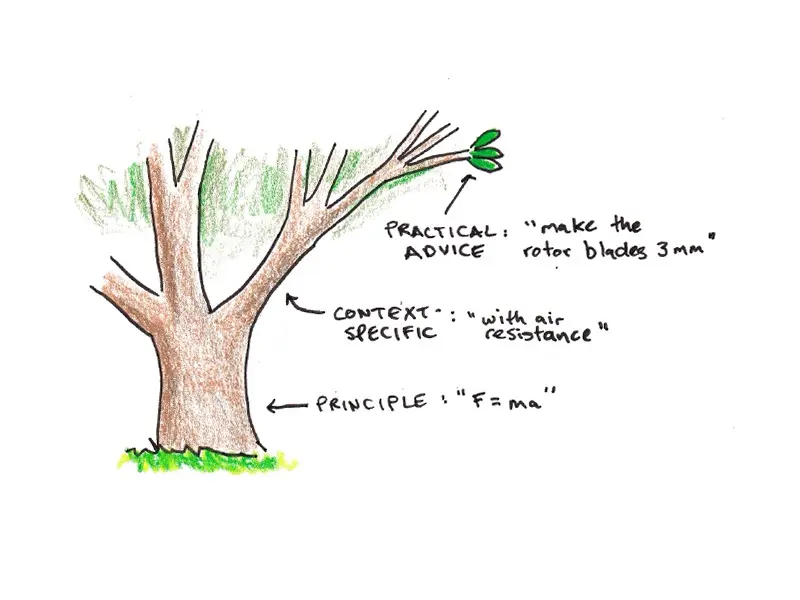
To understand why foundational concepts outlast quick fixes, it helps to visualize knowledge as a biological tree. At the very base of this metaphorical tree lie fundamental principles. These are the core truths least dependent on specific, shifting states of the world. In the physical sciences, this category encompasses bedrock concepts such as Newton’s second law of motion, expressed as force equalling mass times acceleration, alongside the conservation of momentum and energy.
While these principles possess universal validity, they are frequently insufficient on their own to resolve the complex, specific situations individuals care about most. Designing a bridge or a rocket ship requires far more than merely knowing the basic equation of motion. Moving upward from the base of the trunk reveals branching points, which represent major divisions in the operational states of the world.
For instance, physical law dictates that heavy and light objects fall at the identical speed in a vacuum. However, real-world domains diverge: in some environments, air resistance is practically negligible, such as dropping a lead ball versus a solid gold ball, while in others, air resistance becomes a dominant factor, as seen when comparing a feather to a rock.
As learners delve deeper into concrete, specific situations, the paths branch repeatedly until they finally reach the outermost leaves of the tree. These leaves represent practical advice—the specific tips typically offered to novices who lack deep domain knowledge and simply want to know what immediate actions to take. An example of a leaf might be a directive instructing an engineer to shape propeller blades in an exact geometric configuration to minimize air resistance.
The structural reality of this arboreal model is that leaves vastly outnumber the major trunks. Furthermore, each individual leaf covers an incredibly narrow subset of possible environmental conditions. To adequately cover a significant portion of possible scenarios using only leaves, a person would need to memorize countless distinct pieces of advice for countless distinct cases.
Consequently, individuals seeking to maximize the breadth and durability of their useful knowledge—meaning the total number of concrete situations their insights can successfully navigate—are far better off learning closer to the base of the tree. By focusing on foundational ideas and core principles that remain stable across shifting circumstances, learners acquire cognitive tools with vastly superior leverage.
Examining the Principle Across Disciplines
This analytical framework becomes clear when applied to various common areas of personal and professional development. Consider, for example, the widespread objective of getting into physical shape. Within this domain, individual leaves correspond to specific workout routines selected from fitness magazines or online platforms. Moving slightly further down the branches reveals core training principles such as progressive overload and adequate recovery. Deeper still, approaching the trunk, lie fundamental concepts including energy metabolism, muscle physiology, and cardiac mechanics.
Following a rigid, pre-packaged workout plan functions adequately as long as an individual’s personal circumstances closely mirror the demographic for whom the plan was originally designed. However, if a routine was engineered for a competitive athlete in their early twenties, attempting to execute it as a fifty-five-year-old recovering from a joint injury is not only unlikely to produce results but could easily prove counterproductive. In contrast, a firm grasp of basic physiological principles continues to apply across vastly different stages of life, guiding the individual toward more suitable modifications on an entirely different branch of the knowledge tree.
A parallel dynamic governs the world of entrepreneurship and business development. The leaves in this arena consist of tactical maneuvers, such as purchasing targeted advertisements on specific social media platforms or cold-calling purchasing managers at mid-sized corporations. When operating within a niche that precisely matches the environment of the person offering the advice, these tactics can yield results.
If those specific conditions do not align, however, such tactics can drain resources and lead to failure. Entrepreneurs facing unfamiliar markets benefit far more by focusing on ideas located closer to the trunk. Slightly removed from the root level are fundamental startup concepts such as achieving product-market fit, developing a minimum viable product, and executing systematic market research. At the deepest foundational level sits the overarching economic principle of supply and demand.
The same structural hierarchy applies to effective learning and academic study, which represents a heavily researched domain. Students preparing for a high-stakes examination often rely on narrow advice tailored strictly to passing that specific test, representing the leaves of the tree. Moving down the branches uncovers general strategies for organizing study materials or decoding multiple-choice questions. At the trunk level reside bedrock psychological and cognitive principles of learning, such as the spacing effect and retrieval practice. While these fundamental principles can sometimes feel ambiguous because they do not dictate every minute detail of a study schedule, they remain universally applicable across nearly every subject matter imaginable.
Addressing Common Objections to Foundational Learning
Critics of this approach frequently raise specific objections regarding the viability of prioritizing principles over immediate practicalities. The first major concern is that abstract principles alone are rarely sufficient to constrain real-world decision-making. This critique holds merit; rarely does understanding a deep, theoretical principle provide an individual with all the specific details required to determine the optimal course of action in a complex, high-stakes human environment. Additional context is almost always necessary.
Even so, learning principles remains fundamentally more efficient. Returning to the arboreal analogy, imagine searching for a small bird hidden within a dense tree. Being told that the bird is located on the third major branch from the right does not pinpoint its exact coordinates down to the millimeter, but it immediately provides a highly productive sector to search.
Conversely, knowing only whether the bird is resting on one specific leaf is useless unless the searcher happens to inspect that exact leaf first. Specific advice only yields utility when it happens to match the exact circumstances of the observer, whereas principles narrow down the broader search space.
A second common objection suggests that theoretical principles frequently fail to accurately describe the messy reality of the world, resulting in elegant-sounding academic theories that offer little direct utility. This discrepancy typically arises because certain domains remain underexplored, meaning researchers have yet to fully map the intervening branches connecting the deep trunk to the exterior canopy. In scientific fields like physics and engineering, where foundational principles strongly dictate practical outcomes, the justification for mastering the trunk is overwhelming. In more variable domains like entrepreneurship or second-language acquisition, principles still provide immense value, but they must be intentionally supplemented with situation-specific guidance.
A final critique notes that deriving solutions from first principles can sometimes be mentally intractable, forcing individuals to rely instead on pre-packaged practical advice. The closer an individual travels toward the trunk of the knowledge tree, the greater the cognitive effort required to trace the branching points out to practical outcomes. This inherent difficulty explains why hierarchical domains exist in professional practice. Nevertheless, because foundational principles cover vast expanses of reality, mastering them ultimately streamlines the overall learning process over a lifetime.
Practical Implications for Personal Development
Recognizing that the acquisition of fundamental principles outpaces the efficiency of isolated tips serves as a guiding maxim for personal growth and media consumption. Modern publishing markets are saturated with practical advice literature addressing productivity, dietary regimens, and personal finance. Consumers are regularly confronted with new diet trends promising dramatic weight loss within a fortnight, productivity habits practiced by acclaimed authors, or aggressive financial strategies designed for early retirement.
If an individual intends to read only a single book on a newly encountered topic, selecting a purely practical guide may occasionally suffice, provided the author’s specific situation mirrors the reader’s exact circumstances. However, for those committed to continuous learning across a lifetime, starting with the leaves of practical advice is an inefficient strategy.
When exploring a new field, learners should look for textbooks if the trunk of the knowledge tree resides within an academic discipline like nutrition or psychology. For professional practices, readers benefit from seeking out unbiased, general introductory texts that lay out core concepts clearly without sensationalism.
By making a conscious effort to absorb the intellectual trunks of diverse domains, individuals build a robust cognitive framework. When specific, practical problems inevitably arise later, resolving them may still require localized effort, but the most difficult and enduring phase of the educational journey will already be complete.