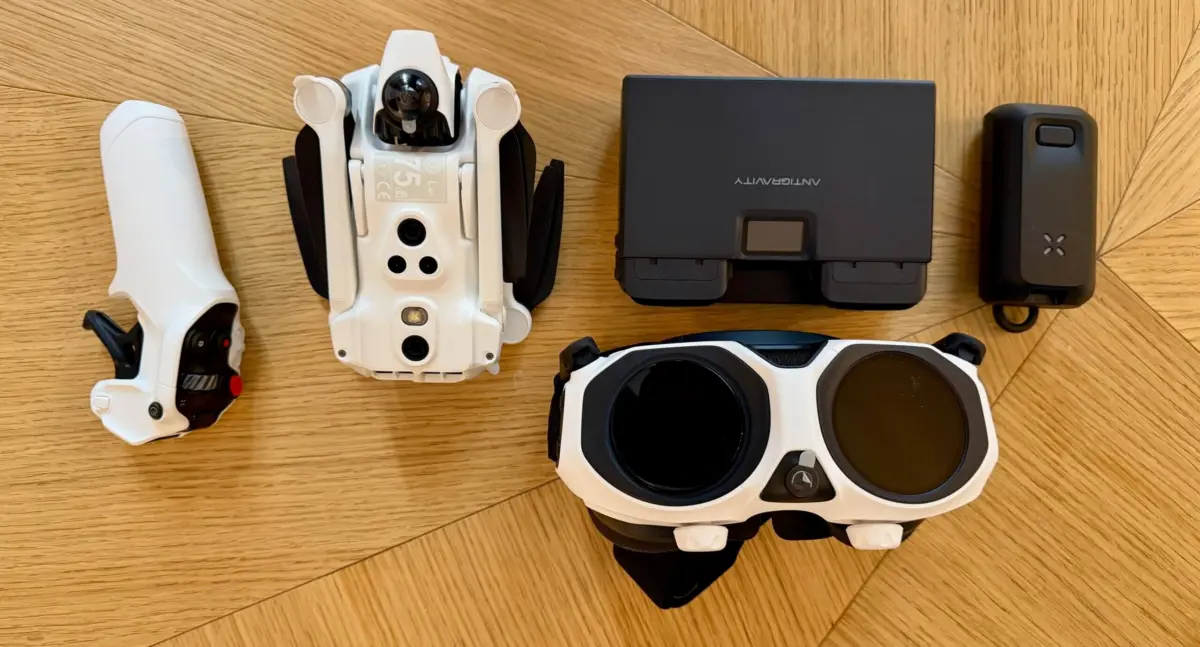
The marketplace features a wide array of exceptional manufacturers, but a particularly innovative device gaining traction is the Antigravity A1. Released in late 2025, this drone attempts to render the traditional camera gimbal obsolete for a vast segment of content creators. By leveraging an advanced dual-lens 360-degree capture system, the A1 records everything in every direction simultaneously. The result is a "fly now, frame later" experience that feels less like manually piloting a traditional aircraft and more like directing a virtual camera within a pre-recorded digital environment.
Reviewers and creators who have spent time with the hardware find that it fundamentally alters how aerial sequences are captured, eliminating the traditional stress of real-time framing during flight.
Two Lenses Eliminate Blind Spots
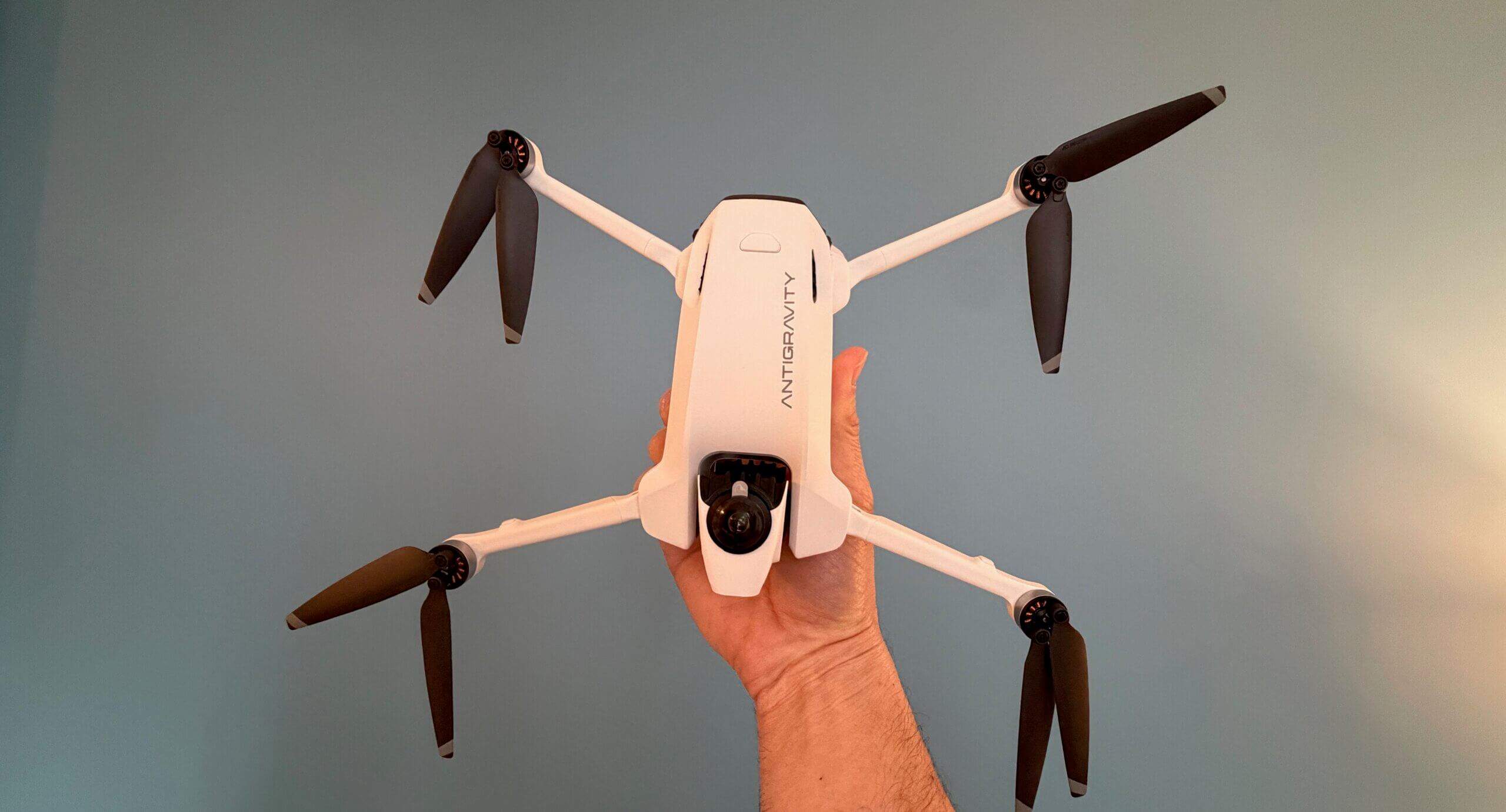
What sets the Antigravity 360 system apart is its optical architecture. Most standard consumer drones rely on a single, forward-facing lens mounted on a motorized gimbal. However, the A1 features two ultra-wide-angle lenses positioned symmetrically on the top and bottom of the central fuselage. Each lens captures a staggering 200-degree field of view. When the onboard software stitches these overlapping images together, it creates a seamless, full 360-degree digital sphere.
A signature visual trick of this configuration is that in the final exported footage, the drone’s body is digitally removed by the processing software. This creates the striking illusion of an independent camera floating freely in mid-air, held up by no visible means of support.
Beneath these lenses lie 1/1.28-inch CMOS sensors. While these sensors are slightly smaller than the 1-inch units found on premium "Pro-level" photography drones, they are significantly larger than the sensors typically packed into standard 360-degree action cameras. This physical advantage translates into notably superior low-light performance and a higher dynamic range. The system captures delicate details in bright highlights and deep shadows that would ordinarily be washed out or crushed under the harsh contrast of a midday sun.
Weight distribution and regulatory thresholds were clearly primary considerations during the engineering phase. Most aviation authorities require drones weighing 250 grams or more to be officially registered, subjecting their operators to much stricter flight rules and operational limitations. Antigravity designed the A1 to weigh precisely 249 grams when equipped with its standard battery. By landing right under this crucial regulatory line, the aircraft avoids mandatory registration in many jurisdictions, easing the logistical burden for traveling filmmakers.
Furthermore, the physical build of the aircraft feels remarkably sturdy. It utilizes a high-grade carbon-fiber-reinforced polymer, which provides a superior strength-to-weight ratio compared to the standard ABS plastic frequently utilized in cheaper models. The folding mechanism operates with a satisfying tactile resistance, clicking firmly into place with a precision that hints at long-term durability on the road. When fully folded down, the drone is roughly the size of a large smartphone, albeit approximately three times as thick, making it effortless to slip into a backpack side pocket alongside a water bottle or travel guide.
The Immersive Flight Experience
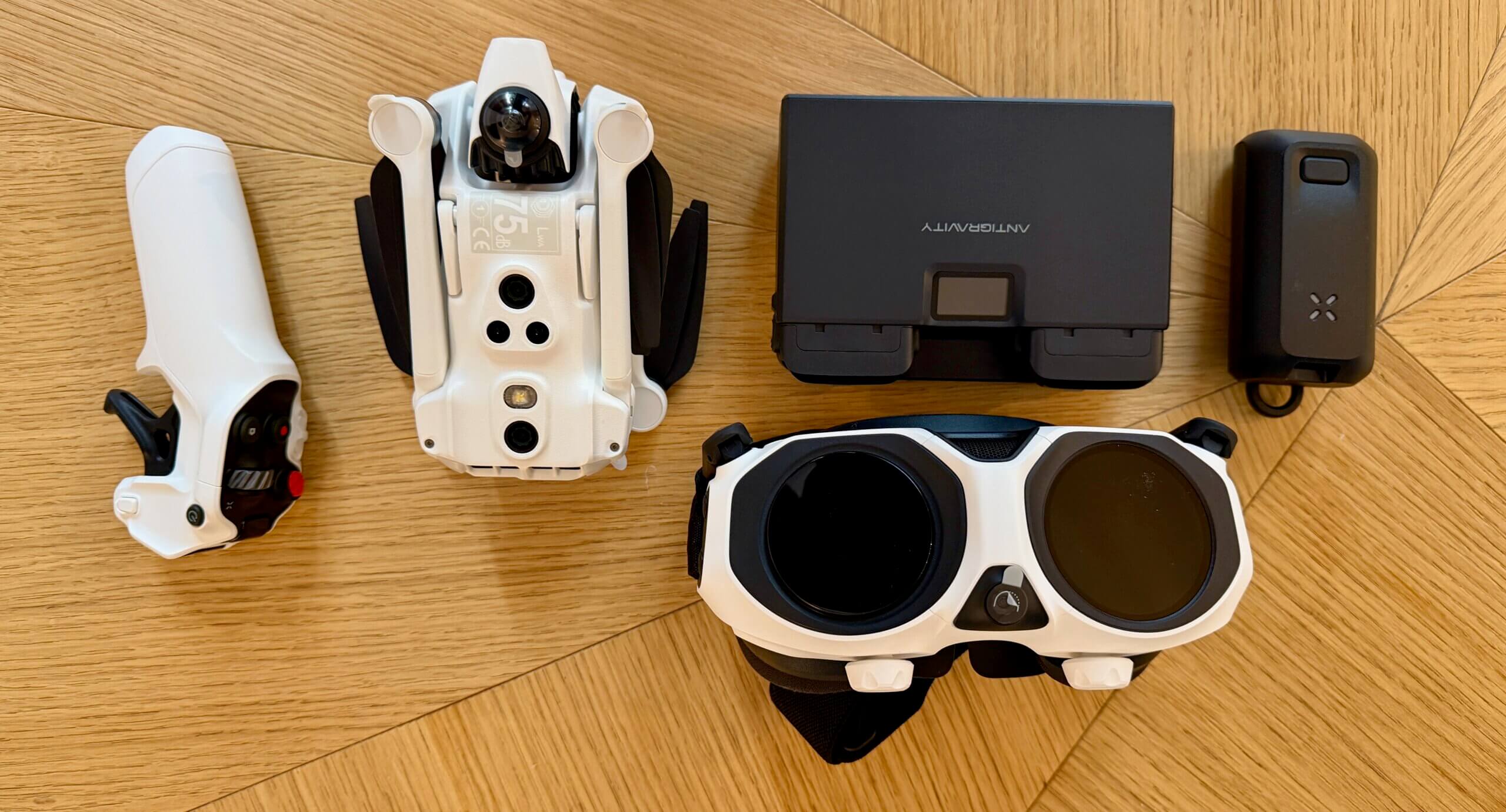
Piloting the A1 offers a departure from traditional dual-stick radio controllers, largely due to the accompanying vision goggles and motion peripherals.
The vision goggles are sleek, lightweight, and equipped with dual 4K micro-OLED displays boasting a 120Hz refresh rate. Visual latency is nearly imperceptible, and the hardware features integrated head tracking. Because the aircraft is constantly recording in a complete 360-degree sphere, the pilot is never restricted to merely watching the perspective directly in front of the drone. When a user turns their head to the left, the goggle feed pans dynamically to the left. Looking downward reveals the terrain passing directly beneath the aircraft. This functionality imparts a profound sense of presence and spatial awareness that is virtually impossible to replicate with a traditional fixed-camera drone.
Complementing the goggles is a single-handed motion controller. To navigate, the operator simply points the controller in the desired direction of travel and pulls the trigger to accelerate. Tilting the wrist to the left or right banks the aircraft, while raising the nose of the controller initiates a climb. It is an exceptionally intuitive control schema that allows even absolute novices to navigate through complex environments within minutes of their first flight.
For professional FPV pilots who prefer the absolute precision of manual acrobatic flight, the A1 also supports a traditional "Mode 2" stick controller. Nevertheless, the fluidity of the motion control system is such that the vast majority of users will likely find little reason to switch back.
Camera Performance and Stabilization
The marketing materials for the Antigravity 360 proudly advertise "8K Resolution." However, understanding how that resolution functions in a 360-degree environment is vital. On a traditional camera, 8K means every single pixel is compressed into a standard 16:9 rectangular frame. In a 360-degree video, those same pixels are distributed across the entirety of a sphere. When an editor "reframes" that 8K sphere into a standard flat video export, the resulting view is essentially a cropped window of the total captured image.
Color science on the A1 shows a measurable improvement over previous generations of 360 hardware. The system includes a "Vivid" profile tailored for users who want punchy, social-media-ready colors straight out of the camera, alongside a professional 10-bit "Log" profile. The latter is intended for editors who need maximum dynamic range and flexibility to match the drone footage with other primary cameras in a dedicated color-grading suite.
Meanwhile, stabilization is handled by Antigravity’s proprietary "FlowState" algorithms, which perform remarkably well under adverse atmospheric conditions. Operators can fly the aircraft in steady winds reaching up to 20 miles per hour, yet the resulting footage remains as smooth and level as if the camera were mounted to a physical studio tripod.
The Editing App and Post-Production Workflow
Managing 360-degree footage has historically been a tedious and demanding computing task, but the "Antigravity Studio" application streamlines the process considerably. The app allows creators to download raw footage wirelessly from the drone at speeds reaching up to 80 megabytes per second. Once transferred, users can reframe their video simply by moving their smartphone around, utilizing the phone’s internal gyroscope to "film" the scene in real time.
Additionally, the software features "Auto-Frame," an artificial intelligence tool designed to scan the video, identify primary subjects, and automatically generate a polished cut that keeps those subjects centered and in focus. For solo travelers and content creators working without a crew, this software effectively acts as a virtual camera operator that ensures key moments are never missed.
Battery Life and Flight Dynamics
Battery technology remains the primary physical bottleneck for all compact aerial vehicles. The A1’s standard Intelligent Flight Battery provides a theoretical maximum of 24 minutes of flight time under optimal conditions. In real-world travel scenarios characterized by moderate winds and continuous recording, users should realistically expect closer to 19 or 20 minutes in the air.
While a 20-minute window may sound brief, the actual "work per minute" output is significantly higher than that of a traditional drone. Because pilots do not need to repeatedly re-fly the exact same flight path to capture different viewing angles or compositions, a single 20-minute flight can yield an equivalent volume of usable, diverse footage compared to multiple flights with standard aircraft.
For creators requiring extended airtime, an optional "Pro Battery" pushes total flight duration up to an impressive 39 minutes, though this heavier power source adds enough mass to the aircraft to marginally affect its overall agility in tight maneuvers.
In terms of flight dynamics, the A1 behaves much like a "cinewhoop" style flyer. It prioritizes stability and predictable handling over aggressive, twitchy racing performance. With a top speed of approximately 36 miles per hour, it is fast enough to comfortably track moving subjects like bicycles or automobiles, though it will not keep pace with dedicated professional racing drones.
If an operator miscalculates a maneuver and the aircraft crashes upside down, an integrated "Turtle Mode" allows the drone to automatically flip itself back over using precise bursts of its propellers. This saves the pilot from taking an inconvenient walk to retrieve the stranded aircraft manually.
Ultimately, the Antigravity A1 successfully bridges the gap between traditional cinematic aerial photography and the immersive capabilities of modern virtual reality. By removing the mechanical constraints of gimbals and the operational stress of real-time manual framing, the hardware allows creators to concentrate fully on the narrative elements of their travel storytelling.