This enduring parable points to a profound and often overlooked truth about human existence: we rarely notice what is closest to us. The traits, habits, and environments that are most obvious to outside observers are frequently entirely invisible to us. This blindness does not stem from a difficulty in spotting these elements, but rather from the reality that we are completely immersed in them at all times.
For many people, gaining true insight into their own lives is a remarkably difficult task. Individuals routinely fail to recognize overarching patterns in their daily routines, choosing instead to react impulsively to isolated events rather than pausing to reflect on their trajectory. Consequently, people often remain stuck far too long in unfulfilling jobs, stagnant relationships, or outdated personal identities that no longer serve their growth or well-being.
Yet, every once in a while, individuals manage to gain a vital sense of perspective. They briefly pull back from their daily routines to see the literal water they have been swimming in, presenting a rare window of opportunity to change course. These moments of clarity are typically scarce, occurring only a handful of times in an ordinary lifetime while a person is busy navigating the relentless currents of day-to-day existence.
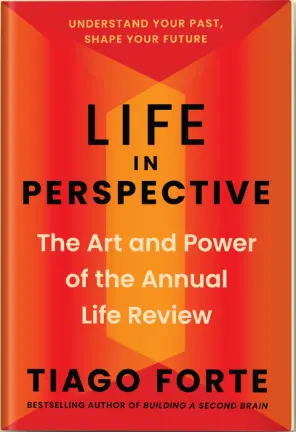
Recognizing the rarity and value of this clarity, writer and educator Scott Young deliberately chose "Reflection" as one of the twelve month-long focuses while developing his comprehensive project, Foundations. The primary objective of this curricular focus was to actively cultivate the kind of perspective that helps individuals recognize the invisible environments shaping their decisions. Reflecting on this ongoing educational endeavor, Young noted that if he were to rebuild the project from scratch, one crucial addition would be Tiago Forte’s latest book, Life in Perspective.
Annual Reviews: Less Analysis, More Feeling
When Tiago Forte first announced that he was writing a book dedicated to the subject of annual reviews, Young admits he was initially skeptical about whether he would enjoy it. A book centered exclusively on conducting annual reviews sounds, on the surface, about as thrilling and engaging as reading a manual on filing taxes. The initial expectation was that the publication would be densely packed with dry, analytical steps for sorting through digital notes, categorizing old spreadsheets, and summarizing arbitrary goals—essentially functioning as a high-level planning seminar tailored specifically for the most left-brained, hyper-logical personality types.
To his pleasant surprise, Young discovered that Forte’s work takes an entirely different direction, focusing instead on the core problem of generating genuine insights into one’s life. Rather than treating review sessions as administrative chores, the book explores whether there is an effective method to make deep reflection a regular, organic practice rather than a haphazard occurrence that happens only by accident.
The underlying methodology that Forte suggests relies heavily on giving oneself the psychological and emotional space to genuinely connect with how one feels about their life—encompassing the past, the present, and future aspirations. Instead of forcing individuals to crunch numbers, tally metrics, or manage rigid spreadsheets, the approach prioritizes emotional resonance and authentic self-awareness as the primary catalysts for meaningful personal change.
My Takeaways from the Book
Although Young does not share a history of conducting structured annual reviews in the precise manner recommended by Forte, he brings decades of personal experience in self-examination to the table. For the past twenty years, Young has maintained a tradition of publishing public reviews of his life and progress on his personal blog, while concurrently accumulating thousands of pages of private journal entries over the course of his career.
Despite his extensive background in personal documentation and public accountability, Young found that a number of Forte’s observations struck a resonant chord. The book successfully brought critical attention to several subtle ways in which conventional reflective practices—including his own—frequently flounder, lose momentum, or fail to produce actionable insight.
Forte’s previous major publication, Building a Second Brain, has already established itself as a modern classic in the specialized field of personal knowledge management, transforming how millions of people organize their digital information and creative outputs. Given the impact of that foundational work, Young expresses full confidence that Life in Perspective is poised to become another essential classic for anyone seeking to better understand and navigate the invisible waters in which they swim.