This widespread cultural pivot toward coziness is hardly accidental. Amid a relentless news cycle and persistent economic pressures, everyday life has become increasingly stressful. According to the American Psychiatric Association’s annual mental health poll, individuals across demographics are grappling with heightened levels of anxiety, with financial expenses, current events, and loneliness standing out as primary stressors.
Delphine Jelk, a Paris-based perfumer and creative director of fragrance for Guerlain, notes that this collective psychological landscape has naturally influenced the sensory world. “I think there is a broader desire for comfort and reassurance,” Jelk explains. “We live in an incredibly fast-paced world, and fragrance can offer a small moment of intimacy. Something warm and almost cocooning that you can wrap yourself in.”
Yet, consumers are not looking for just any form of comfort. Market research platform Spate reports a striking 123.7% year-over-year surge in the popularity of luxury perfumes, but this growth is characterized by a distinct shift in consumer motivation. A recent EY survey highlights that while 62% of respondents consider superior quality a primary driver for their purchases, only 26% actively look for prominent logos. The modern consumer wants the sensory experience of high-end living, but delivered through the lens of quiet luxury—prioritizing personal fulfillment and emotional resonance over outward wealth-signaling.
“There is a real desire for sophisticated simplicity,” Jelk adds, pointing to a broader return to essentials executed with elegance. “I think fragrance reflects the same desire: creations that feel more essential and immediately understandable, but still have sophistication, depth, and emotion.”
This philosophy translates into elevated healing moments through scent. This winter, gourmands are pushing past basic, nostalgic sweetness to deliver complex, gourmet profiles, moving away from simple homemade brownies toward the flaky, buttery, croissant accords reminiscent of an upscale Parisian bakery. Smoky incense, long cherished for its meditative and spiritual qualities, is being rendered more transparent and wearable by pairing it with delicate florals or creamy woods, evoking a serene sunrise yoga class rather than a heavy, traditional church service. Meanwhile, nature-inspired notes balance the crisp aroma of wintry greens with the grounding warmth of aged woods, while subtle musks emulate the delicate, second-skin softness of a freshly laundered set of premium bedsheets. To cut through the oppressive darkness and cold of the winter months, vibrant pink pepper notes are injected into heavier formulations to provide an energizing, sparkling lift.
Winter Forest Notes
The cultural longing to escape the digital grind has steadily intensified, manifesting as a collective yearning for off-the-grid living. Whether driven by digital fatigue or the rising popularity of forest-inspired aesthetics such as the "wilderkind" trend tracked by Pinterest, society’s romance with nature remains robust. The fantasy of retreating to a secluded architectural sanctuary surrounded by wilderness, spending quiet mornings meandering through trees and peaceful evenings under the stars, offers a universal appeal.
Beyond mere aesthetics, escaping into nature carries proven physiological benefits. Recent scientific studies underscore the powerful health impacts of exposure to natural environments and organic scents. The aromatic compounds found in forest fir and mushrooms have been directly linked to enhanced physical and mental relaxation, resulting in reduced cortisol levels and lower blood pressure.
This desire to reconnect with the natural world has spilled over directly into the fragrance industry. Spate reports a 94.4% surge in online searches for petrichor fragrances since last year, alongside an astounding 243.8% year-over-year increase in searches for woody perfumes. Alie Kiral, a Chicago-based perfumer and founder of Pearfat Parfum, attributes this phenomenon to contemporary burnout. “People are worn out by the digital world, surveillance, and chaos of the present day,” Kiral says. “These kinds of smells are a reminder that ultimately, we’re just floating on a big rock in space.”
During the winter months, however, the great outdoors adopts a very different olfactory profile. Moving away from the budding greens and sunny solar notes of warmer seasons, the winter forest is defined by crispness and clarity. Jon Bresler, founder of LAFCO, a New York City-based perfume and home fragrance brand, points to aromatic woods and greens like cedar, pine, fir, cypress, eucalyptus, rosemary, juniper, and moss as essential materials. “These materials can be used to create the sensation of being outdoors in winter; the coolness of the air,” he says.
Los Angeles-based perfumer Richard Saint-Ford, founder of Iggywoo, echoes this sentiment, anticipating high demand for compositions that authentically mimic a winter landscape. “I think people are starting to understand that winter fragrance doesn’t automatically have to mean warm, heavy, or sweet,” Saint-Ford notes. “There’s something incredibly beautiful about amplifying the environment you’re already in, embracing the cold rather than trying to fight it with sweetness.”
To achieve this, perfumers are utilizing mineral and ozonic accords to recreate the bracing sensation of cold air hitting the skin. Classic and contemporary examples include Guerlain’s L’Heure Bleue and Liis’s Forest Sounds, both of which incorporate ozonic elements to generate a fresh, chilled atmosphere. Bresler refers to pine, fir, eucalyptus, and rosemary as “cold greens,” which impart a sharp edge that firmly anchors a fragrance in the winter season. He highlights FFern Winter 26 as a prime illustration, blending eucalyptus, basil, fir, moss, cedar, and vetiver sharpened by lemon and peppermint to evoke an expansive cold landscape rather than a conventional holiday candle.
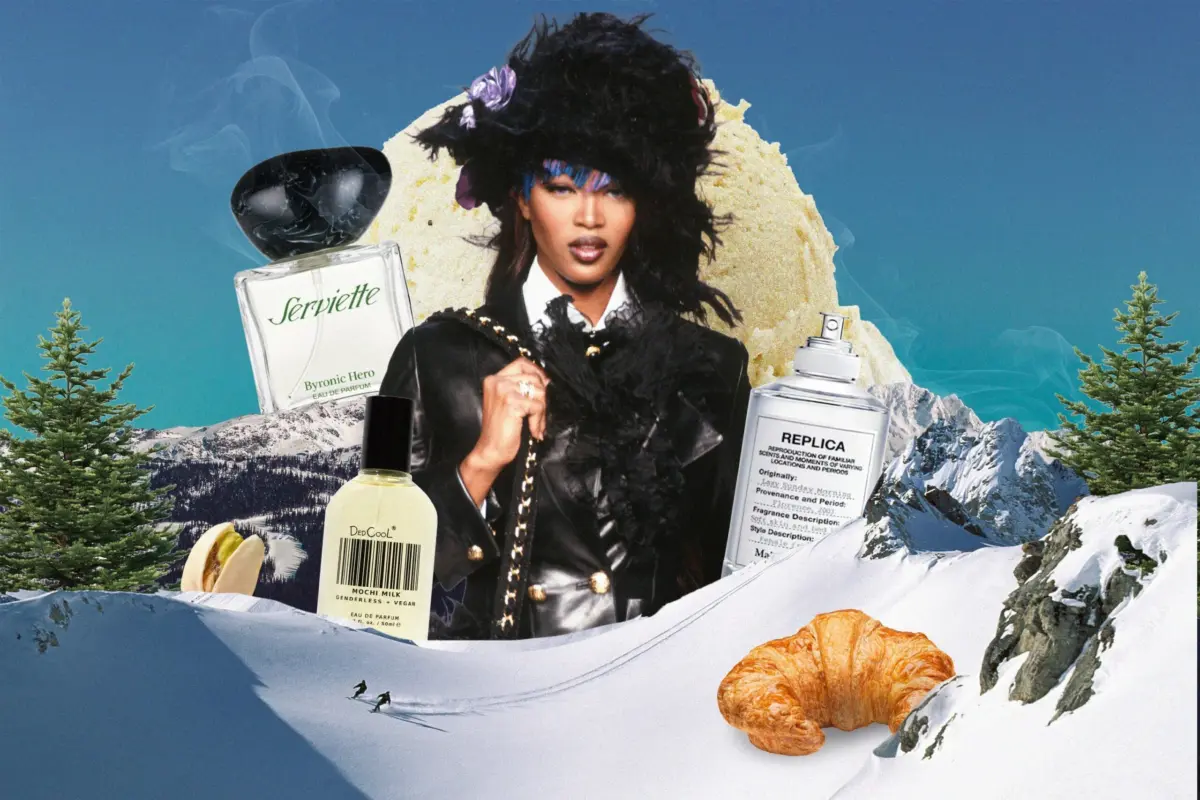
Balancing these winter greens with deeper, anchoring notes—such as moss, aromatic herbs, or aged woods like sandalwood, oud, and patchouli—is vital to ensuring a composition reads as an authentic winter forest rather than a holiday tree. Serviette’s Byronic Hero anchors a fir balsam heart with deep layers of oud and patchouli. LAFCO’s Fireside Light opens with bright fir balsam before settling into a smoky base of patchouli and guaiacwood, while Heretic’s Dirty Hinoki pairs wintry pine, thyme, and nutmeg with rich cedar and resinous frankincense. For a more adventurous interpretation, winter foraging inspires scents like Nasomato Micodeliro, which pairs a distinct mushroom accord with an invigorating spearmint top note.
Bakery Gourmands
The concept of a Parisian winter provides a vivid mental escape: stepping out of a cozy pied-à-terre into the crisp morning air and heading directly to the neighborhood boulangerie. Opening the shop door unleashes a wave of warm, artisanal, and textural comfort that feels sophisticated rather than aggressively sweet.
“This is the season’s most literal comfort language: bready, buttery, faintly toasted accords,” observes Arnaud Guggenbuhl, global head of marketing, insights, and image for fragrance ingredient manufacturer Givaudan. This winter, gourmands are pivoting away from simple sugary sweetness toward richer, more nuanced profiles. “Winter turns a dial back toward warmth, but a smarter warmth.”
To achieve this, perfumers are incorporating toasted elements and honeyed nuances to elevate standard bakery notes. Sol de Janeiro Cheirosa 62 Intense utilizes roasted macadamia, while Clean Reserve Pistachio Addiction layers a honeyed orange flower beneath pistachio, cardamom, and praline. Jeniece Trizzino, vice president of innovation and product at Scentbird and Drift, notes a rising appetite for chewy, milky profiles, pointing to the distinct mochi notes found in DedCool Mochi Milk and Nette Mochi Banane.
Creamy, milky formulations similarly evoke the upscale atmosphere of an artisanal bakery. While traditionally anchored by heavy vanilla or tonka bean, contemporary iterations utilize nuttier milks and creams to transform a simple cookie scent into a freshly baked madeleine. Anti Kleopatra features a smooth almond milk top note laced with cinnamon and jasmine, while Oscar de la Renta New York Rendezvous utilizes airy chantilly and almond flower notes to mimic the delicate aroma of a fresh financier.
Transparent Incense
Incense has historically been an assertive olfactory presence. Known for entering a room before the wearer, traditional smoky incense can be polarizing, despite its widespread cultural use as a meditative and spiritual aid. However, as contemporary consumers seek softer comforts and lean into wellness-focused practices, the demand has shifted toward an incense that whispers rather than projects.
This evolution reflects a broader transformation in consumer preference. “The mood has shifted from ‘notice me across the room’ to ‘recognize me up close,’” Guggenbuhl explains. “A fragrance you wear to say, quite simply: ‘I’m here, come closer.’”
Andreas Wilhelm, a Zurich-based perfumer, agrees that the pendulum has swung toward lighter, more intimate compositions. “After years of powerful projection that could sometimes feel almost intrusive, people seem to be rediscovering the appeal of a more personal scent,” he notes. Combined with a cultural emphasis on mental health and decompression—underscored by a McKinsey report indicating that 42% of US Gen Z and millennial respondents prioritize mindfulness—incense has emerged as a key winter note, albeit in a reimagined format.
Rather than dense, dark, or overtly religious formulations, winter’s incense notes are lighter and more modernized. “Incense is moving somewhere interesting,” Saint-Ford says. “We’ve traditionally made incense fragrances very dark, smoky, and ceremonial. I’m more interested in incense being used almost transparently—frankincense, elemi, and resins with air, citrus, florals, or pale woods around them.” The overarching objective is to provide warmth and atmosphere without encasing the wearer in a heavy cloud.
Fulton & Roark Cathedral of Ruins opens with floral rose and fresh green cypress before settling into a smoldering frankincense. Amouage Overture 41 softens its deep blend of frankincense, benzoin, and patchouli with geranium, cinnamon, rose, and warm sandalwood. Maya Njie Aethi Opum utilizes thiouraye, a sweet traditional resin, alongside vanilla, coffee, and papyrus. Lighter interpretations like Perfumehead 1360 layer grapefruit, pepper, and vetiver over gurjum, a softer resin, while Victoria Beckham Hotel Portofino anchors its incense base with basil, bergamot, and fig to enrich the brighter notes. Ormonde Jayne Tolu similarly lifts frankincense and amber with top notes of juniper berry, orange blossom, and tonka bean.
Cozy Fabrics
The sensation of sitting by a fire is vastly elevated when wrapped in a cashmere blanket inside an alpine chalet. While economic realities may vary, wearing a fragrance that emulates the luxury of soft, tactile fabrics serves as the next best alternative. “Cashmere, suede, velvet, cotton, and skin musks are increasingly shaping fragrance language, mirroring the broader fashion shift toward tactility and second-skin textures,” Guggenbuhl says.
This trend centers heavily on sheerness and physical proximity. Pinterest data reflects this preference, showing a surge in searches for sheer, cozy fragrances, led by a more than 287% increase in searches for “skin scent.” Perfumers are increasingly focused on reconstructing the tactile sensations of materials like cashmere, wool, and linen rather than relying solely on traditional florals and fruits.
Central to this trend is cashmeran, a synthetic molecule developed in the 1970s by International Flavors and Fragrances. According to Trizzino, cashmeran does not smell literally like cashmere, but rather captures the feeling of the fabric. “Cashmeran gives you that cashmere and worn-fabric feeling, so you are essentially wearing texture and then styling a fragrance on top of it,” she explains. Phlur Cashmere Skin pairs cashmeran with almond, cream, and vanilla for a gourmand touch, while Bath & Body Works Cashmere Amber combines cashmere musk with warm amber. Memo Paris Odeon Rosebud tempers its cashmeran base with fresh rose, peony, and freesia accords.
Linen provides an alternative, cleaner tactile experience. The addition of mineral musks helps steer compositions toward a fresh-pressed laundry sensation. Because linen has no natural extract, perfumers construct fantasy accords utilizing white musks for softness, light aldehydes for bright, air-dried clarity, and transparent ozonic notes to simulate the outdoors. Maison Margiela Replica Lazy Sunday Morning employs clean-smelling aldehydes that settle into white musk and iris, while Carolina Herrera Cedar Chic pairs a similar top profile with a creamy cedarwood finish. L’Epoque Parfums Inner Child and Baruti Hot Cotton offer more literal interpretations, opening with linen and hot iron accords before transitioning into second-skin musks.
Pink Pepper
As daylight wanes during the darker winter months, individuals face the daily challenge of maintaining energy levels amidst professional and personal responsibilities. To combat this seasonal fatigue, perfumers are strategically deploying pink pepper to deliver an immediate olfactory pick-me-up.
“It gives an impact at first smell, and nowadays, with such a crowded market, it is important that fragrances impress consumers right from the first spray,” explains Emma, the perfumer and student behind the social media account @perfumerism. Functioning primarily as a top note, pink pepper is spicy, peppery, and sparkling, carrying subtle floral and tea-like undertones. Distinguishable from black pepper, it is derived from a dried berry that possesses a brighter, citrusy, and fruit-forward profile.
Linda Pilkington, London-based perfumer and founder of Ormonde Jayne, relies on pink pepper for its instant invigoration. “It’s unexpected, with a citrus grapefruit-like quality, completely different from a pepper that you would cook with,” she notes.
Rather than adding weight, pink pepper injects light into heavier winter formulations containing incense, vanilla, or rich spices. In Nishane Hold Me Closer, it lifts resinous frankincense and myrrh, while in Ex Nihilo Bois D’Hiver, it contrasts with cedarwood, sandalwood, and patchouli. Byredo Havana Tonka utilizes pink pepper to soften rich rum and tobacco notes, and Cirqadian Brain Stems pairs the spice with bergamot to brighten an amber and vanilla foundation. Furthermore, these citrus facets complement soft musks, as seen in Contrapposto Musc Petille, which combines pink pepper with bitter orange, and Studio Particulier What We Do Is Secret, which layers pink pepper berries over powdery orris, deep suede, and soft skin musk.