
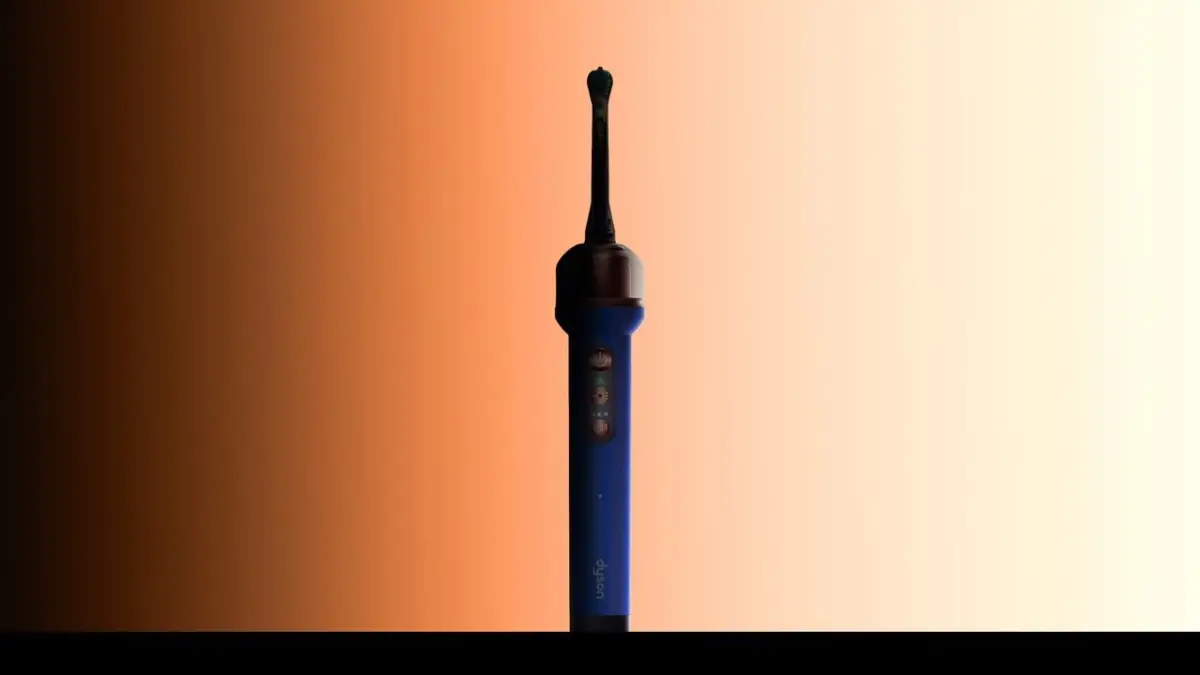
There were some red flags early on, but of course, I ignored them, far too enraptured by the idea of what could be to realize what was actually happening. Our trust dissipated almost all at once when my partner’s diaphragm pump started to slow down. The conical jet began misfiring. In hindsight, maybe it wasn’t vibrating at 245 times per second anymore. Then, quite abruptly, it simply wouldn’t turn on, effectively ghosting me right in the middle of a routine Tuesday morning.
I am not talking about a human partner, nor am I talking about a sex toy in the vein of that memorable episode of Sex and the City, nor an object repurposed as one in the style of Samantha Jones. I am talking about the Dyson CameraJet, a device that promised to revolutionize the mundane chore of oral hygiene through a combination of aerospace-grade engineering and artificial intelligence.
What I initially thought was destined to be the absolute Rolls-Royce of electric toothbrushes arrived at the beginning of the month to a tremendous amount of industry fanfare. A high-profile launch event held in Paris heralded the arrival of the world’s first toothbrush-water-flosser hybrid. The device relied heavily on a specialized camera the size of a pencil tip, designed to fire mouthwash directly in-between teeth while you brush, effectively folding three distinct dental hygiene steps into one seamless routine.
Last spring, Allure’s executive beauty director Jenny Bailly had traveled directly to Dyson’s high-security UK labs to get a top-secret sneak peek of the new innovation before it was unveiled to the public. While she wasn’t allowed to test it hands-on, she was certainly impressed with the sheer institutional rigor that had gone into bringing the ambitious concept to life. As she noted of the development cycle, the idea first arose nine years ago, and engineers spent six intensive years working specifically on the CameraJet. That timeline is actually one year longer than the development cycle for the iconic bagless vacuum cleaner that debuted back in 1983, and longer than the legendary hair-dryer that blew up the beauty industry in 2016.
Naturally, the CameraJet sticker shock at launch was nothing short of gobsmacking. Handing over $499 for a toothbrush is certainly a tall order by any metric, but it was an investment I didn’t find all that unreasonable once I actually used the device. On the day of the launch, a toothbrush was sent to me gratis directly from Dyson to test out. After a couple of blissful days together in my bathroom, I determined that I would gladly pay the full retail price out of pocket if the device were ever to need replacement, assuming that wouldn’t happen for many years in the future, of course. I even went on camera to publicly say as much.
I mean, we all remember when Dyson first launched the Supersonic hair dryer a decade ago. At the time, the $400 price tag for a simple hair dryer felt entirely obscene to consumers, but the tool’s undeniable performance quickly changed our minds—plus, it just looked undeniably cool sitting on a vanity. The CameraJet is similarly sleek, elegant, and its cobalt blue oral-hygiene monolith looked right at home on my bathroom counter. Its charging and refill dock barely squeezed into the tight space under my medicine cabinet, but that was a minor inconvenience I easily overlooked—at least until the hardware died entirely.
My frustrating experience is not happening in a vacuum, nor is it an isolated incident. Across social media platforms, I have seen a mounting wave of complaints from other early adopters who shelled out a cool $500 for Dyson’s latest high-tech innovation, only to find themselves stuck holding a costly lemon. One editor at Consumer Reports reported that the very first toothbrush Dyson sent her to test out stopped functioning less than 24 hours after she opened the shipping box, failing before she even had a single chance to try it out in real-world conditions.
In some ways, I suppose I might actually be one of the lucky ones who managed to keep a working device humming along for almost three weeks. A colleague of mine has also been testing out a CameraJet unit of her own, and while hers is still technically turning on, the automatic firing mechanism of the water jet has slowed down dramatically, raising questions about long-term durability. As of today, the CameraJet is prominently listed as "out of stock" on both dyson.com and sephora.com, effectively pulling the product from shelves while the company deals with the fallout.
Allure reached out directly to Dyson corporate representatives for comment regarding the current availability of the high-end toothbrush, the underlying reasons why it has been failing for so many consumers across the country, and whether a formal product recall would be issued to address the hardware issues. A company spokesperson responded with an official statement, explaining that, unfortunately, one specific production batch of jet tubes experienced an internal process issue during manufacturing. This created a potential for water seepage that ultimately affected the performance of a small number of products on the market.
"We took what we believe to be the right decision to isolate impacted products, which resulted in an out-of-stock position," the spokesperson noted. "We are now in full production and shipping product to our partners. We are sorry that we have let down our loyal customers and we will do all we can to support them."
Despite this official statement, Dyson did not provide a specific calendar date when the CameraJet would officially become available for purchase again by consumers, nor did they respond to direct inquiries regarding the company’s return policy on the defective toothbrush models already sitting in homes.
In pure theory, the CameraJet remains an incredibly sophisticated piece of modern machinery. It reportedly runs on an astonishing 16 million lines of code, and the artificial intelligence learning system that it relies on to accurately detect tooth gaps was initially trained on a staggering 470,000 dental images. It even connects directly to the proprietary Dyson mobile app, where users can view a livestream feed of the inside of their own mouth while they brush their teeth.
That specific feature raised understandable data privacy concerns among some privacy advocates, though Dyson has repeatedly stated that the video feeds are neither stored permanently within its app nor uploaded to the cloud. Personally, I felt the only thing Dyson could possibly glean about me from the space between my molars was how diligently I flossed my teeth. I had zero concerns on that front. A toothbrush that may be fundamentally failing upon contact with water, however, is a catastrophic hardware failure that is highly concerning to me—and certainly not an issue I have ever encountered with standard dental tools.
The situation reminds me vividly of when Apple first introduced Siri to the world, and my brand-new iPhone model at the time completely failed to connect to cellular data. To loosely paraphrase my exasperated conversation with an employee at the Apple Store Genius Bar back then: Siri is great and I love the new camera features, but I would really prefer a cell phone that I can actually call and text people from.
Dyson certainly has a great track record for engineering reliability, at least inside my own house, where I have faithfully used the exact same Supersonic hair dryer for nearly a decade and relied on the exact same cordless vacuum cleaner for the last five years without a single hiccup. But the CameraJet is going to have to produce a lot more concrete receipts before I even consider getting back together with it.
A press release distributed at the time of the device’s launch proudly claimed that it removes up to 69 percent more plaque than "market-leading premium electric toothbrushes in hard-to-reach areas." However, Allure has been repeatedly asking for peer-reviewed clinical data on the CameraJet ever since the product was known only by its internal code name "682," and so far, the only comparative study shared with editorial staff merely compared the CameraJet against a standard manual toothbrush rather than premium electric competitors.
So, while I wait for more verifiable scientific evidence to emerge—and keep a cautious eye on when this high-priced item will even be available for purchase again—I am officially going back to my less-sexy-yet-infinitely-more-reliable ex, a trusty Philips Sonicare model I picked up a few years ago. I know my passionate tryst with my CameraJet burned extraordinarily bright while it lasted, but it went away just as fast as it came. God, what a tool.