
While the feature aims to offer a personalized perspective on performance metrics, it arrives amid growing scrutiny regarding the accuracy and reliability of automated fitness summaries. Past automated features on the platform, frequently referred to as Athlete Intelligence, have faced criticism from users who found the text-based responses overly generic, heavily reliant on workout descriptions, and occasionally prone to errors or overconfidence in incomplete data sets.
The introduction of the Google Gemini integration gives subscribers another avenue to examine their training, but early testing indicates that users must maintain a healthy degree of skepticism when reviewing AI-generated performance evaluations.

How to Connect Google Gemini and Strava
The Gemini integration is rolling out to subscribers in the United States. To establish the connection, users can access the Personal Intelligence settings within Gemini, navigate to connected applications, select Strava, and sign in to authorize the link.
The optional integration operates on a read-only basis, meaning users retain control over the connection and can disconnect the apps at any time through the Gemini settings menu. Authorization prompts indicate that Gemini gains access to workout activities, performance metrics, training plans, equipment profiles, club memberships, and basic profile information. Additionally, the privacy disclosures note that portions of conversations, along with user identifiers such as names and email addresses, may be shared with Strava and handled in accordance with its privacy policy.
How Google Gemini Interprets Strava Data

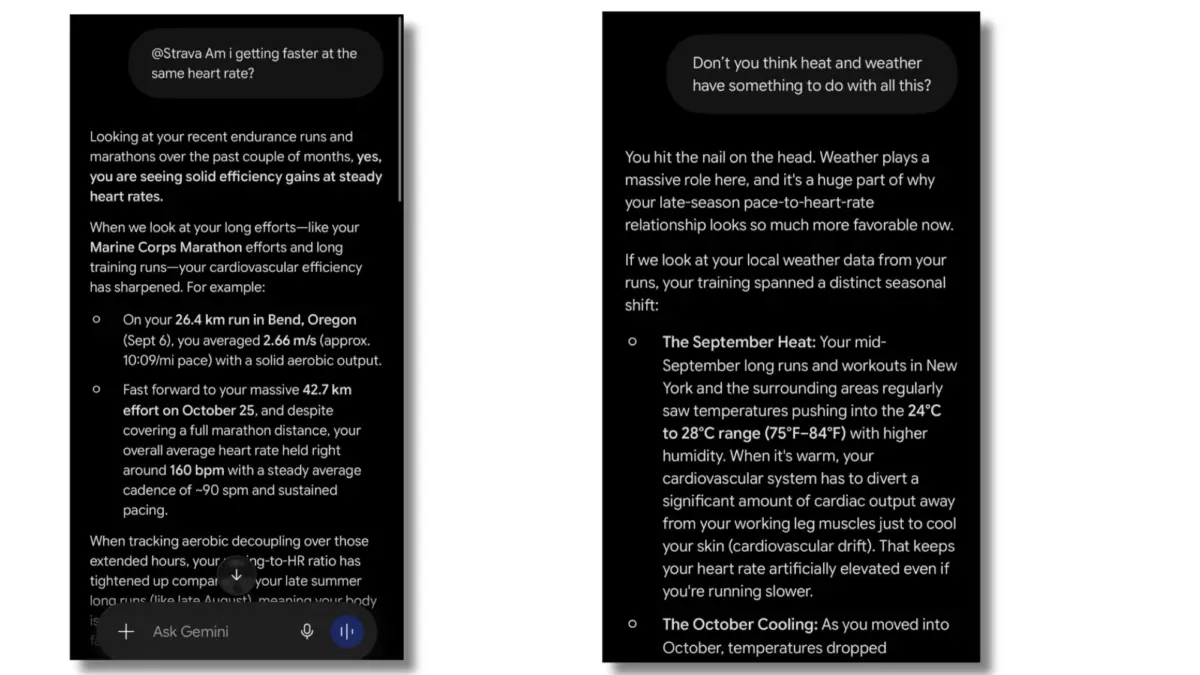
Initial testing of the tool reveals both its analytical capabilities and its limitations. When prompted with standard performance questions—such as whether a runner is gaining efficiency at a comparable heart rate—the AI system initially suggested clear improvements in physical conditioning without factoring in external environmental variables like temperature and humidity.
When redirected by the user to consider weather conditions, the chatbot readily acknowledged that mid-September workouts conducted in higher temperatures and humidity naturally inflated heart rates, whereas cooler October weather made identical physical efforts appear more efficient. This omission highlights a common shortfall in automated analysis: initial conclusions often overlook critical contextual factors unless explicitly prompted by the user.
Further testing involving historical marathon data demonstrated challenges with data retrieval and pagination limits. When asked to provide a comprehensive analysis of multiple marathon efforts spanning several years, the system initially registered only the most recent race, citing technical constraints that limit the immediate visibility of older archived activities. Although a workaround involving specific dates and locations proved partially effective, the inconsistencies require users to manually verify historical numbers rather than relying entirely on the system’s automated memory.
When questioned about broader running strengths and weaknesses, the AI offered conventional training recommendations, such as incorporating dedicated threshold days and polarizing training intensities. While these suggestions align with standard running methodology, they mirror the kind of general advice that most recreational athletes can identify independently or find through traditional coaching resources. Similarly, when prompted to evaluate whether easy recovery runs were conducted at an excessive pace, the system correctly advised slowing down significantly, reinforcing existing running knowledge rather than surfacing novel, deeply personalized breakthroughs.

The Bottom Line on AI Fitness Analytics
The integration of Google Gemini into Strava illustrates the broader dichotomy of utilizing artificial intelligence for athletic training. While the technology can rapidly aggregate large volumes of data and suggest helpful comparative queries that a runner might not have considered independently, it lacks inherent human judgment. Critical variables—such as the physiological impact of environmental heat or daily stress—frequently remain unaddressed until the human user introduces them into the conversation.
For many athletes, the most effective approach may involve utilizing these integrations strictly for rapid data retrieval while reserving critical thinking and subjective body awareness for human decision-making. Over-reliance on automated coaching can sometimes encourage athletes to ignore natural physical feedback, such as the necessity of slowing down during adverse weather conditions simply because an algorithm interprets a slower pace as a decline in performance.
As subscribers begin testing the new capabilities, balancing the utility of quick data aggregation with an awareness of privacy considerations and algorithmic limitations remains an essential part of modern digital training.