
Yet, this rapid acceleration naturally sparks a pressing economic question: Is this historic market expansion grounded in fundamental economic reality, or is it merely an inflated bubble driven by speculative fervor?

The core anxiety among investors centers on the relentless hype surrounding Artificial Intelligence. Many market participants are questioning whether the current environment makes the broader financial system dangerously vulnerable to a severe future crash, and how such volatility might impact long-term retirement security. To properly evaluate the current financial landscape, it is helpful to return to the fundamental economic definition of what a stock actually represents.
At its core, owning a stock is a business arrangement that functions similarly to owning a rental house. When an investor purchases a rental property, they are entitled to collect regular tenant payments. After covering operational expenses, the remaining balance constitutes the profit. If the average market price of rental properties in a specific neighborhood surges while tenant rents remain completely flat, the higher property valuation looks impressive on paper, but it yields no additional cash flow unless the property is sold—at which point the investor must typically pay similarly inflated prices to acquire a replacement asset.

An investor’s actual cash flow remains stagnant unless they actively improve the profitability of the rental business, such as by streamlining operational expenses, adding square footage, or making targeted renovations. When that property is eventually liquidated, the price a subsequent buyer is willing to pay should logically be anchored to that future stream of operational income. For example, a property generating $2,000 per month or $24,000 annually that sells for $240,000 reflects a price-to-earnings ratio of 10. If an investor successfully convinces a buyer to pay $480,000 for that exact same income stream, the transaction occurs at a price-to-earnings ratio of 20—a windfall for the seller, but a compressed future return profile for the incoming buyer.
Translating this dynamic to the broader equity markets reveals a striking parallel. An investor who allocated $100,000 into the stock market in 2019 and continuously reinvested dividends would see that portfolio swell to approximately $256,960 today, representing a 157 percent gain on the original principal. However, over that exact same timeframe, the aggregate share of company earnings generated by that basket of equities has risen from $5,290 to $7,540, a much more modest 42 percent gain. Consequently, the price-to-earnings ratio of the broader market has expanded from roughly 20 to approximately 30.

Modern equity investors in 2025 find themselves in the exact position of real estate landlords observing property values double while rental income inches upward at a much slower pace. This mathematical reality does not render stock ownership or real estate unprofitable, but it dictates that future investment returns purchased at today’s elevated price-to-earnings valuations will inevitably be lower than if those assets were acquired during a market downturn.
The Role of Rising Earnings and the Magnificent Seven
Of course, valuations can remain elevated or expand further if corporate earnings are projected to accelerate dramatically. Consider a prospective rental property investor who knows a massive corporate headquarters is scheduled for construction nearby, signaling that local rental demand and income will climb rapidly for years. In such a scenario, paying a premium for future earnings is justified. This underlying principle explains why individual company stocks surge on positive corporate announcements. During the pandemic, consumer demand for home exercise equipment spiked, leading investors to project permanent growth for companies like Peloton, whose stock price subsequently soared before returning to earth as normalcy resumed.
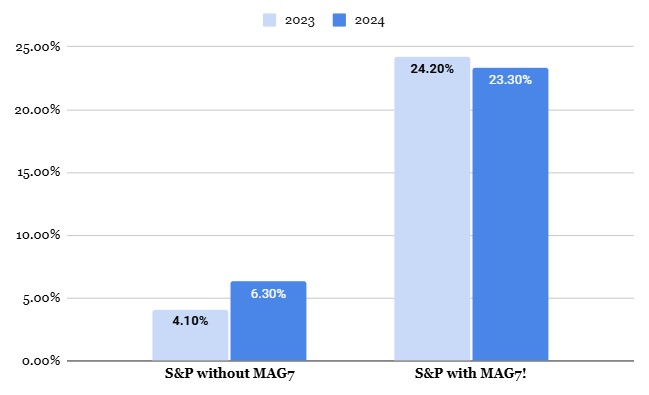
However, when the valuation of the entire stock market climbs universally, it raises the question of whether the broader national economy is poised for unprecedented expansion. In the case of the current market rally, the answer is nuanced. A granular look at the S&P 500 reveals that approximately three-quarters of the recent market gains originated from just seven dominant technology companies: Apple, Nvidia, Microsoft, Amazon, Alphabet, Meta, and Tesla.
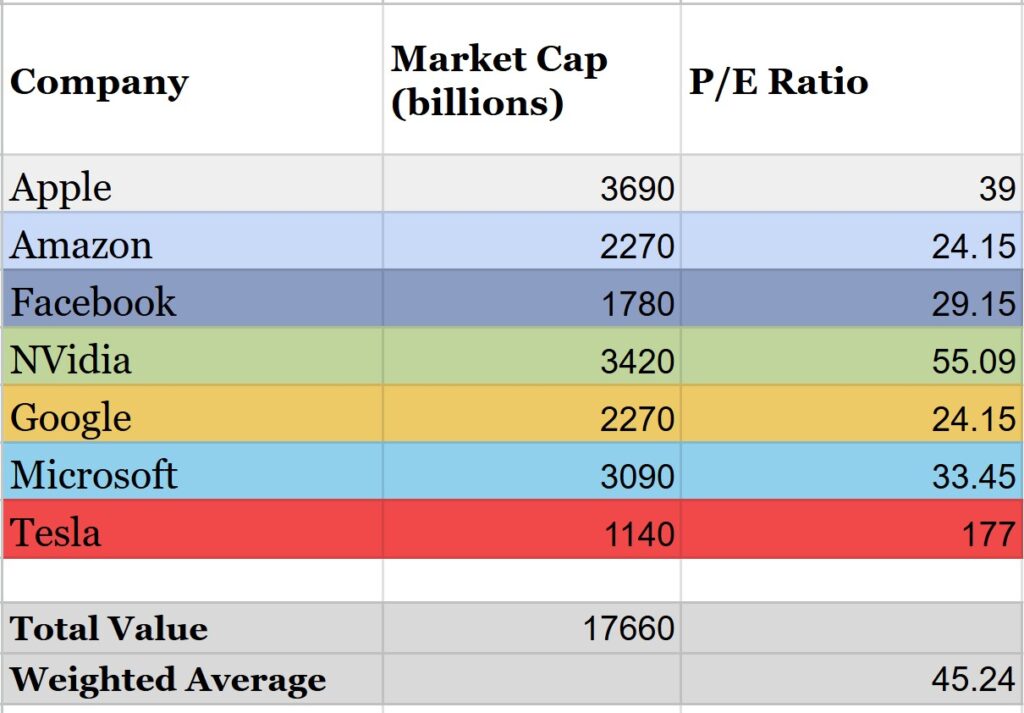
Often dubbed the "Magnificent Seven," these highly profitable tech giants have captured the imagination of investors betting on hyper-growth. Collectively, these seven entities account for more than 25 percent of the entire market’s capitalization—representing a staggering $17.66 trillion—while trading at a weighted average price-to-earnings ratio of about 45. By contrast, excluding these seven behemoths and evaluating the remaining 493 companies in the index yields a more moderate price-to-earnings ratio of 20. This divergence indicates that while market participants anticipate steady macroeconomic health, they are placing an aggressive premium on the future growth trajectories of mega-cap technology firms.
Artificial Intelligence and the Infrastructure Boom
The unifying catalyst behind the soaring valuations of these tech giants is the recent, unexpected leap in Artificial Intelligence capabilities. Software systems are suddenly displaying advanced, human-like reasoning across a rapidly expanding array of domains, triggering widespread corporate excitement. Six of the Magnificent Seven companies are funneling hundreds of billions of dollars into constructing massive data centers housing advanced supercomputers. Meanwhile, Nvidia sits at the center of this capital expenditure wave as the primary manufacturer of these specialized processors, commanding exceptional pricing power amid unprecedented demand.
Beyond the foundational infrastructure, businesses across nearly every sector are betting that AI will usher in a historic era of productivity gains. Modern systems can process complex legal documents, write and debug software code, analyze medical imaging for early disease detection, optimize drug discovery, and lay the groundwork for physical humanoid robotics. The prevailing market thesis is that society stands on the precipice of an infinite workforce of highly intelligent digital labor that can operate continuously, effectively removing humanity’s historical constraint of a finite supply of intelligence and specialized labor.

While technology observers view these long-term advancements as plausible, the critical uncertainty lies in whether projected corporate profits will materialize at the scale currently priced into equities, or if unforeseen cost overruns, regulatory hurdles, and competitive pressures will emerge.
Historical Perspectives and Long-Term Projections
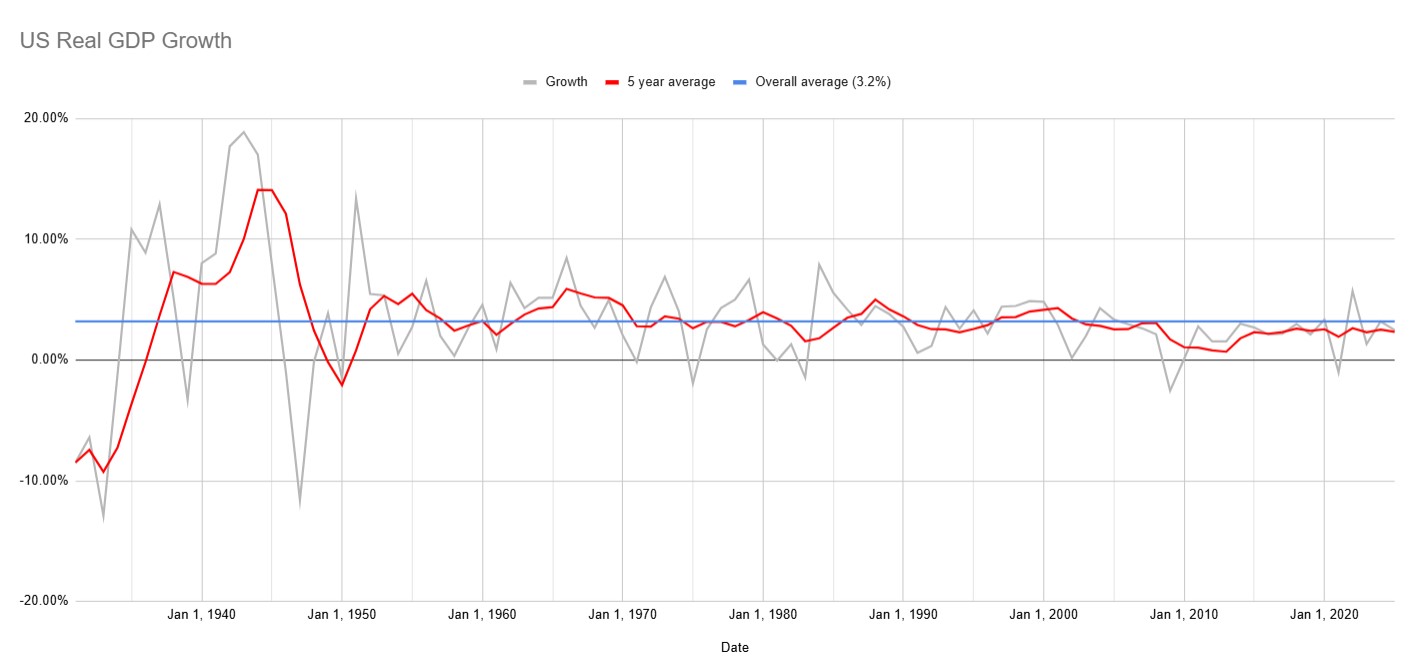
Despite short-term market manias and cyclical panics, long-term historical data provides a steady baseline. US economic growth has averaged a remarkably consistent three percent annually after inflation across decades, with recent decades actually experiencing slightly slower-than-average growth. This historical consistency suggests that while attempting to time market tops and bottoms is historically an unsuccessful strategy, the underlying economy continues its steady upward march. Even if equity valuations eventually compress toward historical averages, corporate earnings are expected to expand over time alongside economic output.
Alternative asset classes offer different perspectives on current valuations. Financial institutions like Vanguard publish ten-year annualized return forecasts that frequently project international equities and fixed-income bonds to outperform domestic US stocks over the coming decade. International markets, such as European equities represented by broad indexes, currently trade at substantially lower price-to-earnings ratios near 16, presenting a significant valuation discount compared to US markets, though domestic tech concentration has consistently favored US-centric portfolios in recent years.
Similarly, conservative capital deployment strategies adopted by seasoned institutional investors reflect caution. Major holding conglomerates have maintained substantial cash reserves rather than aggressively repurchasing shares at current valuation multiples, signaling a market environment where clear bargains are difficult to secure. For individual homeowners, rising interest rates have also shifted the financial calculus surrounding debt, making the guaranteed return of paying down a mortgage increasingly competitive with projected equity returns.
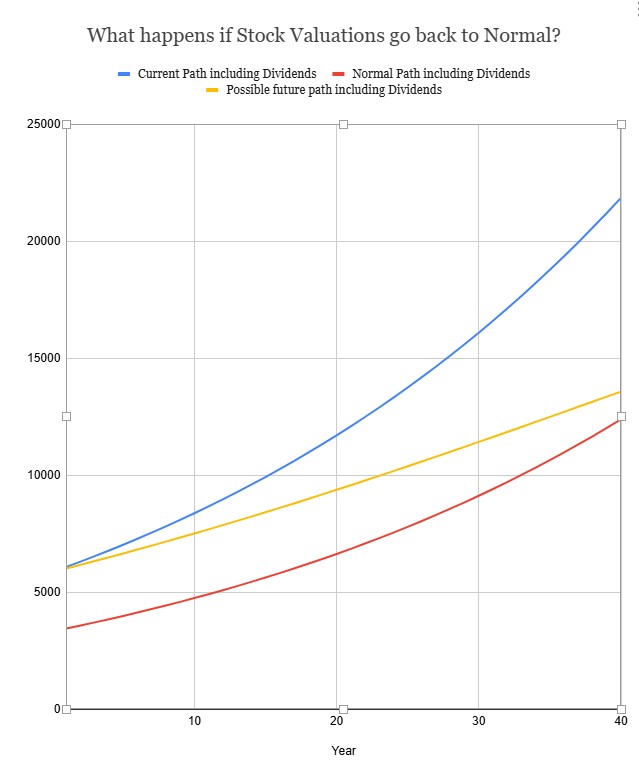
Ultimately, navigating the current economic environment requires balancing awareness of elevated market multiples with a disciplined, long-term perspective. While artificial intelligence and mega-cap tech stocks continue to command historic valuations, the fundamental mechanics of business ownership, economic growth, and personal financial discipline remain the bedrock of long-term financial security.