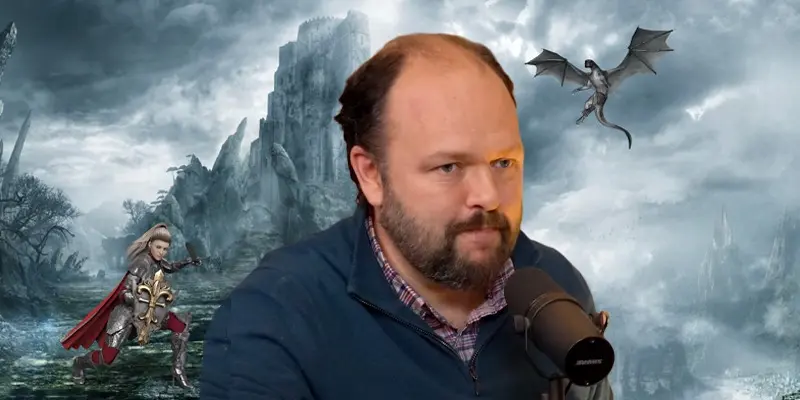
If none of these names ring a bell, however, you have likely missed out on The Falcon’s Children, the debut young adult fantasy trilogy by prominent conservative commentator Ross Douthat. But fret not, for those who have followed the project only in digital fragments are now in luck. The narrative, which previously existed as an exclusive serial on the author’s Substack, is officially making the leap to physical print. Next year, the opening installment will be published by Luminor, a Catholic imprint operating under Word on Fire.
For longtime observers of the cultural and political spheres, Douthat’s pivot to youth fantasy might come as a mild shock, though perhaps it should not entirely defy expectation. The author is widely recognized for his tenure as a right-wing opinion writer at the New York Times, a lofty perch from which he spent years contemplating lofty matters such as spiritual malaise, institutional decline, and political populism in the wake of the Trump era. Recently, however, Douthat journeyed away from the traditional towers of establishment journalism, taking his commentary elsewhere—including recent ventures alongside Bari Weiss and her media projects. Yet, even as his day job involved analyzing the shifting tides of modern politics and the perceived ideological struggles within contemporary religious institutions, he was quietly nurturing a robust side gig as a chronicler of imaginary lands and youthful heroism.
Douthat’s turn toward speculative fiction perhaps finds a faint echo in his broader intellectual history. More than a decade ago, a 2010 profile by Mother Jones observed that his particular brand of conservative vision often drifted "into the realm of the utopian—it’s magical, Tolkien-like thinking." That description, intended at the time as a political characterization, now serves as an apt preview of his creative output.
Readers curious about the quality of the venture have had limited avenues for early assessment, relying largely on snippets made available online. The project’s opening chapters, including a section titled "High House," have been available for public perusal on the internet. However, early critical reception from mainstream literary quarters has been notably harsh. When Slate book critic Laura Miller evaluated the opening pages back in 2023, she was singularly unimpressed, remarking bluntly that if the remainder of the novel matched the tone and execution of the first chapter, the entire work required a ground-up conceptual rewrite.
Despite such early warnings, the world-building behind The Falcon’s Children is undeniably vast and unapologetically traditional in its fantasy tropes. Douthat himself characterizes the project as a work of speculative historical fiction, supported by an array of data-dumping supplemental documents. These companion pieces are dense with detailed histories of dynasties, examinations of nine archangels, and political registries. Naturally, the project also features a hand-drawn map—because, by the unwritten laws of classic high fantasy, no secondary world is truly complete without cartography rendered in ink.
Yet, as the publication date approaches, questions linger regarding the intended audience for such a work. While the political and cultural right has long debated the scarcity of appealing contemporary fiction that aligns with traditional religious worldviews, whether young readers or seasoned fantasy aficionados will embrace a sprawling political fantasy penned by an elite political columnist remains to be seen. Some observers have quipped that the ideal demographic might consist of precocious young staffers at conservative think tanks whose households are looking for a break from traditional policy briefs at bedtime.
Beyond its specific niche, the release of The Falcon’s Children touches upon a broader, perennial conversation among Christian readers and writers: the perennial desire to recapture the literary magic of mid-century giants like J.R.R. Tolkien and C.S. Lewis. Critics of modern faith-based publishing often argue that contemporary efforts to recreate those classic mythologies risk leaning too heavily into overt didacticism or derivative world-building, rather than organically exploring the human condition through art. For those seeking alternative literary traditions, critics often point toward richer, more expansive avenues within speculative fiction, such as Ursula K. Le Guin’s foundational Earthsea cycle.
For those interested in exploring thoughtful, non-regressive Christian perspectives in contemporary literature, literary guides frequently direct seekers away from heavy-handed allegory and toward writers whose spiritual depth is woven directly into modern verse and essay. The poetry and prose of Christian Wiman, for instance—found in luminous collections such as My Bright Abyss and Zero at the Bone—offer profound reflections on faith, doubt, suffering, and what it truly means to navigate existence in a complex world.
As the literary world awaits the official print release of The Falcon’s Children under the Luminor banner, the journey from Substack serial to bound volume marks a fascinating new chapter for one of conservatism’s most recognizable public intellectuals. Whether the Narsil Empire will capture the imaginations of a new generation of readers, or merely stand as an eccentric footnote in the author’s diverse career, time alone will tell.