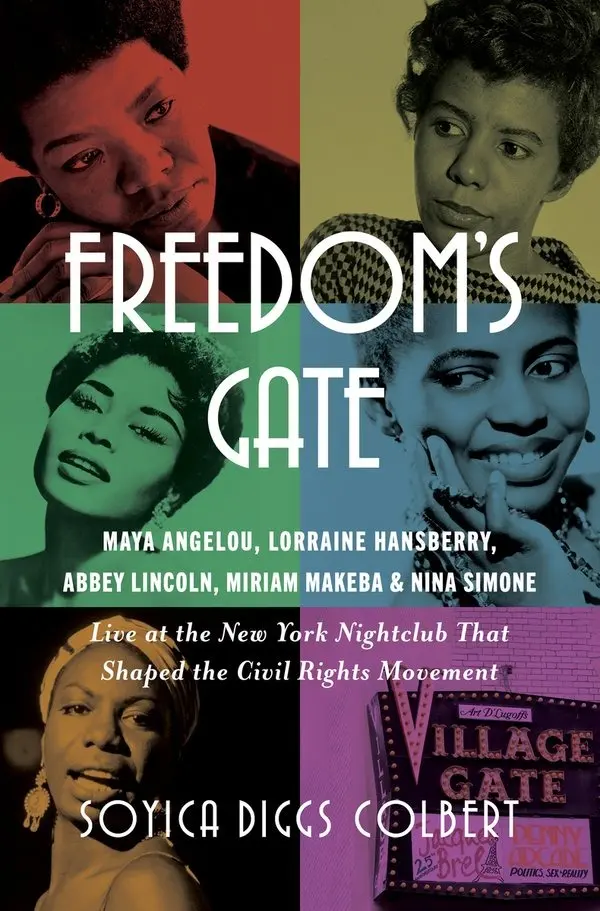
Fresh on the heels of cutting short a frustrating performance run at the Round Table in New York City due to noisy, inattentive audiences, Simone stepped out onto the raised stage, her commanding presence immediately setting the tone for the evening. She was taking control of both her personal and professional life. The whistles and applause captured on the live recording of the concert bleed seamlessly into an opening song about love, “Just in Time.” She sang, “Just in time you found me just in time. / Before you came my time was running low.”
While she was ostensibly expressing deep gratitude to a romantic partner who had rescued her from loneliness, she could just as easily have been thanking the Village Gate itself for serving as a reliable, dependable space for her artmaking during the previous three years.
Leading up to the 1962 release of Nina at the Village Gate, the artist had maintained a grueling, relentless schedule of touring and recording. She often found herself rushing anxiously from city to city, desperately chasing financial freedom, while her core artistic aspiration of becoming a recognized classical concert musician remained stubbornly out of reach. In a remarkably compressed span of time, she released seven albums in four years, beginning with her acclaimed 1959 debut, Little Girl Blue. Although fans adored her talent, their public praise was never a true substitute for the deep closeness of intimates. Nevertheless, her third live recording, Nina at the Village Gate, offers both a vital portal to that historic event and a window into how she meticulously constructed her musical and political worlds.
Entering the club to hear Simone perform between March 30 and April 27, 1961, felt distinctly different from experiencing her in 1959. In the intervening years, her career had experienced a meteoric rise. She had performed a prestigious concert at Town Hall and recorded a major hit live album, At Newport, which included the single “Trouble in Mind” and “Cotton Eyed Joe.” Those tracks climbed through the Billboard Hot 100 R&B singles chart to numbers 11 and 92, respectively. She had also graced the glossy pages of Ebony magazine and appeared on television variety programs, including Hugh Hefner’s Playboy’s Penthouse, the Today show, and The Ed Sullivan Show.
By 1961, she was a bona fide star whose electric energy radiated through the roughly four hundred audience members who each night sat huddled tightly around tables, waiting, listening, and watching. Simone not only demanded attention; she completely commanded a room, captivating audiences with unexpected, daring combinations of genres and her remarkable ability to surrender herself utterly to the music. Her full-body performance expressed her own artistic intentions rather than bending to her audience’s expectations. In the archival recordings from those spring nights, her set list moved fluidly from the romantic, polished sound of the Midtown Manhattan Broadway stage, to foreboding, Appalachian-influenced blue notes, and finally to an unfurling sonic breakdown reminiscent of a Southern church revival meeting. Within the walls of the Village Gate, she built for herself a sanctuary that could gently hold her complex artistry.
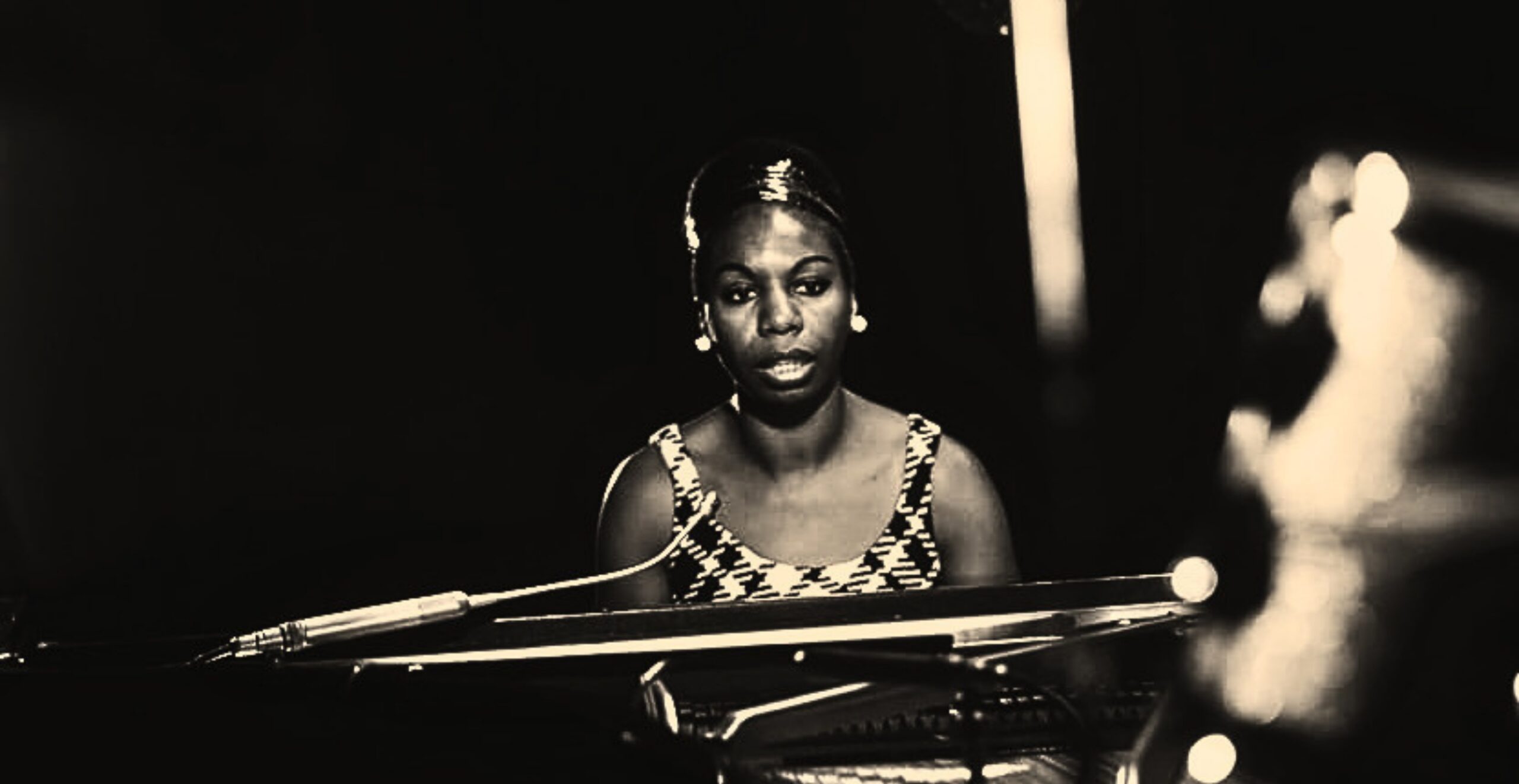
Nina at the Village Gate unfolded in carefully measured layers. The performance’s moments of familiarity and predictability drew the audience close, while unexpected musical references kept listeners surprised and slightly at a distance. Sitting near enough to physically feel Simone’s powerful presence, the audience heard a walking bass line followed by her striking a soft, striking minor chord on the piano. The sound instantly entered the listeners and the physical space. She sat securely at the piano while her band formed an elegant arc around her. The musicians included her long-time collaborator, guitarist Al Schackman, alongside bassist Chris White and drummer Rob Hamilton, together forming a tight, sophisticated quartet.
The set opened with “Just in Time” from the musical Bells Are Ringing, which was followed immediately by “He Was Too Good to Me,” a sophisticated jazz standard featuring music by Richard Rodgers and lyrics by Lorenz Hart, originally written for the 1930 musical Simple Simon.
From there, the soundscape shifted dramatically from familiar romantic standards to a haunting, guitar-backed rendition of Josh White’s version of “House of the Rising Sun.” Bob Dylan would record the song months after Simone’s performances, and by 1964 it became a massive international hit record for the British group the Animals. The song is a cautionary tale centered around a notorious New Orleans brothel known for ruining many poor young women. Its speaker hopes that her tragic life will serve as an earnest warning to her younger sister, because although the speaker’s own fate is bound to unfold beneath the rising sun, her sibling does not have to follow in her footsteps. Said to be inspired by traditional English folk songs, Appalachian artists Tom Ashley and Gwen Foster first recorded the tune in 1933, before White released his influential version in 1942 while he was still actively involved with leftist political circles.
Miriam Makeba also recorded “House of the Rising Sun” in 1960. It was one of only five songs performed in English on her fourteen-song self-titled album. Makeba’s rendition situated her firmly as a vital part of the South African diaspora, drawing musical inspiration equally from the African continent and the American folk music scene.
The profound influence of Black internationalism can likewise be heard clearly on Simone’s Nina at the Village Gate through the inclusion of that very song in the same set as the powerful Black freedom song “Brown Baby”; the rhythmic track “Zungo,” composed by Nigerian teacher, activist, and drummer Babatunde Olatunji; and the traditional African American spiritual “Children Go Where I Send You.” Freedom songs possess a rich musical tradition in the United States and throughout the world—a tradition intimately connected to the spirituals that enslaved Africans sang in the antebellum United States and that free African Americans, including the famed Fisk Jubilee Singers, performed abroad during the nineteenth century.
In both the United States and South Africa, these freedom songs also drew deeply from the tradition of work songs, incorporating call-and-response structures to actively engage listeners in the performance. Simone’s set at the Village Gate was thoroughly steeped in that expansive tradition, with folk music sitting comfortably alongside the gospel and spiritual songs she had heard in church during her childhood, the rigorous classical music of her formal training, and the sophisticated jazz standards she had perfected in nightclubs. The folk tradition, in particular, connected her directly to international Black freedom movements that emphasized labor conditions and systemic equality as core components of the broader struggle.
When Simone sang “Brown Baby,” she explicitly invited the powerful example of composer Oscar Brown Jr. into the room, along with the unwavering calls for Black pride that invariably accompanied his work. Brown had recently contributed significantly to We Insist! Max Roach’s Freedom Now Suite. The audience in the club may have also heard distinct echoes of Mahalia Jackson’s gospel-inspired 1960 recording of the same song. Much like “House of the Rising Sun,” “Brown Baby” is performed for the sake of a future generation, anticipating a day when brown children would finally drink “from the plenty cup.” The singer issues a ringing charge: “I want you to stand up tall and proud / And I want you to speak up clear and loud.” The song concludes with an undeniable call to action, expressing a deep desire for a future where societal rewards truly match human contribution.
“Brown Baby” quickly became a permanent fixture of Simone’s artistic repertoire. She notably performed it on October 21, 1960, at a concert produced by Art D’Lugoff for Hunter College. A contemporary review of that performance recalled, “At the end of the last group of songs, the audience rose to its feet and would not be satisfied until Miss Simone returned and performed once more for them. She chose for an encore ‘Brown Baby,’ a song which has the feeling and pathos of the Negro’s long struggle for a better life.”
Through that performance, Simone aligned herself closely with her friends Lorraine Hansberry and James Baldwin, who frequently engaged with and encouraged college students standing on the front lines of the burgeoning civil rights movement. Through the encore at Hunter College, she spoke directly and urgently to a new generation. During her residency at the Village Gate, she sang not only to the live audience seated before her tables, but also to those who would experience the recorded artifact in the future.
“Brown Baby” anticipated the complicated emotional state later expressed in Simone’s iconic recording of “Feeling Good.” Her bluesy, unvarnished rendition of “Brown Baby” imagines the collective comfort of communal solidarity, but does so with her characteristically haunting vocal timbre. When listeners encounter the true blues, they understand implicitly that there is no profound beauty without underlying brutality. In “Feeling Good,” upbeat horns counter the melancholy undertone of her voice; in “Brown Baby,” the stark predominance of her singing backed almost exclusively by piano intensifies the stark juxtaposition of pain and promise. Serving equally as an acknowledgment of survival and a rallying cry, the song elicits both deep sadness and fierce satisfaction from the listeners.
On Nina at the Village Gate, she transitions seamlessly from “Brown Baby” to “Zungo,” a song composed and taught to her specifically for the album by Olatunji. Like her friends Baldwin and Harry Belafonte, Olatunji had cultivated a close relationship with Dr. Martin Luther King Jr., which included visiting him in the American South and later participating in the historic March on Washington. In her performance at the Gate, Simone sang the lyrics “Zungo is my home” in Yoruba, powerfully affirming the diasporic nature of her evolving artistic work as early as 1961.
To conclude her powerful performance residency at the Village Gate, Simone effectively transformed the secular nightclub into a Black church, returning to a sturdy, familiar foundation reminiscent of the emotional crescendo at the end of her live 1960 concert in Newport, Rhode Island. In the penultimate song of the set, “If He Changed My Name,” she offered a solemn dirge of suffering and spiritual sacrifice in the service of personal and collective self-transformation. “Jesus,” she sang, “told me I would go hungry if He changed my name / But I told Jesus it would be all right if He changed my name.” The evocative lyrics point to a profound understanding that true systemic and personal change requires heavy sacrifice. In later years, she would accelerate the tempo and intensity of the song to further emphasize the steep cost of seeking and realizing a radically different political order.
The potential danger of her explicit political turn came into sharp relief as she gave dimensions to a sound that completely enveloped the room. Because Simone’s exposure to global Black freedom movements through her collaboration with Olatunji and her friendship with Makeba had brought entirely new worlds of political possibility into view, she was ultimately willing to accept that the world might end up hating her—much as it had already rejected Abbey Lincoln before her—for turning decisively away from polite popular music toward uncompromising freedom music.
Simone drew her audience even further into the deep-seated gospel tradition with “Children Go Where I Send You.” She asked the crowd, Have “you ever been to revival meeting?” Her band members replied slyly, “They don’t know nothing about that,” to which she quipped back, “I bet you don’t even know what I’m talking about,” as the bass line drove forcefully forward and the audience erupted in laughter. She clarified playfully, “Well, you in one right now.”
In that definitive moment, Simone had successfully transformed the Village Gate into a stage entirely of her own design for making cultural meaning. The audience may have arrived at a famous Greenwich Village nightclub expecting merely to hear a rising jazz star, but what she ultimately conveyed was that upon entering 185 Thompson Street that evening, they had stepped into a sacred space of her own divining. Her unforgettable live performances continually blurred the traditional lines separating theater, church, and concert hall, forging an entirely new artistic space where sound, dance, and powerful oration met in a deeply constructive arrangement.