This counterintuitive reality upends conventional wisdom about effective study habits. To understand why studying solutions often surpasses raw problem-solving, cognitive scientists trace the inner workings of the human mind when it encounters unfamiliar challenges. The insights reveal a nuanced relationship between effort, memory, and expertise, offering a revised framework for how students, educators, and professionals approach skill acquisition.
The Puzzle of Unconscious Problem-Solving
The scientific inquiry into this phenomenon dates back to 1982, when psychologist John Sweller conducted a series of experiments with undergraduate students. The subjects were given simple numerical puzzles where the objective was to transform a starting number into a goal number using only two permissible moves: multiplying the current number by three or subtracting twenty-nine. Every single puzzle shared an underlying structural trick—they could all be solved by repeatedly alternating between those two specific rules in a precise sequence.
While the undergraduates found the problems relatively easy to solve and achieved high success rates, Sweller noticed a startling discrepancy during post-experiment interviews. Despite successfully navigating the puzzles, virtually none of the students discovered or consciously recognized the alternating rule they were repeatedly applying. Whatever cognitive mechanisms the problem solvers utilized to reach their destinations, learning the underlying method did not factor into their success. The students could solve the puzzles without actually learning how or why their solutions worked.
The Mechanics of Cognitive Search
A decade prior to Sweller’s experiments, future Nobel laureate Herbert Simon and Allen Newell published their landmark text, Human Problem Solving, which mapped out the mental processes people employ when tackling unfamiliar challenges. They discovered that when individuals face a problem without a pre-existing solution path, they engage in a mental search process across a conceptual landscape known as a problem space. Navigating this conceptual space resembles walking through a maze filled with potential dead ends.
To manage the overwhelming complexity of these choices—such as the vast configurations found in a Rubik’s cube—the human brain spontaneously deploys innate, general-purpose procedures called heuristics. Simon and Newell identified several such heuristics, but one specific strategy captured Sweller’s attention: means-ends analysis.
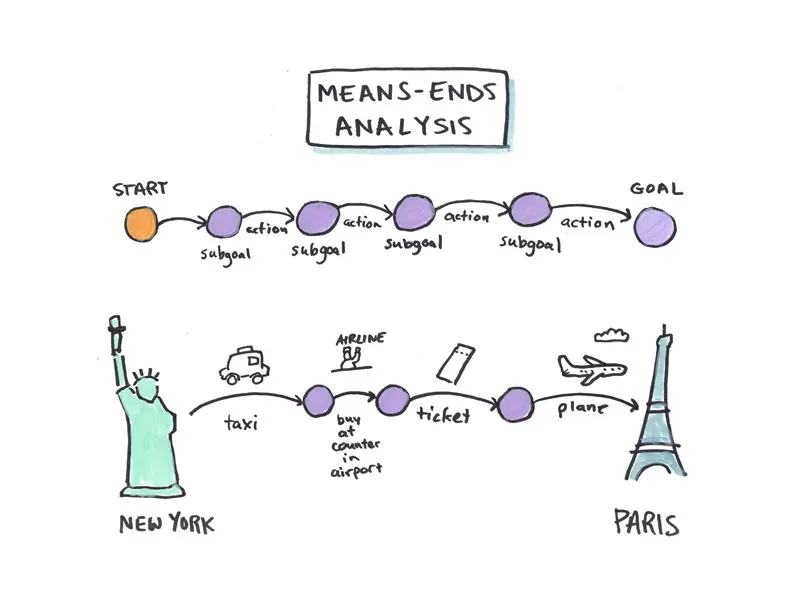
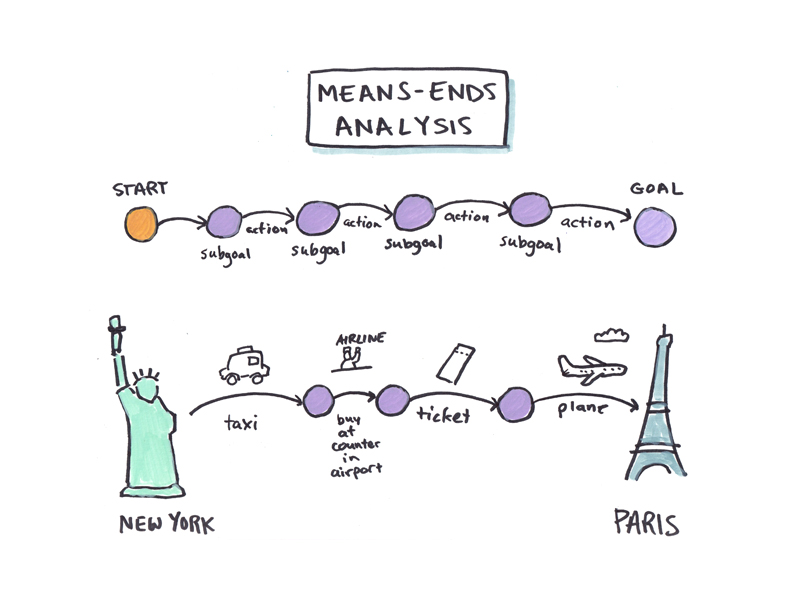
Means-ends analysis operates by evaluating the ultimate goal, identifying an action to reach it, and establishing a sub-goal if that primary action cannot be executed directly. For example, traveling from New York to Paris involves booking a flight, which requires purchasing a ticket from an airport, which requires taking a taxi to reach the airport. While means-ends analysis remains an effective strategy for navigating unfamiliar territory, it carries a severe drawback. Generating and tracking multiple goals and sub-goals simultaneously consumes an immense amount of mental bandwidth within working memory. When working memory is entirely consumed by managing the search process, little capacity remains for noticing and internalizing the underlying principles or patterns of the subject matter.
Redesigning Instruction to Protect Working Memory
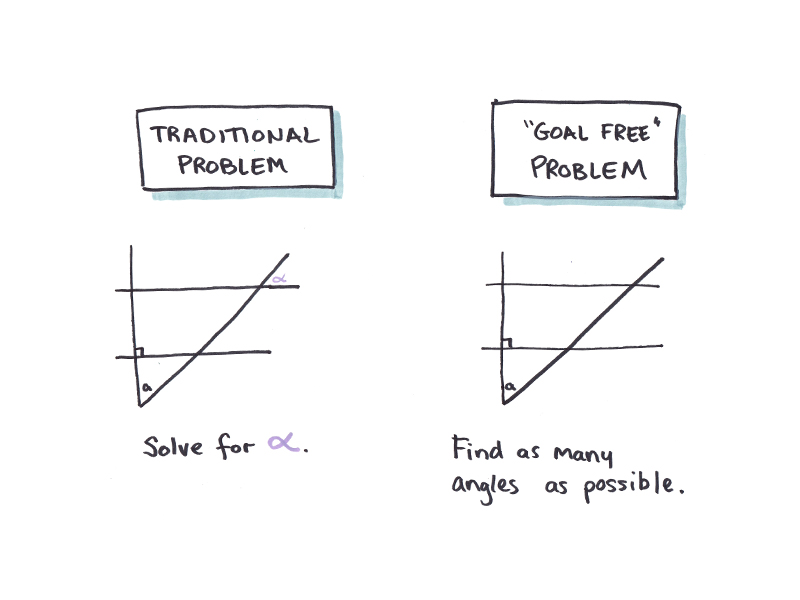
Suspecting that means-ends analysis hindered genuine learning by overloading working memory, Sweller sought to test his hypothesis. He turned to trigonometry puzzles, which traditionally require students to find a specific missing angle or side length by working backward from a designated goal. This backward-chaining approach forces students to rely heavily on means-ends analysis, consuming precious cognitive bandwidth.
To bypass this bottleneck, Sweller and his colleague Elizabeth Owen introduced "goal-free" problems. In these modified trigonometry exercises, students were not asked to find a single designated angle. Instead, they were instructed to calculate as many unknown angles and side lengths as possible using the provided geometric principles. When tested later on entirely novel trigonometry puzzles they had never encountered before, the students trained with goal-free problems dramatically outperformed their traditionally trained peers, correctly solving eight out of ten problems compared to just three out of ten for the control group.
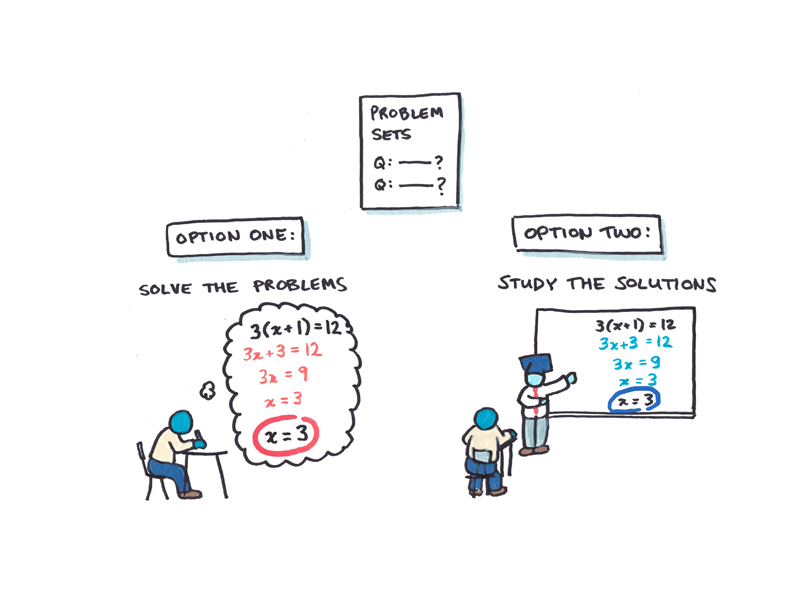
Recognizing that goal-free problems were difficult to scale for complex, real-world domains with vast problem spaces, researchers pivoted to another technique: worked examples. These consist of fully written-out solutions paired with subsequent practice problems to verify comprehension. In experiments involving algebra students, half the participants received worked examples while the other half solved problems independently. To control for failure rates, students in the problem-solving group who stalled for more than five minutes were simply given the solution, ensuring every participant ultimately reached the correct answer.
When tested on similar problems, both groups performed comparably. However, when researchers introduced a novel variation of the problem, three-quarters of the worked-example group successfully solved it, while none of the independent problem-solving group managed to do so. Studying worked examples fostered a deeper, more generalizable understanding of the underlying mathematical techniques than struggling through independent problem-solving.
Cognitive Load Theory
These experimental findings culminated in the formulation of cognitive load theory, which posits that learning places two distinct demands on our limited cognitive capacity. The first, intrinsic load, represents the mental effort strictly required to process the material and achieve learning. The second, extrinsic load, encompasses mental effort that is not essential for learning but is unnecessarily imposed by the task structure, such as means-ends analysis or disorganized visual layouts.
When the combined cognitive load surpasses an individual’s working memory capacity, the brain drops information. If the discarded information happens to be intrinsic to the learning process, overall comprehension declines. Optimizing cognitive load requires minimizing extrinsic distractions so that mental effort is funneled directly into genuine learning.
The Expertise-Reversal Effect
Despite the robust evidence supporting worked examples, educators often push back, arguing that advanced subjects like mathematics, physics, and computer programming cannot be mastered merely by reviewing answers. This perspective aligns with the proven benefits of retrieval practice, where recalling information from memory strengthens neural pathways far more effectively than passive review.
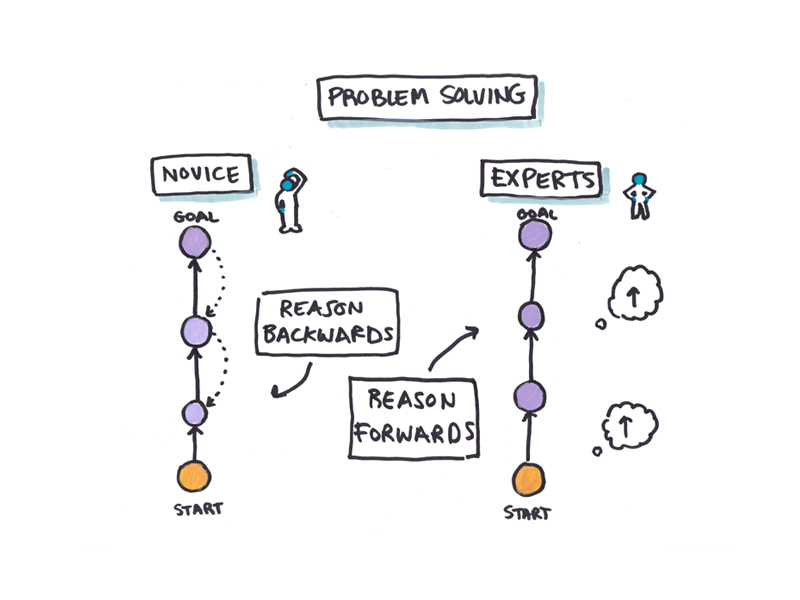
This apparent contradiction dissolves when examining how learning transforms over time. While novices must rely on heuristics like means-ends analysis because they lack prior context, experts operate entirely differently. Experts possess stored knowledge structures known as schemas, allowing them to bypass heuristic searches and execute forward reasoning. When an expert encounters a familiar problem, they retrieve the appropriate schema directly from memory, mapping out a solution path without overloading their working memory.
Furthermore, through a cognitive process known as chunking, our effective working memory capacity expands within specific domains as we acquire expertise. Consequently, as learners progress from novices to experts, the utility of worked examples steadily diminishes, eventually reversing entirely. For advanced learners, independent problem-solving and active retrieval become the superior strategies for mastery.
This expertise-reversal effect demonstrates that instructional design must adapt to the learner’s current proficiency level. Beginning learners benefit immensely from clear explanations and worked examples, while advanced practitioners require independent problem-solving to continue growing.
Practical Applications for Learners
Integrating these cognitive insights into personal study habits involves recognizing that both worked examples and independent practice are essential components of skill acquisition. Early in the study of a new domain, reviewing worked examples prevents cognitive overload and accelerates pattern recognition. As familiarity increases, transitioning toward independent problem-solving and retrieval practice ensures deeper consolidation.
Researchers have also explored hybrid strategies to smooth the transition between studying examples and independent practice. One approach involves self-explanations, where learners review worked examples while explicitly generating written or verbal justifications for each consecutive step, deepening their conceptual understanding. Another method utilizes fading, where instructional support is gradually withdrawn by omitting the final steps of a worked example and requiring the learner to complete them independently. A third strategy implements stepwise retrieval, revealing problem solutions incrementally to prompt active recall without demanding a complete, unassisted solution upfront.
Ultimately, cognitive science demonstrates that effective learning requires effort, but not all efforts yield equal returns. By aligning study methods with the mind’s current stage of expertise—balancing the guidance of clear examples with the rigor of independent practice—learners can optimize their cognitive architecture for long-term mastery.