From his troubled, working-class childhood in Yorkshire to his eventual knighthood by Queen Elizabeth II, Stewart remained a fiercely committed socialist and a passionate advocate for progressive causes. Throughout his life, he lent his considerable voice and resources to the fights for LGBTQ+ acceptance, animal welfare, and the eradication of domestic violence. For millions of fans across the globe, his performances across television, film, and theater meant the world—and often, the entire galaxy.
While those who knew him personally will offer the most fitting tributes, the breadth of his artistic footprint is vast. Beyond his legendary, career-defining turns as Captain Jean-Luc Picard in the Star Trek universe and Professor Charles Xavier in the X-Men film franchise, Stewart built a staggering resume of complex, unforgettable characters. Here is a retrospective look at ten of his most iconic performances beyond the final frontier.
Jeffrey (1995)
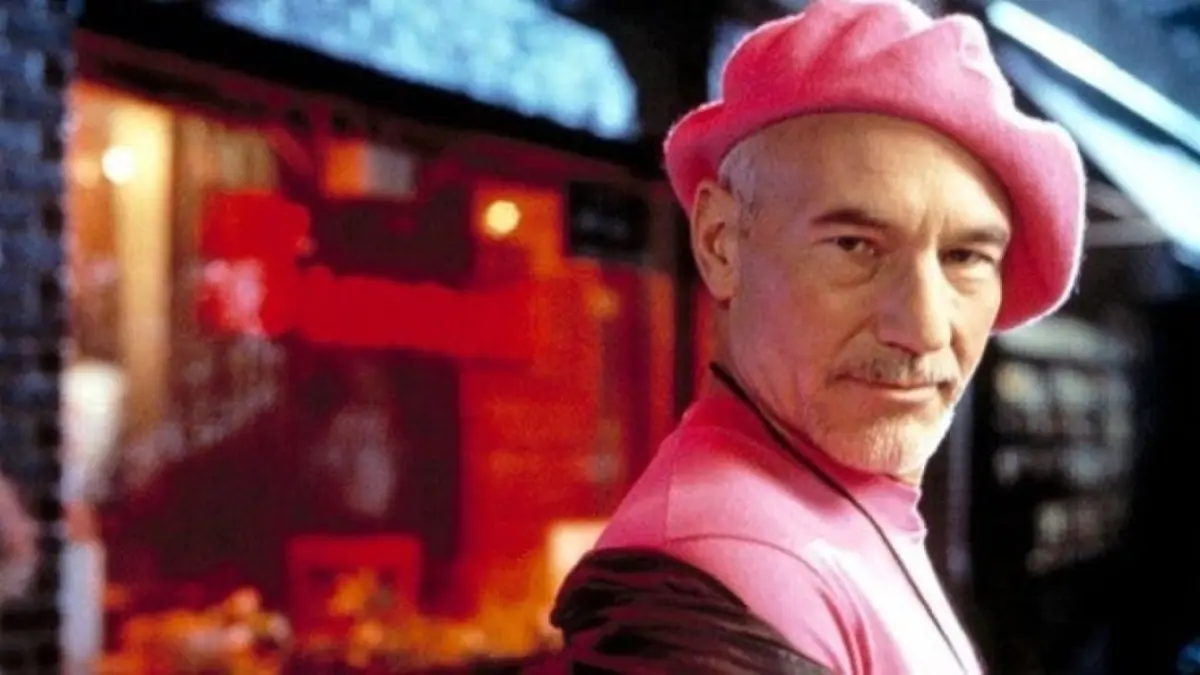
Released during the height of the HIV/AIDS crisis, Jeffrey was a remarkable cinematic anomaly in the mid-1990s: a romantic comedy that neither villainized its queer characters nor reduced them to pitiable martyrs. While the film starred Steven Weber and Michael T. Weiss alongside an ensemble featuring Christine Baranski, Victor Garber, Nathan Lane, Olympia Dukakis, and Sigourney Weaver, Stewart emerged as an undeniable standout. He played Sterling, an irrepressible, high-camp gay best friend who stole every scene with sass and theatrical flair without ever descending into mere caricature. As the leader of the "Pink Panthers"—a squad dedicated to defending locals from bigotry—Stewart’s character was unapologetic, vibrant, and fiercely resilient, cementing the role as a beloved milestone in queer cinema.
Excalibur (1981)
John Boorman’s sprawling, visually stunning epic take on the King Arthur legends remains a fascinating cinematic achievement. Amid a cast of larger-than-life figures, Stewart made a memorable impression as Leodegrance. Boisterous, occasionally boorish, but fiercely loyal, Leodegrance was the father of Guenevere and one of the very first nobles to pledge his absolute allegiance to Arthur, bringing a grounded, earthy authority to the high-fantasy landscape.
Green Room (2015)
In Jeremy Saulnier’s harrowing thriller, which operates with the intensity of a horror film, Stewart delivered one of the most chilling performances of his career. As Darcy Banker, the leader of a remote Oregon bar operating as a haven for white supremacists, Stewart played a man who was erudite, intellectual, and unnervingly calm. Stripped of any redeeming qualities, Darcy’s terrifying composure when a young punk band witnesses a murder and becomes trapped backstage makes him an all-time great cinematic villain.

Logan (2017)
Spanning 26 years and numerous films, Stewart’s portrayal of Professor Charles Xavier became a cornerstone of modern superhero cinema. However, he delivered his most profound and elegiac work in James Mangold’s Logan. Playing an elderly Professor X suffering from severe cognitive decline, Stewart stripped away the character’s traditional bravado, replacing it with a heartbreaking, prickly dependence and profound vulnerability. It remains a rare, courageous depiction of a superhero facing the twilight of his life.
A Christmas Carol (1999)
While this television adaptation of Charles Dickens’ classic holiday ghost story leans into a theatrical staging, it features one of the definitive portrayals of Ebenezer Scrooge. Stewart’s booming, resonant voice and his mastery of heightened performance styles allowed him to capture the multifaceted bitterness and ultimate redemption of Scrooge without resorting to hollow caricature, proving his deep affinity for classic literary adaptations.
Hamlet (2009)
Long before achieving mainstream television stardom, Stewart spent two decades as an associate artist with the Royal Shakespeare Company, building a theatrical legacy that serves as an essential pillar of 20th-century performance. While much of his live stage work lives on primarily through historical record, this modern-dress film production preserves his brilliant interpretation of King Claudius. Acting opposite David Tennant’s melancholy Prince of Denmark, Stewart brought chilling calculation and regal depth to the tragic monarch.
Match (2014)
In contrast to the operatic, larger-than-life roles that defined much of his screen career, Stewart offered a quieter, deeply muted performance in Match. Playing Tobi Powell, a legendary choreographer and Juilliard professor whose career is winding down, Stewart navigated a narrative where a quiet interview with a visiting couple slowly unravels into a confrontation with a long-buried past. The film builds to a devastating emotional climax anchored entirely by Stewart’s subtle, restrained artistry.
Robin Hood: Men in Tights (1993)
Mel Brooks’ comedic romp featured a famously game performance from Stewart, who gleefully leaned into self-parody. Having famously once scolded rowdy co-stars on the set of Star Trek: The Next Generation by declaring, "We are not here to have fun," Stewart proved by 1993 that he had entirely shed any such pomposity. His delightful cameo as King Richard offered a wonderfully silly subversion of the noble monarch archetype he could have easily played with stone-faced seriousness.
Dune (1984)
Stewart’s first major cinematic foray into science fiction arrived via David Lynch’s ambitious, divisive adaptation of Frank Herbert’s masterwork. As the troubadour-warrior Gurney Halleck, Stewart brought immediate gravitas, physicality, and unwavering commitment to Lynch’s wildly surreal vision of the desert planet Arrakis, anchoring the dense narrative with his unmistakable presence.
The Kid Who Would Be King (2019)
In this imaginative, modern-day reimagining of Arthurian lore, Stewart stepped into the robes of Merlin. Sporting wild hair and rock-band t-shirts, his iteration of the legendary wizard balanced eccentric charm with a profound, aching kindness. It provided a fittingly poignant and memorable farewell to a cinematic landscape where Stewart spent decades leaving an indelible mark.