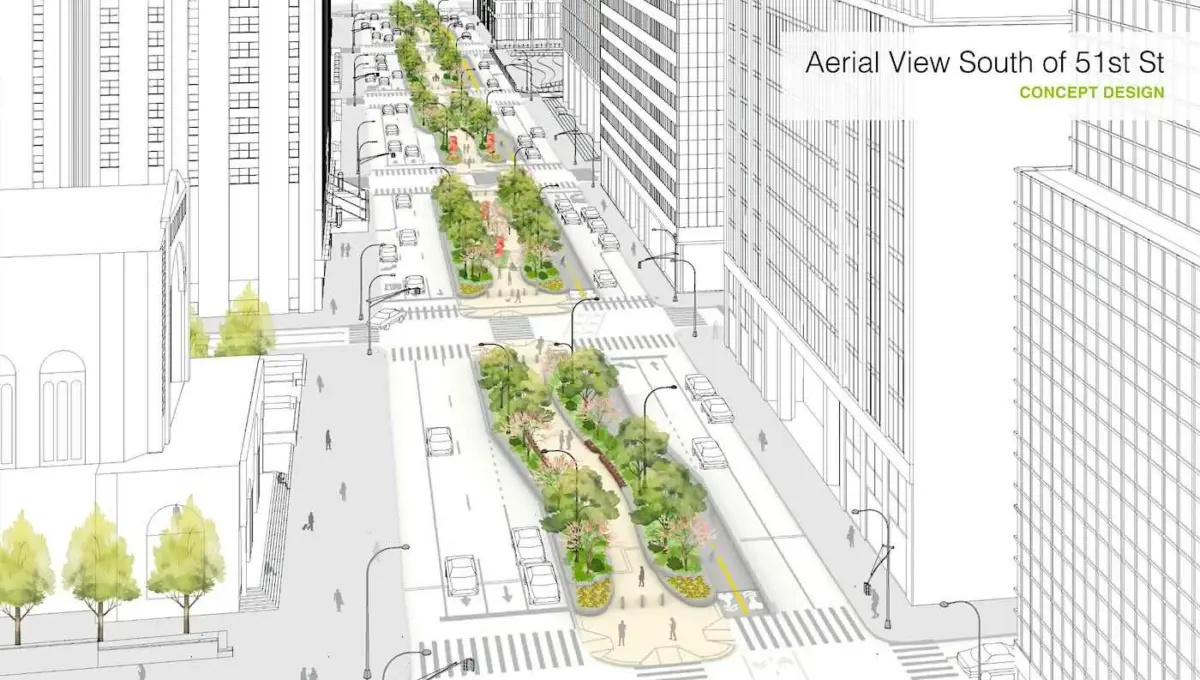
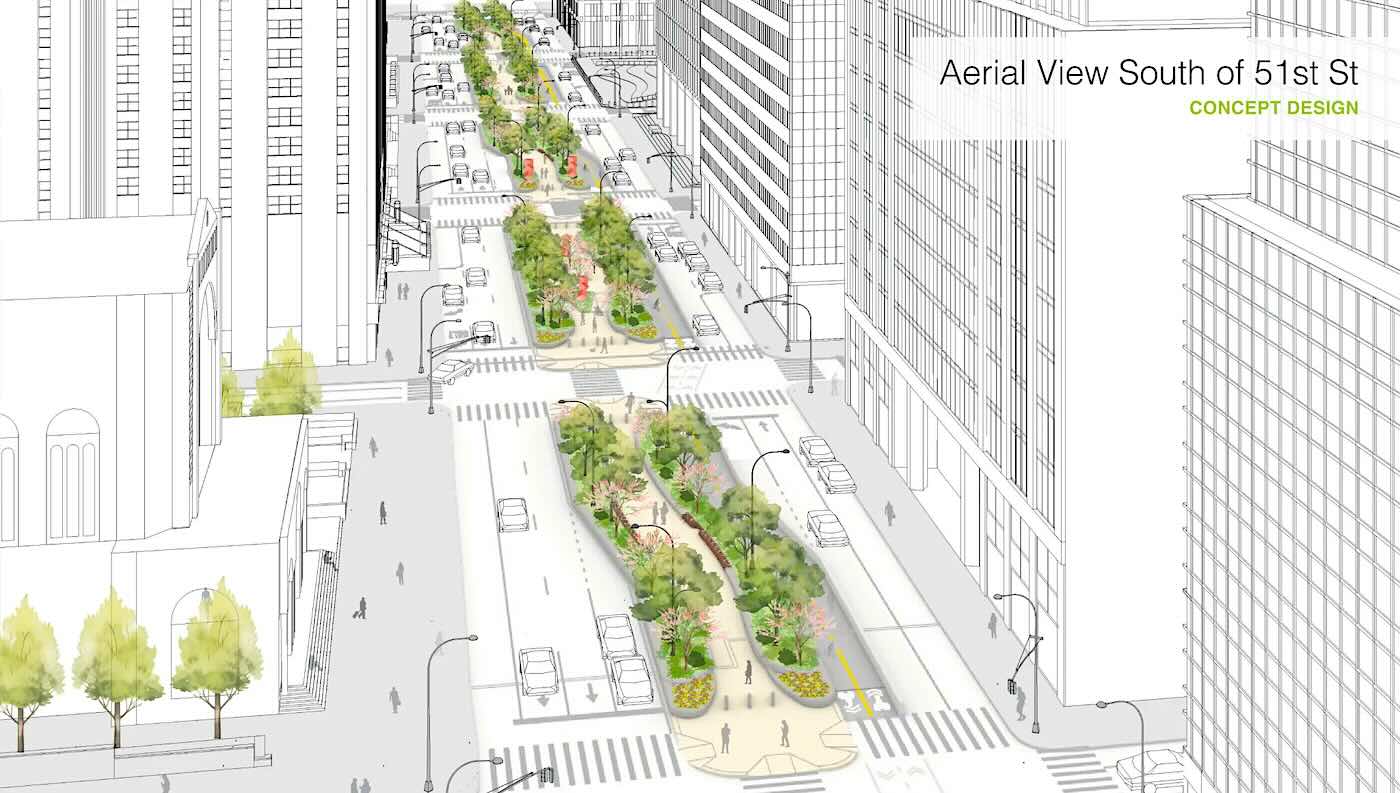
The sweeping redesign addresses a long-held vision for the corridor by shifting its focus away from purely vehicular traffic and toward a more people-centered design. Spanning from 46th Street to 57th Street, the project responds directly to feedback from New Yorkers who have increasingly called for safer streets, expanded bicycle infrastructure, and more accessible public green spaces in the heart of Midtown Manhattan.
Under the newly announced blueprint, the avenue’s wide medians will undergo a dramatic transformation. Underused median space will be converted into vibrant public areas featuring new trees, plants, custom seating, and designated spots for public art. Enhanced crosswalks will stitch the corridor together, making it easier and safer for pedestrians to navigate the bustling stretch.
To accommodate these pedestrian and cyclist upgrades, the street layout itself will be reconfigured. The project will remove one travel lane in each direction. Crucially, an existing southbound vehicle lane will be converted into a brand-new, two-way protected bike lane, closing a significant infrastructure gap and providing a world-class connection for riders traversing East Midtown.
"New Yorkers asked us to make more room for people to walk, bike, and enjoy their city, and we listened," Mayor Mamdani said in a statement announcing the project.
The initiative represents more than just a surface-level cosmetic upgrade; it is timed to coincide with a massive, foundational infrastructure project happening right beneath the pavement. The 11-block project area sits directly above the historic Grand Central Terminal train shed, which is currently undergoing a major capital rehabilitation effort led by Metro-North Railroad and the Metropolitan Transportation Authority (MTA).
As the MTA works deep underground to replace aging infrastructure and waterproof the century-old structure, city planners recognized a rare and valuable opportunity to align these heavy engineering investments with a forward-thinking vision for surface-level public space.
NYC DOT Commissioner Mike Flynn emphasized the strategic importance of the design, noting that it turns forgotten pavement into community assets while establishing a vital cycling corridor. "This final design converts underused median space into vibrant public space while incorporating a dedicated, world-class bike connection that lays the foundation for future bike network upgrades in East Midtown," Flynn explained.
Federal and local leaders have also rallied behind the initiative, pointing to the growing demand for sustainable and active transportation options in dense urban centers.
"As more people turn to biking and walking as cleaner, more effective modes of transportation, we must continue updating our infrastructure to keep our riders and pedestrians safe," said Congressman Jerrold Nadler. "I’m grateful to Mayor Mamdani and Commissioner Flynn for advancing this ambitious reimagining of one of Manhattan’s most iconic thoroughfares, and I look forward to seeing work get underway."
The partnership between the city and the transit authority highlights a collaborative approach to urban renewal, breathing new life into a transportation hub that has fueled Manhattan’s economic growth for generations.
"The reconstruction of the Grand Central Train Shed is part of the MTA’s commitment to modernize the infrastructure that keeps New Yorkers moving," said MTA Construction and Development President Jamie Torres-Springer. "This century-old structure made it possible for Midtown to grow into one of the world’s most important business districts—and now, as we rebuild it, we’re thrilled to partner with the city to deliver a greener, more vibrant public space."
With community backing, coordinated agency efforts, and a design that nods to the avenue’s historic roots, the reimagined Park Avenue is set to bridge New York City’s past with its sustainable future, offering residents and visitors a greener, safer, and more welcoming urban experience in the heart of Manhattan.