
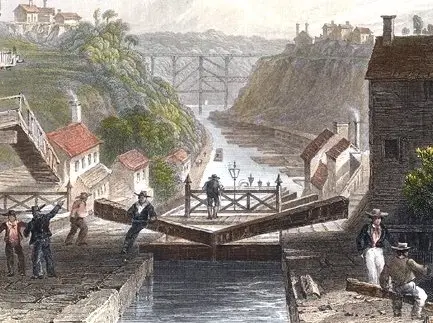
The Engineering Feat That Transformed America: The Erie Canal
Exactly 201 years ago, the Erie Canal officially opened, forging a vital navigable passageway from New York to the Great Lakes. Conceptualized to establish an uninterrupted water route from the Atlantic Ocean to the Midwestern United States, the massive infrastructure project took eight years to complete. Engineers and laborers constructed 36 locks to successfully navigate a total elevation differential of approximately 565 feet, or 172 meters.
At a historical juncture when transportation relied heavily on pack animals, and long before the widespread adoption of steamships or railways, water emerged as a remarkably cost-effective shipping method. This artificial waterway fundamentally transformed the economic and geographic landscape of the Great Lakes Region.
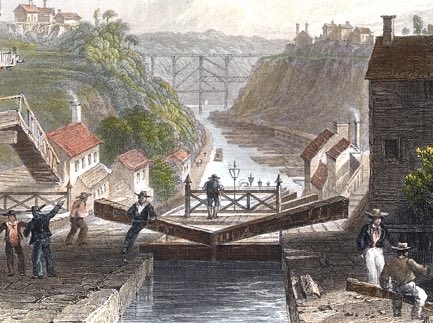
At the time of its completion, the 363-mile, or 584-kilometer, canal stood as the second-longest in the world, surpassed only by the Grand Canal in China. Commercial traffic on the canal reached its zenith in 1855, recording an astounding 33,000 commercial shipments in a single year. The waterway maintained its competitive edge against burgeoning railroads until roughly 1902, when tolls were officially abolished.
However, commercial traffic experienced a heavy decline during the latter half of the 20th century. The rise of competitive trucking, facilitated by the newly developed Interstate Highway System, alongside the 1959 opening of the larger St. Lawrence Seaway, drew cargo away from the historic route. The canal’s last regularly scheduled commercial hauler, the Day Peckinpaugh, officially ended its service in 1994.
In the modern era, the Erie Canal serves a different purpose, utilized primarily by recreational watercraft. Some long-distance boaters navigate the historic Erie as part of the Great Loop, a continuous, navigable circuit of the Eastern United States that incorporates the Mississippi River, the Gulf of Mexico, the Atlantic Ocean, the Great Lakes, and their associated canals.

A Landmark Vote in British Parliament
In another political milestone, 27 years ago marked the day Britain’s House of Lords voted to end the age-old right of hereditary peers to sit and vote in the upper chamber of Parliament. For centuries, the House of Lords had included several hundred members who automatically inherited their legislative seats by birthright. The House of Lords Act of 1999 brought a decisive end to that practice.
The reform was spearheaded by the Labour Party, led by Tony Blair, after securing a landslide victory in the 1997 general election. Campaigning heavily on modernizing the legislature, the party promised that the right of hereditary peers to participate in the lawmaking process would be terminated by statute. This legislative overhaul ultimately reduced the sprawling membership of the House from 1,330 to 669, marking a historic shift in the structure of British governance.
The Final Chapter of Smallpox
Global health history also marks a monumental anniversary: 49 years since the last known natural case of smallpox was uncovered in Somalia. The containment and treatment of this final case signified the ultimate eradication of the disease and brought a successful, triumphant end to an unprecedented global vaccination campaign.

English physician Edward Jenner had discovered the protective vaccine 180 years prior, yet as late as 1958, two million people were still dying from smallpox annually. Supported by vaccine supplies from both the Soviet Union and the United States, the World Health Organization undertook an ambitious global initiative to wipe out the disease, which was notorious for causing severe blistering, blindness, and permanent physical deformity.
An international effort led across the Horn of Africa crossed the finish line when it successfully cured Ali Maow Maalin, a Somali hospital cook and health worker who became the last person in the world known to be infected with naturally occurring Variola minor smallpox. Diagnosed in October 1977 with a disease historically feared as "The Greatest Killer," Maalin made a full recovery. Deeply grateful that his friends and colleagues had been spared, he dedicated much of his life to public health advocacy. He tragically passed away in 2013 from malaria while carrying out polio vaccinations during a regional resurgence of that virus.
Cultural Milestones: Birthdays of Icons in Music, Film, and Literature
This date also marks the birthdays of several influential figures across the arts.

Musician William Collins, universally recognized by his immortal moniker "Bootsy," celebrates his 75th birthday. A legendary bass guitar virtuoso, Collins honed his skills early by playing in a band alongside his older brother Phelps as part of The Pacemakers, the backup band for James Brown. Bootsy famously recalled those formative years under Brown’s tutelage, noting how the soul legend served as a vital father figure who demanded absolute rhythmic precision.
Moving beyond his early soul roots, Collins joined George Clinton’s legendary musical collective, lending his unmistakable bass playing, songwriting, and vocal talents to some of the most influential P-Funk albums ever recorded for Parliament and Funkadelic. Amid the flamboyant culture of the P-Funk era, Collins developed a series of colorful alter egos. What began as a persona of a bass player from a deep-space radio collective called "The Mothership Connection" out of "The Chocolate Nebula" evolved over the decades. By the 1980s, Collins embraced identities such as Casper the Holy Ghost and the action-figure-inspired "Bootzilla," famously styled as the "world’s only rhinestone rockstar monster of a doll."
Actor Cary Elwes celebrates his 64th birthday. The British actor is forever immortalized in cinematic history for his charming portrayal of the stable-hand-turned-swashbuckler Westley in the beloved 1987 film The Princess Bride. Although the film achieved only modest success at the box office upon its initial release, it gradually blossomed into an enduring cult classic, widely regarded by critics and rating agencies as a near-perfect cinematic fairy tale.

Reflecting on the film’s unique trajectory during a 2001 DVD release interview, Elwes noted that the studio initially struggled with how to market the picture, questioning whether it was an adventure, a fantasy, a comedy, a romance, or a children’s movie. Ultimately marketed primarily as a children’s film, it relied heavily on word-of-mouth recommendations, leading generations of fans to pass down their cherished VHS copies to their children.
Notably, Elwes is a direct descendant of John Elwes, a famous 18th-century British Member of Parliament whose famously frugal lifestyle inspired Charles Dickens’s iconic character Ebenezer Scrooge in the 1843 novella A Christmas Carol. Embracing this literary connection, Elwes later lent his voice to five distinct roles in the 2009 animated film adaptation of the classic holiday story.
Actress, singer, songwriter, and producer Rita Wilson marks her 70th birthday. Born Margarita Ibrahimoff, Wilson has built an impressive career on both stage and screen. Her extensive film credits include memorable performances in Sleepless in Seattle, Now and Then, That Thing You Do! (directed by her husband, Tom Hanks), Jingle All the Way, Runaway Bride, It’s Complicated, and Larry Crowne, alongside television appearances in acclaimed series such as The Good Wife.

Beyond her film work, Wilson has performed on Broadway and established herself as a prolific producer, notably backing the blockbuster independent comedy My Big Fat Greek Wedding. As a recording artist, she has released multiple studio albums and EPs, including her 2021 project Trilogy III. In April 2015, Wilson publicly announced her diagnosis with breast cancer, subsequently undergoing a double mastectomy and reconstructive surgery. Demonstrating immense resilience, she returned to the stage just one month later to star in Larry David’s Broadway production Fish in the Dark.
Finally, the cultural landscape recognizes the 56th anniversary of the debut of the groundbreaking comic strip Doonesbury. Created by cartoonist Garry Trudeau while he was a student at Yale University, the strip initially premiered in 28 newspapers, introducing readers to a cast of college characters including Mike Doonesbury and BD.
Chronicling the lives of its characters as they aged from college students into senior citizens, the strip blended sharp social observation with political satire, eventually featuring caricatures of numerous U.S. Presidents. In 1975, Doonesbury made history by becoming the first daily newspaper comic strip to win a Pulitzer Prize for Editorial Cartooning. The strip’s distinctive title was coined by combining "doone"—prep school slang for a clueless or careless individual—with the surname of Charles Pillsbury, Trudeau’s college roommate. To commemorate its 50th anniversary, publishers released a deluxe multimedia retrospective set titled Dbury@50, offering fans comprehensive digital archives, historical trivia, and commemorative artwork celebrating half a century of the iconic American comic strip.