

This rapid expansion, however, has triggered widespread anxiety among everyday investors. A pressing question dominating financial discussions centers on whether this environment reflects genuine economic strength, an artificial bubble, or a temporary financial illusion fueled heavily by the recent hype surrounding artificial intelligence.

To evaluate the vulnerability of the current market and understand its potential impact on long-term retirement security, financial analysts often return to the foundational mechanics of what a stock actually represents: a corporate enterprise operating much like a rental property.
Ownership of a rental house entitles the landlord to collect rent, cover related expenses, and retain the remaining profit. If local real estate prices skyrocket while tenant rents remain flat, the higher valuation looks impressive on paper, but it yields no immediate cash benefit unless the property is sold—at which point the owner must typically purchase another similarly inflated asset. Personal income generated by the rental business remains unchanged unless the owner actively improves profitability by adding square footage, executing renovations, or streamlining operational costs.

When that property eventually changes hands, the purchase price should theoretically reflect that future income stream. A property generating $24,000 annually sold for $240,000 carries a price-to-earnings ratio of 10. Persuading a buyer to pay $480,000 for that same income stream doubles the price-to-earnings ratio to 20, favoring the seller while significantly dampening the long-term return prospects for the incoming buyer.
A strikingly similar dynamic applies to the broader stock market. An investment of $100,000 made in 2019 with reinvested dividends would have grown to approximately $256,960 today, representing a 157 percent gain on the original principal. Over that exact same timeframe, however, the underlying share of company earnings generated by that basket of stocks has risen from $5,290 to $7,540, a much more modest 42 percent increase. Consequently, the overall price-to-earnings ratio of the market has expanded from roughly 20 to approximately 30.

Current stock investors find themselves in the position of landlords watching property values double while rental income inches upward. While ownership remains fundamentally profitable, basic financial mathematics dictates that future returns purchased at today’s elevated price-to-earnings ratios will inherently be lower than earnings acquired during market downturns.
The Role of Rising Earnings and the Magnificent Seven
Higher market valuations can be justified if corporate earnings are projected to accelerate dramatically. For instance, a real estate investor might willingly pay an inflated price for a rental property if an upcoming corporate campus development guarantees a surge in local rental demand. Individual stocks frequently experience similar price expansions when specific positive catalysts emerge, such as the temporary surge in demand for home exercise equipment during pandemic lockdowns—a trend that eventually normalized as consumer habits returned to baseline levels.
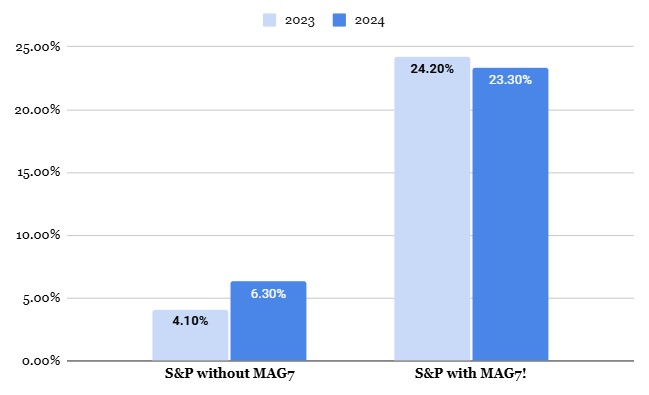
When an entire market index climbs uniformly, however, it raises questions about whether the broader economy is slated for unprecedented expansion. A closer examination of the S&P 500 reveals a stark concentration of growth: approximately three-quarters of the recent market gains originated from just seven dominant technology corporations, widely referred to as the "Magnificent Seven," which include Apple, Nvidia, Microsoft, Amazon, Alphabet, Meta, and Tesla.
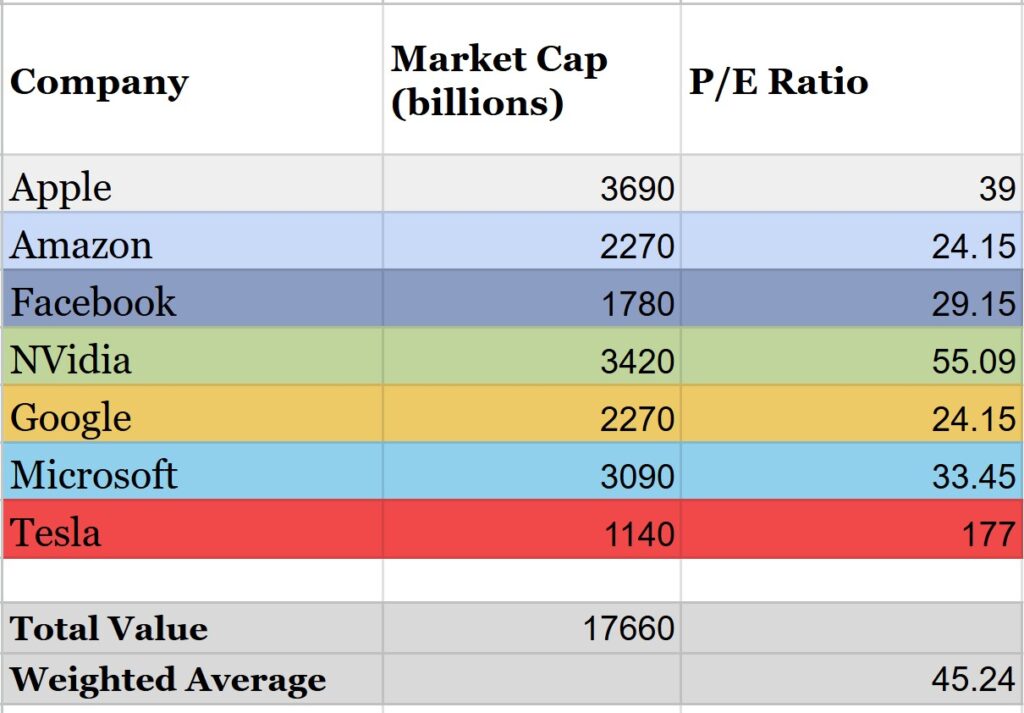
These high-profile technology firms command a collective market value exceeding $17 trillion, representing over 25 percent of the entire market. Their weighted average price-to-earnings ratio sits near 45, far outpacing the rest of the market. Excluding these seven companies leaves the remaining 493 firms with a more moderate, though still elevated, price-to-earnings ratio of approximately 20. This divergence indicates that while the broader U.S. economy is anticipated to remain steady, market participants are pricing in exceptionally rapid growth specifically for the nation’s largest technology enterprises.
Artificial Intelligence and the Infrastructure Boom
At the heart of the recent mega-cap tech surge lies the rapid evolution of artificial intelligence. Recent breakthroughs have demonstrated software capable of sophisticated reasoning across an expanding array of disciplines, igniting widespread enthusiasm across the corporate sector.
Six of the Magnificent Seven companies are channeling hundreds of billions of dollars into constructing massive data centers housing advanced supercomputers. Meanwhile, Nvidia benefits directly from this capital expenditure by supplying the specialized hardware required to drive the AI revolution, commanding substantial pricing power amidst unrelenting global demand.

Beyond foundational infrastructure, industries across the commercial spectrum anticipate a new era of productivity gains. Modern AI systems can analyze extensive legal documents, write and debug software code, autonomously pilot vehicles, identify medical anomalies from imagery, accelerate pharmaceutical discovery, and power emerging humanoid robotics. Proponents argue that humanity is approaching a milestone where an effectively infinite workforce of intelligent systems could alleviate traditional constraints imposed by finite human labor and cognitive capacity.
While the long-term realization of these technological advancements appears probable to many industry observers, significant uncertainties remain regarding corporate execution. Potential pitfalls include severe cost overruns, intensifying market competition, and unexpected regulatory or operational hurdles as companies attempt to commercialize complex software systems on a global scale.
Long-Term Economic Realities and Valuation Comparisons
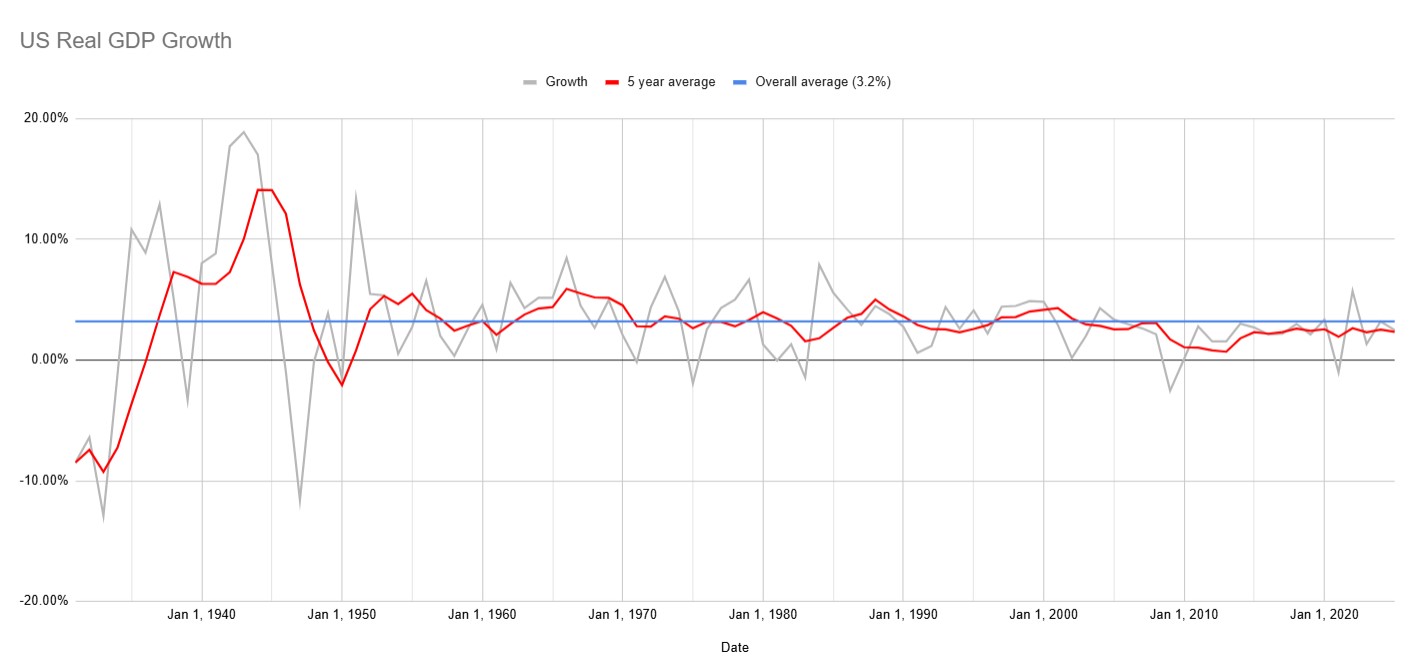
Historically, U.S. economic growth has maintained a remarkably consistent trajectory, averaging approximately three percent annually after accounting for inflation over successive decades. Interestingly, economic growth during recent decades has actually trended slightly below this historical average, providing further context regarding current market valuations.
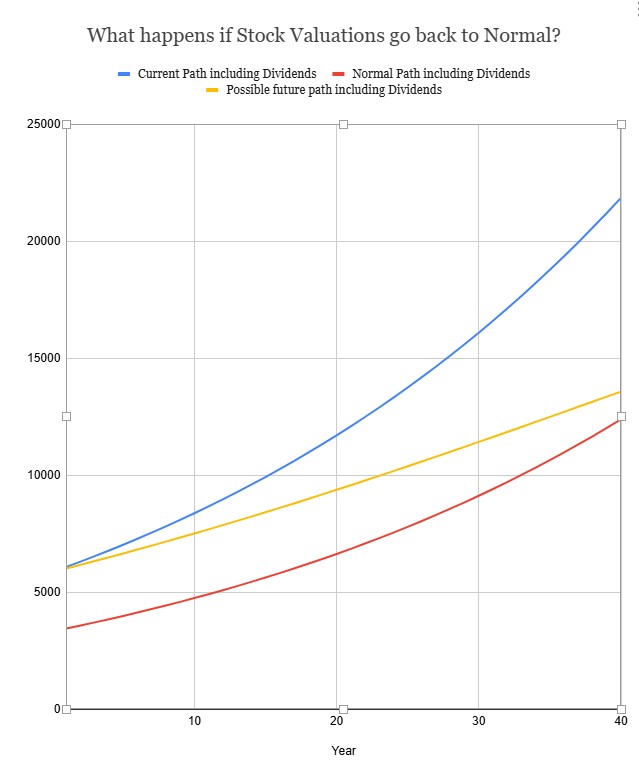
While market corrections, manias, and panics remain inevitable features of financial history, attempting to time these cycles by liquidating portfolios to buy back in at lower prices historically proves detrimental to long-term wealth accumulation. Even if stock valuations eventually compress toward historical averages, corporate earnings are expected to expand in tandem with economic growth, preserving long-term purchasing power for patient investors.
Broader asset allocation models provide alternative perspectives on global valuation disparities. Institutional forecasters, including Vanguard, have projected that international equities and fixed-income assets could outperform U.S. stocks over the coming decade. This outlook is supported by valuation metrics such as the price-to-earnings ratio for broad international indexes, which hovers near 16, presenting a significant valuation discount compared to U.S. markets. Despite these projections, U.S. equities have continued to outperform, largely propelled by the domestic concentration of AI-driven technological innovation.
Other investment vehicles, such as multi-asset robo-advisor portfolios, balance exposure across domestic equities, international markets, and bonds to moderate portfolio volatility, maintaining blended price-to-earnings ratios near 22. Meanwhile, conservative capital allocators like Berkshire Hathaway have signaled caution, accumulating substantial cash reserves while avoiding aggressive share repurchases in light of prevailing market valuations.

For individual property owners, rising interest rates have also altered the traditional calculus between maintaining a mortgage and directing surplus cash into equity markets. While historical data favors maintaining low-rate mortgages and investing the differential, current interest rate environments make debt reduction an increasingly attractive alternative for risk-conscious households prioritizing financial peace of mind.
Ultimately, long-term market participation requires adherence to fundamental principles: maintaining consistent investment habits, tuning out daily market volatility, and focusing on long-term financial security.