
For those who have tuned out the financial news cycle to focus on daily life, the underlying narrative may seem distant. But the broad strokes of the current AI story are familiar to anyone tracking modern technology and markets: rapid advancements in machine intelligence, massive capital expenditures by major tech firms, and a polarized debate over whether the technology represents a genuine industrial revolution or an over-hyped financial bubble.

Skeptics and cautious investors worry that while AI is undoubtedly a major invention, the financial mania surrounding it is moving too fast and reaching unsustainable valuations. Many fear a replay of the dot-com crash of the early 2000s—a historical boom that served as a catalyst for early internet careers before the ensuing market correction threatened jobs and financial stability. As financial commentators and long-term retirees field increasing questions about the current investment cycle, these historical parallels continue to drive public anxiety. Recently, veteran financial commentators have taken to public speaking circuits, addressing audiences at financial independence events like Camp FI Midwest and preparing discussions for upcoming gatherings such as the Bogleheads conference, aiming to provide perspective on how modern market hysteria matches up against historical precedents.
Will the AI Bubble Ruin Our Retirement?
Achieving long-term financial independence and spending over two decades in retirement brings a certain level of comfort with market volatility. Yet, conversations with peers often reveal a stark contrast in perspectives. Friends and retirement planners frequently voice deep anxieties, asking how anyone can remain comfortable and sleep at night given the state of the modern world.

A standard catalog of contemporary anxieties includes geopolitical instability driven by prominent political figures, persistent inflation eroding purchasing power, the looming shadow of the AI bubble, rising national debt figures, and simmering international conflicts that threaten global stability. Interestingly, these categories of worry are remarkably consistent across decades. Looking back twenty years to 2006, investors and the general public were wrestling with a nearly identical list of existential concerns: controversial global leaders, military conflicts in the Middle East, escalating national debt, and inflation.
At that time, however, the overvalued stock market was attributed to a massive housing bubble rather than an artificial intelligence boom, and public anxiety over employment centered on the outsourcing of jobs overseas rather than automation. There were even fierce debates over "Peak Oil," with many predicting that increasing fossil fuel consumption combined with dwindling supplies would spell doom for modern civilization.

Yet, looking at how the past two decades unfolded provides valuable context. Despite the arrival of the Great Financial Crisis—a severe economic downturn sparked by housing market exuberance and complex financial leverage that represented the largest crash since the Great Depression—broad market indexes continued their upward trajectory over the long term. A hypothetical $100,000 investment made during those turbulent years would have grown substantially by modern measures, easily absorbing subsequent market disruptions such as the 2020 pandemic-related downturn.
Simultaneously, broader global indicators improved dramatically over the same twenty-year period. The proportion of the global population living in extreme poverty dropped significantly, infant mortality rates were cut in half, and clean energy alternatives expanded rapidly. Solar power generation saw dramatic cost reductions, transforming solar technology into a primary source of new energy capacity, while pure electric vehicles surged from negligible market share to meaningful global adoption.

Examining this historical trajectory raises a fundamental question about human psychology: whether energy is better spent worrying about an uncertain future or maintaining an optimistic, resilient outlook. As modern markets confront the possibility of the AI bubble, questions linger over whether current challenges—such as towering national debt or the rapid rise of machine intelligence—fundamentally change the economic landscape. Financial media outlets frequently amplify these fears, but they often overlook a foundational economic principle: true prosperity does not originate from the abstract numbers of the financial system or the stock market, but rather from human productivity.
Productivity as the Foundation of Prosperity
The underlying mechanics of capitalism are inherently volatile, prone to sharp swings and sudden corrections. However, beneath the surface of the financial markets, real people continue to perform real work, invent new tools, and drive tangible progress. The concept of an economy or a financial system is ultimately a human invention. If a financial system experiences severe corrections because market participants lose confidence in prevailing valuations, economic systems have historically demonstrated an ability to restructure, adapt, and move forward.

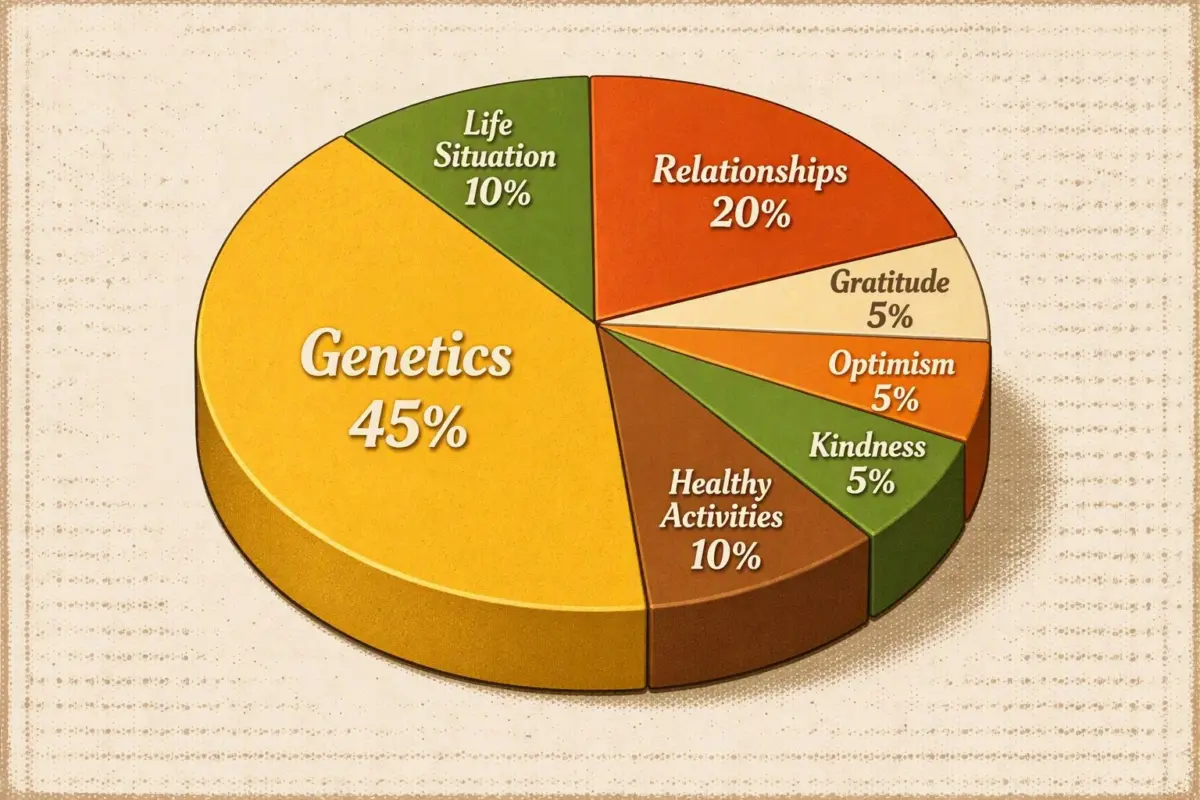
Standard living conditions, economic growth, and the viability of long-term retirement planning are fundamentally tethered to productivity gains. Throughout modern history, productivity has consistently outpaced short-term market turbulence. Once societies achieve a baseline standard of living that fulfills basic physical and economic requirements, happiness and life satisfaction depend far more on personal choices, close human relationships, lifelong optimism, and physical well-being than on marginal shifts in net worth.
Despite these historical realities, background anxiety remains a persistent feature of the human experience. Psychologically, humans function largely as danger-detection machines, an evolutionary trait designed to protect against threats in the natural world. When immediate physical dangers are resolved through technological and societal advancement, the human mind often adapts by shifting its focus to abstract worries—moving from basic survival and food security to social standing, financial comparison, tax strategies, and even minute lifestyle regulations.

Combatting this pervasive fear requires self-awareness and a recognition that much of modern anxiety stems from evolutionary programming and personal history rather than an objective assessment of present risks. Childhood experiences, family attitudes toward scarcity, and past trauma often shape financial fears in adulthood. By identifying the specific nature of these fears and evaluating worst-case scenarios rationally, individuals can better manage their emotional responses. Taking proactive steps—such as reducing exposure to sensationalized daily news cycles, focusing on positive behaviors, engaging in physical activity, and surrounding oneself with optimistic, productive peers—helps ground individuals in reality rather than speculation.
Treating Technological Shifts as Experiments
Adopting an experimental mindset toward new developments can fundamentally alter how individuals perceive modern disruptions. Whether applied to minor lifestyle changes or major decisions such as changing careers or entering early retirement, viewing life circumstances as ongoing experiments reduces the paralyzing impact of fear.

This philosophy applies directly to the current expansion of Artificial Intelligence. Rather than succumbing to doomsday narratives, framing the AI era as a vast technological and economic experiment reveals a landscape rich with potential. Viewed through the lens of economics and technology, AI functions essentially as a sophisticated cognitive tool designed to amplify human efficiency.
Like previous technological revolutions, AI will inevitably boost productivity and economic prosperity while simultaneously displacing certain entry-level administrative, technical, and logistical roles. Historically, technological advancements have consistently disrupted existing labor markets while simultaneously creating entirely new industries, much like the widespread adoption of the internet and mobile computing decades prior. While the economic rewards of these transitions often concentrate among enterprise owners and equity shareholders, the broader technology itself remains an open-ended tool.

Ultimately, artificial intelligence represents another choice point for society—an opportunity to embrace learning, adaptability, and proactive engagement rather than fear-driven avoidance. By addressing the root causes of anxiety and focusing on resilience, individuals can navigate market cycles and technological revolutions with confidence, keeping sight of the fundamental truth that lasting fulfillment lies just beyond the horizon of fear.