

For those detached from daily financial news cycles, the current AI phenomenon rests on a few core pillars: rapid technological advancement, massive capital expenditure by major tech conglomerates, and sky-high expectations for future commercial disruption. Yet, widespread market worry persists. Investors fear that while AI is undoubtedly a transformative invention, the speculative mania surrounding it is moving too fast and reaching too high. Many predict a recurrence—albeit on a much larger scale—of the dot-com crash of the early 2000s, a historical market event that shaped the early career paths of many modern financial commentators before threatening subsequent stability.

Addressing these cyclical anxieties has become a central focus for veteran financial educators and long-term retirees. Recent presentations at gatherings such as Camp FI Midwest and upcoming discussions at the Bogleheads conference highlight a pressing question among the public: Will the current AI bubble ruin retirement plans, or is it merely the latest incarnation of historical panic?
The Evolution of Market Worries: Looking Back Twenty Years
Reflecting on decades of retirement offers a unique perspective on financial anxiety. Conversations with worried peers often reveal a recurring theme: the persistent fear that global events, economic instability, or overvalued markets will instantly unravel a lifetime of careful saving.

A retrospective look at the financial landscape of 2006 reveals a strikingly similar climate of fear. Two decades ago, observers wrestled with geopolitical tensions involving prominent leaders, ongoing conflicts in the Middle East, soaring national debt, and rising inflation. At that time, the primary catalyst for stock market anxiety was not an artificial intelligence boom, but a dangerously overvalued housing market driven by speculative real estate enthusiasm and complex financial leverage. Furthermore, widespread public concern focused heavily on economic outsourcing to emerging global markets like India and China, alongside urgent debates regarding "Peak Oil" and the impending depletion of fossil fuels.
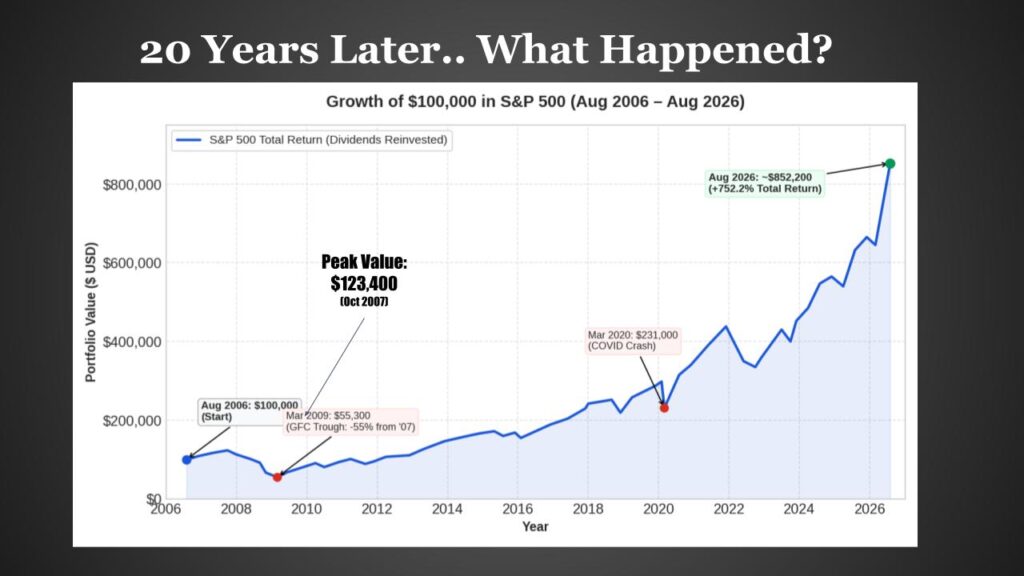
Despite the severe economic turbulence that followed—most notably the Great Financial Crisis of 2008, which triggered the deepest market contraction since the Great Depression—broad market indices demonstrated remarkable resilience over the subsequent twenty years. Even factoring in subsequent shocks, such as the pandemic-induced market drop of 2020, historical data shows that disciplined, long-term investments experienced substantial growth over the long haul.

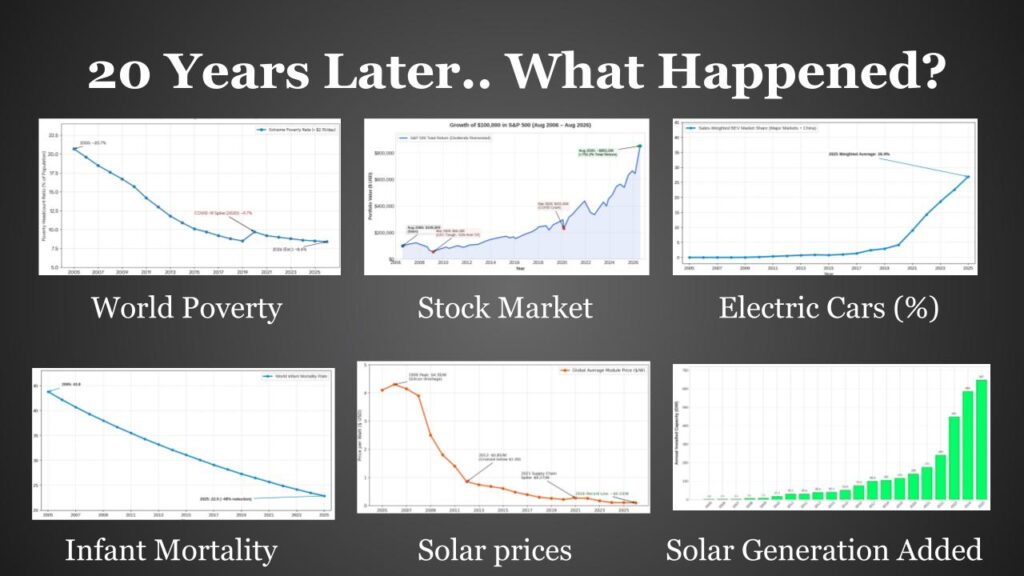
Concurrently, global socioeconomic indicators registered remarkable improvements. Over a twenty-year span, the global proportion of people living in extreme poverty declined significantly, while childhood mortality rates were cut in half. Technological shifts materialized in unexpected ways; rather than facing energy scarcity, the world witnessed a dramatic expansion in renewable energy, with solar panel costs plummeting and solar power generation surging globally. Simultaneously, electric vehicle adoption transitioned from a theoretical concept into a major automotive market share.
This historical context challenges the utility of chronic financial worrying. Rather than succumbing to doomsday predictions, analysts emphasize that genuine economic prosperity originates from productivity rather than temporary fluctuations in financial systems or stock market valuations.

Prosperity, Productivity, and the Roots of Human Happiness
The underlying mechanics of modern capitalism are inherently volatile, prone to sharp cycles of expansion and contraction. However, beneath short-term market movements lie tangible human efforts, practical work, and genuine technological inventions. Economic and financial systems are ultimately human constructs; if a system experiences severe disruption, historical precedent demonstrates that societies adapt, restructure, and resume productive activity.
Sustainable standards of living, economic growth, and the feasibility of early retirement are fundamentally anchored in productivity gains. Yet, financial prosperity represents only one dimension of overall human well-being. Beyond basic material security, psychological research indicates that happiness plateaus once fundamental standards of living are met. In developed nations, baseline requirements were surpassed decades ago, shifting the primary determinants of human fulfillment toward non-financial factors.

Behavioral studies suggest that overall life satisfaction is largely influenced by personal choices, psychological resilience, and social connectedness. Cultivating strong personal relationships, practicing gratitude, maintaining an optimistic outlook, and engaging in regular physical activity outdoors play a far greater role in day-to-day happiness than portfolio balances or short-term market movements.
Despite these principles, financial anxiety remains widespread, largely driven by the human brain’s evolutionary function as a danger-detection mechanism. Human psychology is conditioned to scan the environment for threats. Once immediate physical dangers, such as scarcity or disease, are successfully mitigated, psychological focus tends to shift toward abstract concerns—ranging from social integration and economic standing to complex tax strategies, required minimum distributions, and future uncertainties.
Confronting Fear and Treating AI as an Experiment
Combating persistent financial fear requires conscious self-awareness and rational evaluation. Examining personal history often reveals the root causes of scarcity mindsets or anxiety regarding money, which frequently trace back to childhood experiences or familial backgrounds shaped by historical economic hardships. Identifying specific fears and evaluating realistic worst-case scenarios helps strip abstract anxieties of their perceived power.
Taking proactive measures remains one of the most effective antidotes to fear. Direct engagement with unfamiliar concepts transforms uncertainty into familiarity, fostering resilience and adaptability. Moreover, curating information diets by reducing exposure to sensationalized daily news media helps mitigate unnecessary psychological distress. Shifting focus away from speculative fear-mongering toward positive behaviors, continuous learning, and supportive social communities fosters a more constructive outlook on the future.
This perspective applies directly to the current artificial intelligence landscape. Rather than viewing AI through the lens of catastrophic doom-scrolling, observers can approach the technology as a large-scale socioeconomic experiment. While technological shifts inevitably bring uncertainty, they also offer profound potential upside.
AI functions fundamentally as a powerful cognitive tool capable of dramatically enhancing efficiency and productivity. Just as historical innovations—such as the advent of the internet and the proliferation of smartphones—displaced certain traditional job roles while simultaneously spawning entirely new industries and economic sectors, artificial intelligence is reshaping modern labor markets. Entry-level administrative, financial, and technical roles face immediate disruption, yet these efficiency gains ultimately drive down service costs and foster unexpected economic growth.

Ultimately, technological transitions like Artificial Intelligence present individuals with choices. By reframing systemic shifts as opportunities for learning, action, and adaptation, investors can navigate market volatility with confidence, ensuring that fear does not dictate their financial future or their overall quality of life.