
For those who have tuned out the financial news cycle, the basic narrative of the artificial intelligence boom is straightforward. Investors and technologists are pouring immense capital into AI infrastructure, applications, and hardware, convinced that the technology will fundamentally reshape global commerce. However, this rapid acceleration has triggered anxiety among market observers who fear the mania is moving too fast and too far. Many warn of a repeat of the dot-com crash of the early 2000s—an era that initially supercharged early careers and paved the way for early retirement, only to culminate in a severe market correction that threatened jobs and financial security.
As questions mount regarding this current investment cycle, long-time financial commentators and early retirement advocates are finding themselves addressing the same anxieties they have navigated for decades. Discussions surrounding these market dynamics recently took center stage at events like Camp FI Midwest, with further presentations planned for the upcoming Bogleheads conference. While financial markets experience predictable turbulence, examining historical cycles offers valuable perspective on whether current market anxieties are genuinely justified or simply a manifestation of recurring human fears.

Will the AI Bubble Ruin Our Retirement?
Hitting milestones such as two decades of retirement brings a certain level of comfort with market fluctuations, yet questions from concerned peers remain persistent. Conversations with friends and fellow investors often center on how anyone can remain retired and sleep soundly given the state of the world. A comprehensive list of contemporary worries usually includes polarizing politicians, persistent inflation, the AI bubble, soaring national debt, and geopolitical conflicts that threaten global stability.

Yet, a look back two decades reveals a striking parallel. In 2006, investors were grappling with an entirely different set of perceived existential threats. Back then, public discourse focused on political leaders of the era, conflicts in the Middle East, national debt, and inflation. The overvalued stock market of the mid-2000s was fueled by a dangerous housing bubble rather than an artificial intelligence boom, and anxieties about labor displacement centered on outsourcing to emerging markets rather than automated software. There were even intense debates regarding peak oil, with widespread fears that growing fossil fuel consumption would inevitably outstrip dwindling global supplies.
Despite the profound anxieties of 2006, the subsequent decades revealed a different trajectory. The eventual arrival of the Great Financial Crisis—driven by irrational exuberance in housing prices and excessive financial leverage—triggered the most severe economic downturn since the Great Depression. Yet, when viewed across a long-term horizon, even that historic crisis appears as a temporary dip within a broader pattern of economic growth. A hypothetical investment of one hundred thousand dollars made during that era would have grown significantly over the following twenty years, absorbing subsequent shocks such as the pandemic-related market correction of 2020.

Beyond financial portfolios, broader global indicators demonstrated substantial progress over the same twenty-year timeframe. The global proportion of people living in extreme poverty dropped markedly, while infant mortality rates were cut in half. Clean energy adoption surged, driven by a dramatic reduction in the cost of solar panels, making solar generation a dominant source of new capacity. Concurrently, the adoption of electric vehicles shifted from a theoretical concept to a substantial share of global automotive sales.
The Core of Prosperity and the Trap of Fear

Financial media thrives on cultivating alarming narratives about impending economic doom, frequently overlooking a foundational economic truth: true prosperity does not originate from the financial system or the stock market, which ultimately represent numerical abstractions tracked on computers. Instead, sustainable prosperity is fundamentally derived from productivity.
Capitalism is inherently volatile, characterized by choppy waters and wild swings. However, beneath the surface waves, real people continue to perform tangible work and develop practical inventions. The concept of an economy is a human construct; if a financial system suffers a systemic shock, society has repeatedly demonstrated the capacity to reset numerical baselines and resume productive labor. Long-term standards of living, economic growth, and the viability of early retirement are all underpinned by high productivity rather than short-term market sentiment.

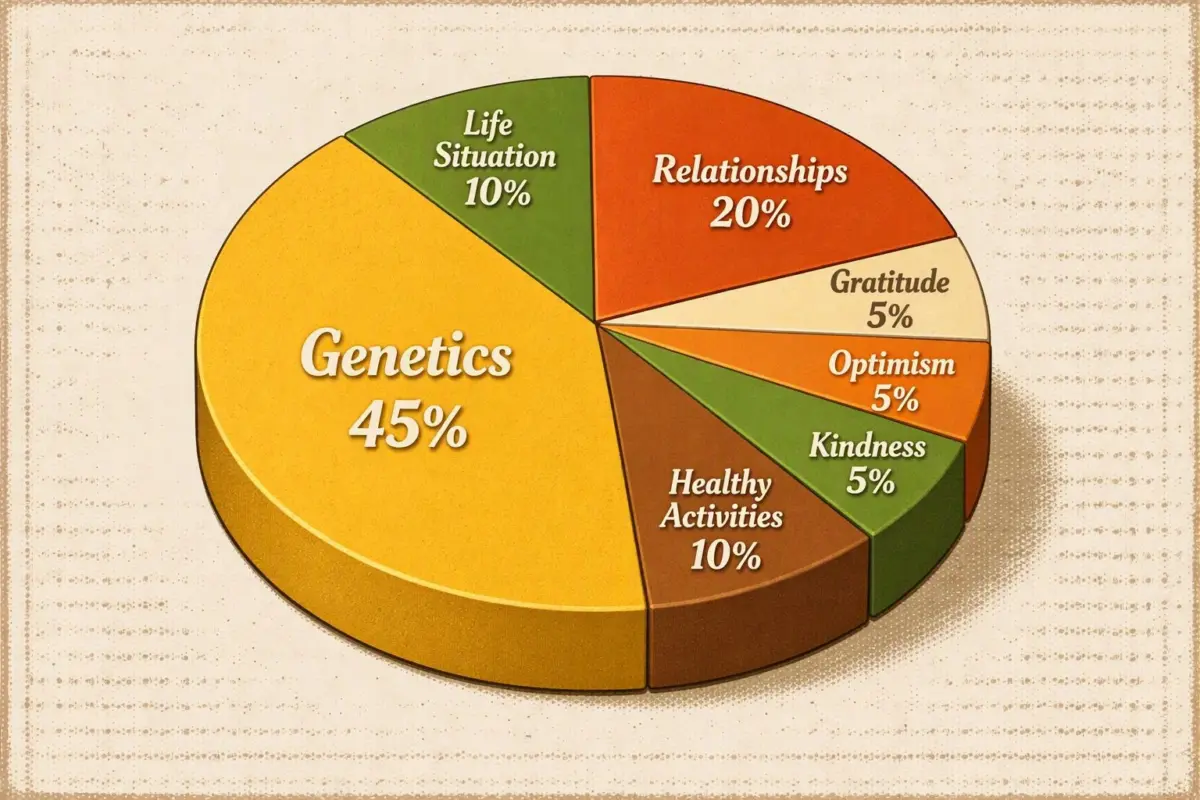
Furthermore, once societies achieve a certain baseline standard of living, human happiness tends to plateau along that specific dimension. In developed nations, those minimum material requirements were surpassed decades ago, shifting the focus of human well-being toward non-financial factors. While genetics plays a substantial role in baseline disposition, controllable choices—such as cultivating positive relationships, practicing gratitude, maintaining an optimistic philosophy, and incorporating outdoor physical activity—far outweigh financial accumulation in determining long-term life satisfaction.
Despite these realities, persistent anxiety remains common even among experienced investors. This persistent background fear is largely an evolutionary trait. Human beings evolved as danger detection machinery designed to protect against immediate threats. When physical dangers such as predators and disease are mitigated, the human brain continues scanning the horizon for new sources of worry, seamlessly moving the goalposts from basic survival to food scarcity, social exclusion, financial security, and eventually hyper-specific concerns like tax strategies and required minimum distributions.

Combating Financial Anxiety Through Action
Countering ingrained fears requires active self-awareness and rational evaluation. Examining personal and family history often reveals the root causes of financial scarcity mindsets or anxiety, which may stem from childhood experiences or the generational trauma of historical events like the Great Depression. Identifying specific fears by playing out worst-case scenarios typically demonstrates that catastrophic outcomes are statistically unlikely.

Action remains one of the most effective antidotes to fear, transforming the unfamiliar into the familiar and fostering resilience. Individuals who develop broad mental, physical, and emotional adaptability find that few external situations remain genuinely terrifying. Additional strategies for managing anxiety include curating one’s mental diet by reducing consumption of sensationalized daily news, focusing on positive behaviors outdoors, and surrounding oneself with optimistic, productive peers rather than fear-mongers.
Approaching life transitions—whether changing careers, moving to a new home, or entering early retirement—as active experiments helps reframe uncertainty from a source of dread into an opportunity for discovery. This experimental mindset applies directly to the current artificial intelligence landscape. Rather than succumbing to doom-scrolling, viewing AI as a powerful cognitive tool helps clarify its dual nature.

Much like previous technological revolutions, artificial intelligence acts as a cognitive nail gun, dramatically boosting efficiency, productivity, and ultimately broader economic prosperity. While this shift inevitably displaces certain entry-level office and administrative roles, historical precedent suggests it will simultaneously lower service costs and catalyze entirely new industries, mirroring the transformative impact of the internet and mobile computing.
While the economic rewards of such technological leaps frequently concentrate among business owners and shareholders, artificial intelligence remains fundamentally another operational tool. Whether it becomes a source of chronic anxiety or a catalyst for lifelong learning and adaptation depends entirely on individual perspective. Ultimately, the challenges of the modern economy suggest that everything desired on a personal level lies just beyond the boundary of fear, waiting for those willing to engage with the future constructively.