

For those entirely tuned out of daily financial market drama, the fundamental narrative of the current AI boom can be summarized quite simply: rapid technological acceleration, massive capital investments in data infrastructure and computational power, and widespread speculation regarding how artificial intelligence will reshape global labor markets. Yet, for investors, the central worry is that while AI is undoubtedly a transformative innovation, the market mania surrounding it is moving too fast and too intensely. This has triggered widespread fears of an economic correction mirroring the dot-com crash of the early 2000s—a historical parallel that holds personal significance for early retirement advocates and internet financial commentators who lived through that era as young professionals.
As questions surrounding this latest investment cycle multiply, financial educators are taking the discussion beyond traditional blog posts and into live speaking engagements, including recent presentations at events like Camp FI Midwest and upcoming appearances at the Bogleheads conference. These discussions address a recurring human phenomenon: the tendency to view contemporary financial booms and stock market valuations through a lens of acute anxiety.

Will the AI Bubble Ruin Our Retirement?
Reaching more than two decades of retirement brings a certain comfort with financial independence, yet it also exposes veterans of the early retirement movement to persistent questions from anxious peers. A common inquiry often centers on how anyone can remain retired and sleep soundly amid global instability, economic volatility, and shifting market cycles.
A glance at nightly news broadcasts or financial headlines reveals a familiar roster of anxieties: geopolitical tensions involving major global leaders, persistent inflation eroding purchasing power, the towering U.S. national debt, active international conflicts, and, of course, the towering specter of the AI bubble. Yet, a historical perspective reveals that these worries are merely modern iterations of anxieties that have plagued investors for decades.

Looking back twenty years to 2006, the worries of the day felt equally existential. At that time, the world fixated on different geopolitical leaders, ongoing conflicts in the Middle East, national debt, and inflation. Back then, investors worried about an overvalued stock market driven by the housing bubble rather than artificial intelligence. Concerns centered not on AI displacing office workers, but on the outsourcing of American jobs to developing economies like India and China. There was even widespread panic over "Peak Oil"—the prevailing theory that global fossil fuel consumption would inevitably outstrip dwindling supplies, leading to economic collapse.
Instead of total destruction, the subsequent two decades delivered the Great Financial Crisis, triggered by lax mortgage lending standards and high financial leverage. It was the most severe economic downturn since the Great Depression. Yet, viewed through the lens of long-term market history, even that monumental crash appears as a temporary dip within a broader upward trajectory. A standard market investment made during those turbulent years would have experienced substantial long-term growth, weathering subsequent shocks like the pandemic-induced market correction of 2020.

Beyond financial markets, the broader global reality over the past twenty years has registered remarkable progress. The proportion of the global population living in extreme poverty dropped significantly, while infant mortality rates were cut in half. Clean energy sectors expanded dramatically as solar panel manufacturing costs plummeted, allowing solar generation to become a dominant source of new global electrical capacity. Simultaneously, electric vehicle adoption surged from a statistical zero to substantial percentages of total worldwide vehicle sales.
This historical contrast raises a fundamental question about human psychology: whether energy is better spent worrying about an uncertain future or maintaining an optimistic, pragmatic outlook. Naturally, this leads to the perennial market question of whether current conditions are fundamentally different. Skeptics point to the expanding U.S. national debt, the unprecedented scale of the AI valuation boom, or theoretical scenarios involving artificial general intelligence spinning out of control. Financial media outlets capitalize on these fears by manufacturing compelling narratives of impending doom.

However, these cautionary narratives often overlook a fundamental economic principle: true prosperity does not originate from financial systems or stock market tickers, which ultimately represent numerical abstractions tracked on computer servers. Real prosperity is rooted entirely in productivity.
Productivity, Prosperity, and Human Happiness
The underlying mechanics of capitalism are inherently choppy, marked by frequent volatility and speculative excesses. Beneath the shifting surface waves, however, real people perform tangible work and develop genuine innovations. Economies and financial systems are human constructs; if a financial system experiences a severe correction due to shifting valuations, society has historically recalibrated the underlying mechanisms and resumed productive activity, just as it did following the 2008 financial crisis and prior economic disruptions.

Every productivity-enhancing tool humanity has ever invented remains intact. Higher productivity directly drives improved standards of living, sustained economic growth, and the feasibility of early retirement. Yet, once a society achieves a certain baseline standard of living, human happiness tends to plateau along that specific financial dimension. Advanced economies surpassed those minimum material requirements decades ago, shifting the primary determinants of overall life satisfaction toward non-financial factors.
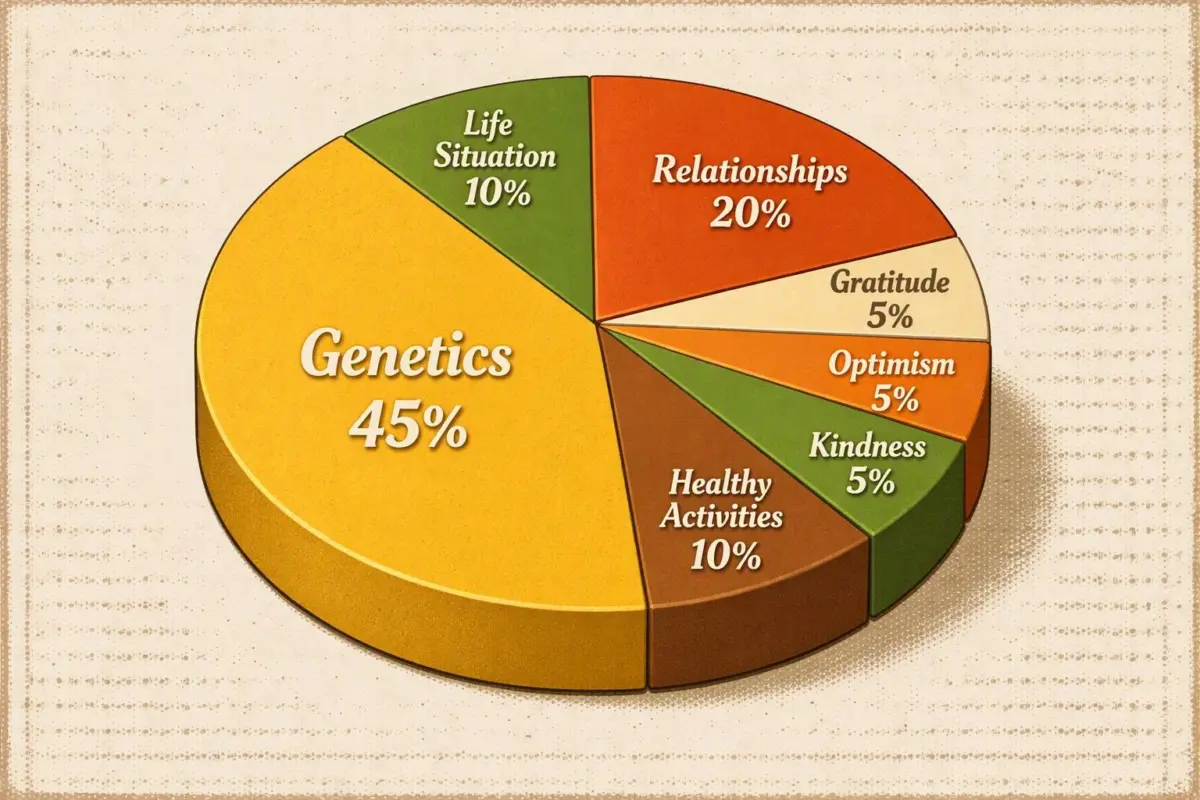
Behavioral studies and general observations suggest that human happiness is governed by a combination of factors, with baseline temperament and genetics playing a substantial role. Beyond innate traits, however, individuals retain control over several crucial choices: cultivating strong interpersonal relationships, practicing daily gratitude and optimism, and maintaining active, outdoor lifestyles. Despite the widespread dissemination of these principles within financial independence communities, background anxiety remains remarkably persistent among savers and retirees alike.

The root of this persistent unease often lies in fear itself. Human beings evolved as sophisticated danger-detection machines, utilizing background anxiety as an evolutionary mechanism to protect against immediate physical threats. The complication arises when actual environmental dangers recede, yet the cognitive machinery continues scanning for alternative sources of worry. Once immediate survival and food scarcity are secured, anxiety shifts toward social standing, tribal acceptance, and eventually, highly specialized financial concerns. These can range from portfolio allocation strategies and tax optimization to managing Required Minimum Distributions—a regulatory mechanism where individuals with substantial retirement portfolios are legally required to begin drawing down funds.
Combating this ingrained fear requires deliberate self-awareness and rational evaluation. Examining personal history often reveals the origins of modern financial anxieties, whether rooted in childhood experiences, family scarcity mentalities, or historical events like the Great Depression passed down through generations. Identifying specific worst-case scenarios through structured analysis frequently demonstrates that potential outcomes are far less catastrophic than anticipated.

Taking decisive action serves as an effective antidote to fear, transforming the unfamiliar into the familiar and building genuine personal resilience. When individuals develop broad emotional, mental, and physical capabilities, external uncertainties lose much of their threatening aura. Furthermore, curating one’s daily information diet by reducing exposure to sensationalized news media helps eliminate unnecessary psychological distress. Shifting focus away from speculative macro-narratives and toward constructive, positive behaviors aligns modern life more closely with human evolutionary design.
AI as an Experiment and a Cognitive Tool
Viewing major life changes and macroeconomic developments through the framework of experimentation can fundamentally alter one’s perspective. Whether applied to personal decisions such as changing careers, relocating, or transitioning into early retirement, treating life’s uncertainties as experiments neutralizes visceral fear.

This experimental mindset applies directly to the current artificial intelligence landscape. Rather than succumbing to doom-scrolling and ominous news coverage, examining the technological and economic drivers behind AI reveals a different perspective. AI functions fundamentally as a sophisticated cognitive tool—effectively a high-powered cognitive nail gun designed to amplify human efficiency and productivity.
Just like previous technological revolutions, artificial intelligence will inevitably boost economic output while simultaneously displacing specific categories of labor, particularly entry-level administrative, financial, and routine cognitive roles. Over time, however, these technologies tend to reduce service costs and stimulate entirely new industries, mirroring the transformative economic expansion unleashed by the internet and mobile computing.

While productivity gains and technological advancements tend to concentrate financial rewards among capital owners and shareholders—a demographic that includes a significant portion of long-term market investors—artificial intelligence ultimately presents an individual choice. It can be approached as a source of existential dread or as a catalyst for continuous learning, adaptation, and engagement.
Ultimately, confronting future uncertainties requires looking past surface-level symptoms of anxiety and addressing the root emotional causes. As many financial independence advocates frequently emphasize, the most meaningful milestones and desired outcomes in life invariably lie just beyond the threshold of fear, waiting for those willing to confront uncertainty with action and optimism.