For those happily tuned out of financial drama, the advice remains simple: keep enjoying life. However, understanding the core narrative provides valuable context. Investors today worry that while artificial intelligence is unquestionably a major technological leap, the mania surrounding it is moving too fast and furious. This has led many to warn that the market is setting itself up for a modern, supersized version of the dot-com crash of the early 2000s.

That particular historical parallel carries personal significance for financial commentator and early retirement pioneer Pete Adeney, widely known online as Mr. Money Mustache. The dot-com boom helped launch his early career and paved the way for his eventual early retirement, even though the subsequent crash nearly cost him his job and his citizenship application. Decades later, as an established internet financial commentator, Adeney frequently receives inquiries about the current investment cycle, prompting him to develop a presentation debuted at Camp FI Midwest and slated for further refinement at the upcoming Bogleheads conference.
Will the Artificial Intelligence Bubble Ruin Retirement?
Having spent over two decades in retirement, Adeney has grown comfortable with the lifestyle, yet he remains occasionally struck by questions from concerned acquaintances. A recurring query asks how anyone can remain retired and sleep soundly at night given the state of the world, assuming that ongoing crises should be a constant source of worry.

News consumers and habitual worriers can easily generate a long list of modern anxieties. Today’s headlines feature volatile political figures menacing the global stage, persistent inflation eroding purchasing power, the towering U.S. national debt, and international conflicts threatening to spiral out of control. These modern fears sit alongside anxieties about the artificial intelligence bubble taking over the job market.
Curiously, these exact themes echo concerns raised decades prior. Looking back twenty years to 2006, the worries of the day felt remarkably similar, even if the specific players and technologies had different names. Back then, political instability in the Middle East dominated the news, alongside concerns over the national debt and inflation. The overvalued stock market was blamed on a looming housing bubble rather than an artificial intelligence boom, and job displacement fears centered on outsourcing to overseas markets rather than automated software. There was even widespread panic over "Peak Oil," with doomsayers arguing that rising fossil fuel consumption against dwindling supplies would inevitably doom civilization, an outcome that ultimately did not materialize.

Following the intense anxieties of 2006, the global economy did experience the Great Financial Crisis—driven by irrational exuberance over housing prices and complex, leveraged mortgage instruments. It remains the largest market crash since the Great Depression. Yet, viewed through the lens of a long-term timeline, that massive downturn appears as a temporary dip. A $100,000 investment made during that turbulent era would still have ballooned significantly over the subsequent two decades, easily absorbing subsequent shocks like the 2020 pandemic crash.
Simultaneously, broader global indicators improved dramatically over the same twenty-year period. The proportion of the global population living in extreme poverty dropped from 20% down to single digits, while global infant mortality rates were cut in half. Clean energy expanded rapidly as solar panel manufacturing costs plummeted, allowing solar generation to become a dominant source of new power capacity globally. Meanwhile, sales of electric vehicles transitioned from a statistical zero to claiming a substantial share of worldwide auto sales.

These historical realities raise a fundamental question: does focusing energy on worrying about an uncertain future yield better results than maintaining long-term optimism?
Skeptics today frequently ask whether "it is different this time." Concerns persist that the U.S. national debt has finally grown large enough to destabilize the global economy, or that the artificial intelligence bubble is so unprecedentedly massive that markets will fail to bounce back. Others worry that AI could rapidly evolve into an uncontrolled superintelligence. While financial media outlets frequently capitalize on these scary narratives, they consistently overlook a fundamental economic principle: true prosperity does not originate from financial systems or stock markets, which ultimately function as mathematical constructs.

Prosperity, Productivity, and the Human Experience
Real economic prosperity stems directly from productivity. Adeney notes that the fundamental lesson remains unchanged through decades of market cycles: capitalism is inherently choppy and prone to wild swings, but beneath the turbulent surface, real people perform real work and invent genuine solutions.
The concept of an economy or a financial system is entirely a human invention. If a system collapses due to overextended numbers, society possesses the capacity to reset the metrics and return to work—a playbook successfully utilized during 2008 and numerous historical downturns prior. Society retains every productivity tool ever invented, and high productivity continues to drive the standard of living, economic growth, and the feasibility of early retirement.

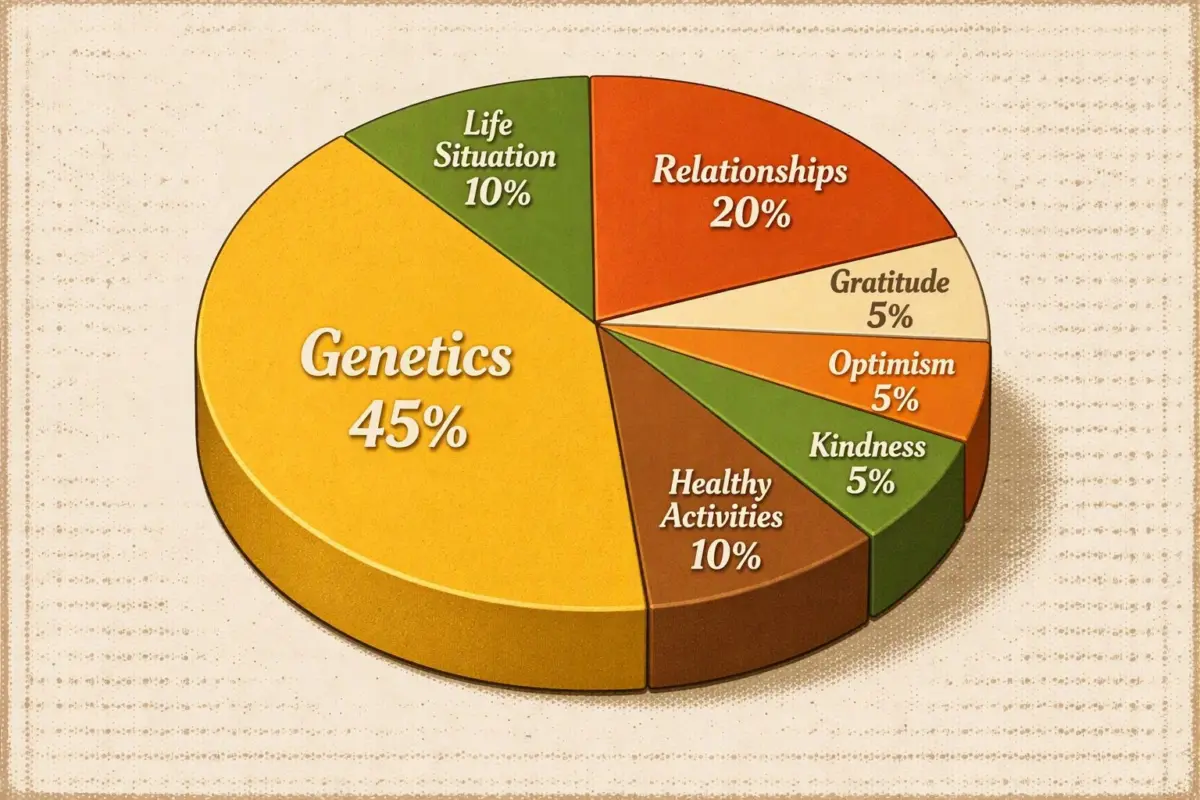
Beyond productivity and economic prosperity, human happiness tends to plateau once a baseline standard of living is achieved. In developed nations, those minimum material requirements were surpassed decades ago. Consequently, personal well-being relies far more heavily on non-material factors. While genetic predisposition plays a role in baseline happiness, daily choices remain within individual control. Cultivating strong personal relationships, practicing gratitude, maintaining an optimistic philosophy, and incorporating regular outdoor physical activity into daily routines consistently rank as the primary drivers of life satisfaction.
Despite the accessibility of these principles, background anxiety remains pervasive. Many individuals continue to harbor deep-seated fears regarding retirement and an unknown future, pointing to the underlying influence of fear itself.

Confronting the Roots of Fear
Human beings have evolved as sophisticated danger detection machines, utilizing background worry as an evolutionary mechanism to protect against threats. However, this detection machinery often malfunctions in modern environments. When actual physical dangers recede, the brain continues scanning for things to worry about, shifting goalposts indefinitely. Once basic survival and food security are established, anxiety migrates toward social belonging, financial optimization, and eventually trivial concerns like neighborhood aesthetics or complex tax strategies.
Fighting back against this pervasive fear requires self-awareness and rational evaluation. Examining personal history often reveals the origins of modern anxieties. Family backgrounds marked by scarcity mentalities—sometimes passed down from generations who lived through economic depressions—can imprint long-term financial caution. Similarly, personal trauma or adverse life events frequently manifest as persistent anxiety in adulthood, making it essential to recognize whether emotional responses stem from past experiences rather than an objective assessment of the present reality.

Identifying specific fears through analytical questioning—such as mapping out the worst-case scenario—often reveals that projected disasters are far less catastrophic than imagined. Action consistently cures fear by transforming the unfamiliar into the familiar, fostering resilience and confidence. Furthermore, intentionally reducing exposure to sensationalized daily news diets prevents unnecessary mental poisoning. Shifting focus away from media-driven alarmism and toward constructive, positive behaviors aligns more closely with the active lifestyles humans were naturally built to lead.
Applying an experimental mindset to major life transitions—whether changing careers, relocating, or entering retirement—helps reframe uncertainty. Rather than viewing uncharted territory as a threat, treating life changes as controlled experiments diminishes panic and encourages curiosity.

The AI Era as a Technological Experiment
Viewing the current artificial intelligence boom through this experimental lens strips away much of its terror, leaving behind profound technological fascination. Rather than yielding to doom-scrolling and ominous media coverage, understanding the underlying mechanics of AI reveals its primary function: a sophisticated cognitive tool designed to boost human efficiency.
Much like the introduction of automated machinery in construction or the widespread adoption of the internet and smartphones, artificial intelligence acts as a powerful amplifier of human productivity. While it inevitably displaces specific entry-level administrative and technical roles, historical precedent demonstrates that such technological shifts simultaneously reduce service costs and spark entirely new industries.

Naturally, the economic rewards of new technologies often concentrate among capital owners and shareholders, a dynamic visible in recent portfolio growth for market participants. Ultimately, artificial intelligence functions like any other historical innovation, presenting individuals with choices. It serves as either a source of paralyzing fear or a catalyst for continuous learning, proactive adaptation, and a more engaged life. As financial observers frequently emphasize, the experiences and achievements desired most in life invariably lie just beyond the boundary of fear.