


Veteran financial commentators and long-term retirees are frequently asked how they manage to sleep at night amidst such economic turbulence. The underlying fear is that the AI boom represents an over-hyped bubble poised to burst in a manner far more severe than the dot-com crash of the early 2000s—an era that shaped the early careers and financial philosophies of many of today’s early-retirement advocates. To address these widespread concerns, financial educators have taken to presenting structured insights at gatherings like Camp FI Midwest and the upcoming Bogleheads conference, unpacking the mechanics of modern market anxiety.

Looking Back at Two Decades of Financial Worries
To understand the current anxiety surrounding the artificial intelligence boom, it is instructive to look back exactly twenty years. In 2006, retirees and investors faced a completely different set of catastrophic predictions. The headlines of that era were dominated by fears of soaring national debt, persistent inflation, geopolitical conflict in the Middle East, and dangerous political leadership. Furthermore, investors worried about an overvalued stock market—though at the time, the anxiety stemmed from the inflating housing bubble rather than advanced technology. Other prominent fears included the outsourcing of domestic jobs to emerging markets like India and China, alongside the looming threat of "Peak Oil," a theory predicting that global fossil fuel consumption would inevitably outstrip dwindling supplies with disastrous consequences.

None of those scenarios unfolded precisely as the doom-mongers predicted. While the subsequent Great Financial Crisis did materialize as the largest economic downturn since the Great Depression—driven by irrational exuberance in housing prices and complex financial leverage—the broader economic trajectory over the subsequent twenty years tells a remarkably resilient story. A hypothetical investment made during that period of peak anxiety in 2006 would have weathered both the 2008 crash and the subsequent market disruption of the 2020 pandemic, ultimately expanding significantly by the present day.

Simultaneously, the global standard of living advanced on multiple fronts. Over a twenty-year horizon, the proportion of the global population living in extreme poverty dropped dramatically. Infant mortality rates were cut in half, while clean energy adoption surged as the cost of solar panels plummeted, transforming solar power into the dominant source of newly added electrical generation capacity. Simultaneously, pure electric vehicle adoption transitioned from a statistical anomaly into a substantial fraction of global automobile sales.

Prosperity and the Misunderstanding of Fear
Despite these historical lessons, the financial media continues to spin cautionary narratives about the fragility of the global system. However, these pessimistic outlooks often overlook a fundamental economic principle: true societal prosperity is driven not by the abstract numerical fluctuations of the stock market or financial systems, but by underlying human productivity.

The core mechanics of capitalism are inherently volatile, characterized by cyclical waves of enthusiasm and correction. Yet beneath these market fluctuations lie real people performing real work and developing tangible innovations. Financial and economic systems are human constructs; if a system experiences a severe failure due to distorted valuation metrics, society has historically adapted by restructuring the framework and resuming productive output. Standard of living, economic growth, and the viability of early retirement ultimately rely on continuous technological and operational productivity rather than speculative trading.

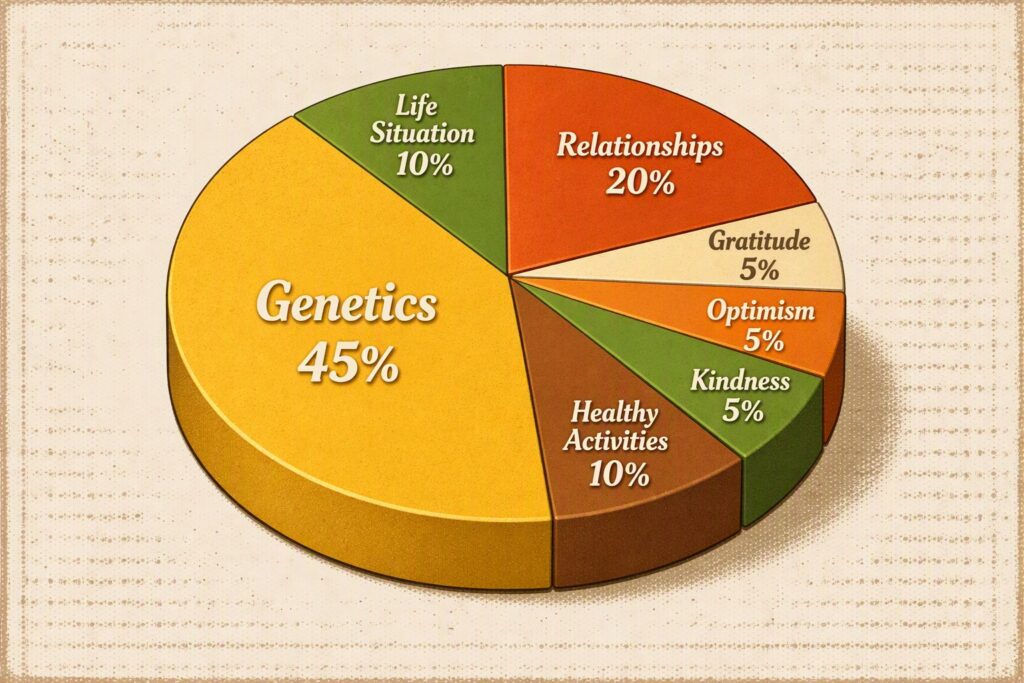
Beyond economics, human happiness tends to stabilize once basic material requirements are met. Psychological research indicates that long-term well-being is influenced heavily by internal and behavioral factors, including genetics, close social relationships, daily physical activity, and a deliberate practice of optimism. Despite these well-established insights, background anxiety persists among investors, largely driven by the evolutionary mechanics of the human brain.

Humans evolved primarily as danger-detection machines. This evolutionary trait was essential for survival in primitive environments, but it creates a modern psychological paradox. When immediate physical threats like predators or acute scarcity are eliminated, the brain does not simply switch off its vigilance; instead, it relocates the goalposts. Once basic financial security is achieved, anxiety migrates toward secondary concerns, ranging from neighborhood social standing and tax strategies to complex estate planning and regulatory rules such as Required Minimum Distributions.
Challenging Fear Through Action and Perspective
Combating this pervasive anxiety requires conscious self-awareness and an understanding of personal history. Many individuals who experience chronic financial fear carry forward scarcity mindsets inherited from older generations who lived through historic economic depressions or personal hardships. Identifying the specific roots of anxiety—often through introspection or therapeutic frameworks—allows individuals to evaluate worst-case scenarios objectively rather than reacting to emotional triggers.

Action remains one of the most effective antidotes to fear. Engaging directly with unfamiliar situations transforms uncertainty into familiarity, building psychological resilience. When individuals develop broad emotional, mental, and physical adaptability, external uncertainties lose much of their threatening nature.

Concurrently, curating one’s daily information diet is essential for maintaining mental clarity. The modern news ecosystem relies heavily on highlighting catastrophic narratives to capture attention, which can systematically distort an individual’s perception of risk. Shifting focus away from speculative financial media and toward tangible, positive behaviors—such as physical activity, community engagement, and continuous learning—helps align daily life with human evolutionary needs. Surrounding oneself with optimistic, productive peers further reinforces a balanced perspective on the future.

The AI Era as a Technological Experiment
This philosophy of proactive adaptation applies directly to the current artificial intelligence landscape. Rather than viewing the rise of AI through a lens of unmitigated doom, it can be approached as a profound technological experiment. While technological shifts inevitably introduce uncertainty, historical precedents suggest that viewing innovations through the lens of productivity unlocks enormous potential.

Artificial intelligence functions fundamentally as a cognitive amplifier—a sophisticated tool designed to enhance human efficiency and problem-solving capabilities. Much like previous technological revolutions, such as the advent of personal computing, the internet, and mobile smartphones, AI will inevitably displace certain routine administrative and operational tasks while simultaneously lowering service costs and catalyzing entirely new industries.
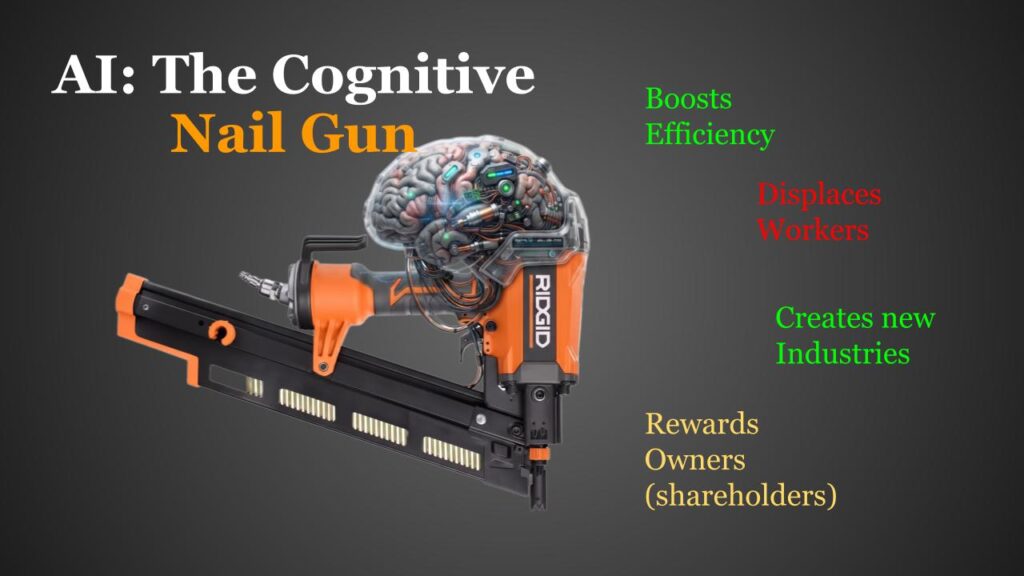
While these transitions present structural challenges regarding labor distribution and wealth concentration among capital owners, they ultimately represent an expansion of human capability. Approaching the artificial intelligence boom not as an existential threat, but as an unprecedented opportunity for learning and adaptation, reframes the narrative surrounding modern economic change. Ultimately, overcoming financial and existential anxiety requires confronting the root causes of fear and recognizing that personal growth and fulfillment lie consistently on the other side of uncertainty.