While many observers have tuned out financial media entirely to focus on day-to-day living, the broader cultural conversation around AI mirrors past market frenzies. Investors worry that while AI is undoubtedly a monumental technological advancement, the surrounding market mania is developing too fast and too intensely. This has sparked widespread fears that the global economy is heading toward a much larger version of the early 2000s dot-com crash. For veterans of the financial independence movement—such as early retirees who launched their careers during the turn-of-the-century tech boom—these cyclical cycles of exuberance and correction are intimately familiar, having once threatened early employment and stability before ultimately giving way to decades of long-term growth.

Financial commentators and retirement experts continue to field heavy inquiries regarding this investment cycle, drawing parallels to past market booms and busts. Recently, these themes took center stage during presentations at events like Camp FI Midwest, with further discussions slated for upcoming gatherings such as the Bogleheads conference. These discussions consistently circle back to a central question confronting modern retirees and savers: Will the AI bubble ultimately ruin retirement?
Looking Back at Two Decades of Market Worries
Reflecting on more than two decades of retirement offers a unique perspective on financial anxiety. The peace of mind that comes with long-term financial security frequently clashes with the prevailing sentiment of a world constantly exposed to breaking news headlines. When friends or observers ask how anyone can remain comfortable in retirement amid global turbulence, the list of concerns cited by news watchers is extensive.

Today’s anxieties often include geopolitical instability involving major world leaders, persistent inflation eroding purchasing power, the looming shadow of the AI market bubble, towering national debt levels, and simmering international conflicts threatening wider escalation. Yet, these exact fears bear a striking resemblance to the anxieties of twenty years prior.
Back in 2006, the prevailing worries centered on a different set of political leaders, ongoing conflicts in the Middle East, surging national debt, and inflation. At that time, market anxiety was driven by the towering housing bubble rather than an artificial intelligence boom, while job security fears focused heavily on offshore outsourcing to emerging economies like India and China rather than automated algorithms. Discussions were dominated by the concept of "peak oil"—the widespread fear that global fossil fuel consumption would inevitably outstrip dwindling supplies and lead to societal collapse. Instead, technological advancements and alternative energy developments shifted the global energy landscape entirely.

Following the intense anxieties of 2006, the global economy indeed experienced the Great Financial Crisis, triggered by a combination of housing market irrational exuberance and high-risk financial leverage. It was widely regarded as the most severe economic downturn since the Great Depression. Yet, when viewed through the expansive lens of multi-decade market history, even that historic crisis appears as a temporary dip within a broader upward trajectory. Long-term market data demonstrates that diversified equity investments continued to compound significantly over the subsequent two decades, weathering both the 2008 crash and subsequent disruptions such as the economic shock of the 2020 pandemic.
Concurrently, the broader world experienced significant structural improvements across key human development metrics. Over a twenty-year period, the global population living in extreme poverty dropped substantially, while infant mortality rates were drastically reduced. Clean energy technologies matured rapidly, with solar panel manufacturing costs falling dramatically to the point where solar generation now accounts for the vast majority of new energy capacity additions worldwide. Electric vehicle adoption similarly transitioned from a theoretical concept to a major share of global auto sales.

Examining this historical trajectory highlights a fundamental tension in personal finance: whether an individual’s energy is best directed toward chronic worry about an uncertain future or toward long-term optimism and resilience.
The Core of Economic Prosperity: Productivity Over Paper Metrics
Whenever a new technological wave crests, analysts and financial media outlets are quick to question whether "this time is different." Speculation runs rampant that national debt levels have finally reached a tipping point, that the AI bubble far exceeds the housing market excesses of the past, or that artificial intelligence will inevitably spin out of control.

However, these alarmist narratives frequently overlook a foundational economic principle: true prosperity does not originate from the financial system or the stock market, which ultimately represent numerical tracking systems managed through computers and ledgers. Instead, genuine economic prosperity stems directly from human productivity.
The underlying reality of capitalist economies is that they are inherently volatile and prone to cyclical swings. Beneath the surface turbulence, however, real people continue to perform real work, solve complex problems, and invent practical tools. Financial systems and monetary economies are human-made constructs; if a financial system experiences a systemic correction due to overextended valuations, economic participants retain the capacity to restructure financial metrics and resume productive labor—a mechanism demonstrated repeatedly during past historical corrections.

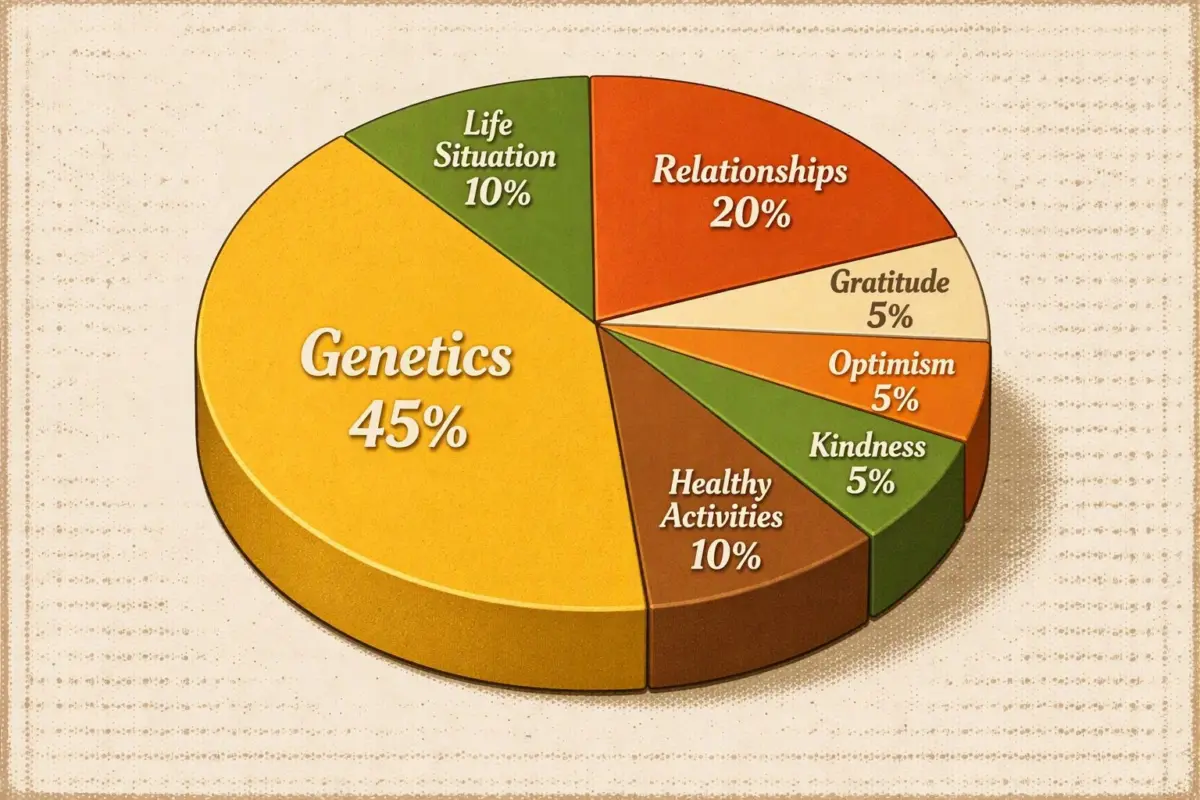
The fundamental tools utilized to boost human productivity remain intact, and sustained improvements in living standards, economic growth, and the feasibility of early retirement are directly tied to these productivity gains. Nevertheless, once society achieves a certain baseline standard of living, human happiness tends to plateau along financial dimensions. In developed nations, basic survival and comfort thresholds were surpassed decades ago, shifting the primary determinants of overall well-being toward non-financial factors.
Understanding Human Fear and the Nature of Modern Anxiety
Despite historical proof that market economies recover and expand, many individuals—including those who have achieved financial independence—remain perpetually anxious about the unknown future. This persistent apprehension is deeply rooted in human evolutionary biology. As human beings, individuals function largely as sophisticated danger-detection mechanisms, an adaptive trait originally designed to protect early humans from physical predators and environmental scarcity.

The challenge with this evolutionary hardware is that when immediate physical dangers are successfully mitigated, the brain continues scanning the environment for new threats to monitor. Once physical survival and food security are established, anxiety shifts toward social acceptance, tribal belonging, and eventually, financial security. Even among individuals who achieve comfortable upper-middle-class lifestyles, this anxiety often manifests in micro-concerns, ranging from neighborhood property aesthetics and tax optimization strategies to managing government-mandated retirement account distributions.
Combating this persistent background fear requires self-awareness and rational evaluation. Understanding personal financial history—such as whether a scarcity mindset stems from family upbringing or historical periods like the Great Depression—can shed light on irrational present-day worries. Acknowledging that past trauma or prolonged stress can warp an individual’s perception of current safety helps separate emotional responses from objective reality.

When specific financial or existential fears are identified, breaking them down through logical worst-case analysis frequently reveals that the imagined catastrophic outcomes are vastly exaggerated. Taking proactive steps to address unfamiliar challenges builds personal resilience—a trait that transforms abstract worries into manageable circumstances. Furthermore, curating one’s daily information diet by reducing exposure to sensationalized news media helps eliminate unnecessary psychological distress, allowing individuals to focus instead on positive behavioral actions, physical health, and constructive community engagement.
Artificial Intelligence as a Cognitive Tool
Viewing major technological shifts through the lens of experimentation rather than existential dread provides a rational framework for understanding developments like the modern AI boom. Rather than succumbing to doom-scrolling and alarming headlines, exploring the practical applications of artificial intelligence reveals why technologists and economists view the innovation with optimism.

Rather than an uncontrollable autonomous force, AI functions primarily as a sophisticated cognitive tool—effectively serving as a digital equivalent of a cognitive nail gun. By enhancing operational efficiency, artificial intelligence drives productivity gains that ultimately contribute to broader economic prosperity. Like any major technological revolution before it, AI will inevitably displace certain routine tasks and administrative positions, particularly in entry-level administrative, software, and financial sectors. Simultaneously, however, it lowers service costs and fosters entirely new industries, mirroring the transformative economic impact of the internet and mobile computing revolutions.
While productivity-enhancing technologies tend to concentrate financial returns among asset owners and shareholders, they also provide broader opportunities for individuals who approach technological change with curiosity rather than fear. Ultimately, the rapid expansion of artificial intelligence represents another chapter in human innovation, offering an opportunity to evaluate personal assumptions, engage in continuous learning, and maintain an objective, forward-looking perspective on the future of work and retirement.