How do I get the most out of a hair-dryer brush?
Even when utilizing the most advanced hot tools on the market, top professionals agree that the foundation of a glorious, long-lasting blowout begins long before the device touches a power outlet. New York City-based hairstylist Takisha Sturdivant-Drew stresses the importance of thorough preparation, advising users to always start with clean, thoroughly detangled, and damp hair treated with a quality leave-in conditioner.
When applying the tool, technique matters immensely. Stylists recommend starting at the root and working downward toward the ends, ensuring that excessive heat and physical tension are avoided. Furthermore, even though many modern styling brushes claim to minimize heat damage, applying a dedicated heat protectant spray—or utilizing a leave-in treatment that incorporates heat-protective properties—remains vital for safeguarding both the hairstyle and the structural integrity of the hair fibers.
Different hair textures demand tailored approaches to achieve optimal results. For individuals with straight or wavy hair, building volume is remarkably straightforward when combined with the correct physical motion. Twisting the dryer in a continuous circular motion as it moves through the hair effectively boosts lift and body. Conversely, those with curly or coily hair who desire a sleek, straightened finish must adapt their methodology. Sturdivant-Drew suggests using the blow-dryer brush alongside a secondary smoothing brush held directly underneath to stretch and smooth kinky strands completely. Alternatively, users can follow up with a flatiron or complete the final passes with the heat setting turned off.
How do I minimize heat damage from a hair-dryer brush?
Mitigating the risk of thermal damage requires deliberate management of temperature settings. Consumers are advised to select blow-dryer brushes equipped with multiple heat levels, allowing for precise control over the thermal exposure applied to different hair types. Because hair textures vary widely in their tolerance to heat, users—particularly those new to the tool—should closely monitor how their strands react during initial styling sessions and adjust the temperature controls accordingly.
Incorporating a specialized heat protectant serves as another dependable line of defense. Cosmetic chemist Ginger King notes that protective formulations typically incorporate ingredients such as meadowfoam seed oil, light polymers, or silicones. These components function by forming a protective coating around the hair shaft, which effectively minimizes direct thermal trauma during the styling process. Nevertheless, industry experts emphasize that the most foolproof method for preventing heat damage is simply avoiding the overuse of thermal stylers altogether.
Are hair-dryer brushes easier to use than traditional hair-dryers?
Selecting any hair-care tool ultimately comes down to personal preference, yet both everyday consumers and professional stylists consistently praise blow-dryer brushes for their exceptional ease of use, making them particularly accessible to beginners. Industry professionals note that these hybrid styling tools are remarkably user-friendly, enabling individuals to accomplish an impressive blowout at home without requiring advanced styling proficiency. Furthermore, they significantly reduce styling time, cutting the duration down by roughly half compared to the traditional method of coordinating a handheld dryer in one hand and a round brush in the other.
Beyond convenience, these tools offer significant ergonomic advantages. For individuals experiencing chronic pain, limited mobility, or fatigue in their hands, wrists, or arms, a blow-dryer brush presents a practical alternative to conventional drying methods. The enhanced maneuverability minimizes physical strain, reducing the likelihood of arm exhaustion and eliminating the need for a secondary styling phase with a separate flatiron or curling iron.
Despite these benefits, proper moisture management prior to styling is crucial. Experts advise letting hair air-dry to roughly 70 percent dampness, or alternatively performing a quick rough-dry with a standard blow-dryer, before introducing the styling brush. Engaging the tool on soaking-wet hair not only compromises the final frizz-free finish but also increases the risk of mechanical breakage and thermal damage, as these devices are not engineered to handle water-logged strands.
How do I clean my hair-dryer brush?
Because blow-dryer brushes feature diverse structural designs encompassing varying barrel materials, bristle types, and overall shapes, cleaning methods must be adapted to the specific device. Weekly maintenance is essential for preserving the lifespan and functionality of the equipment. Devin Toth, a New York City-based hairstylist, recommends checking for a removable air filter and clearing out accumulated dust on a weekly basis. To extract trapped hair from the bristles, users can employ a standard fine-tooth comb or a specialized boar bristle brush cleaner.
Tackling stubborn product buildup—such as residues from hairsprays, styling creams, and pomades—requires targeted cleaning agents. A damp cloth is generally sufficient for routine wipe-downs, but for persistent residue that refuses to budge, Los Angeles-based hairstylist Cherin Choi suggests applying a small amount of rubbing alcohol to dissolve the sticky film.
Maintaining a clean hot tool is critical for optimal performance. Atlanta-based hairstylist Tukia Allen warns that neglected product and hair accumulation can severely restrict a tool from operating at its full capacity. Nashville-based hairstylist Brian O’Connor echoes this sentiment, cautioning that a dirty thermal styling brush can distribute heat unevenly across the hair shaft, leading to inconsistent styling results and localized thermal damage.
How we test and review products
Evaluating beauty and hair-care products requires a rigorous, multifaceted methodology. While certain cosmetics and skincare formulas can be assessed across a broad demographic, hair-care products and tools demand a more specialized approach. Hair products are frequently formulated to target specific concerns—such as dandruff, structural brittleness, or breakage—or to perform optimally within distinct hair textures, ranging from tight 4C curls and wavy patterns to fine straight hair and gray strands. A specialized item like a purple shampoo or a textured hair diffuser must be evaluated by individuals whose hair types match the intended design of the product.
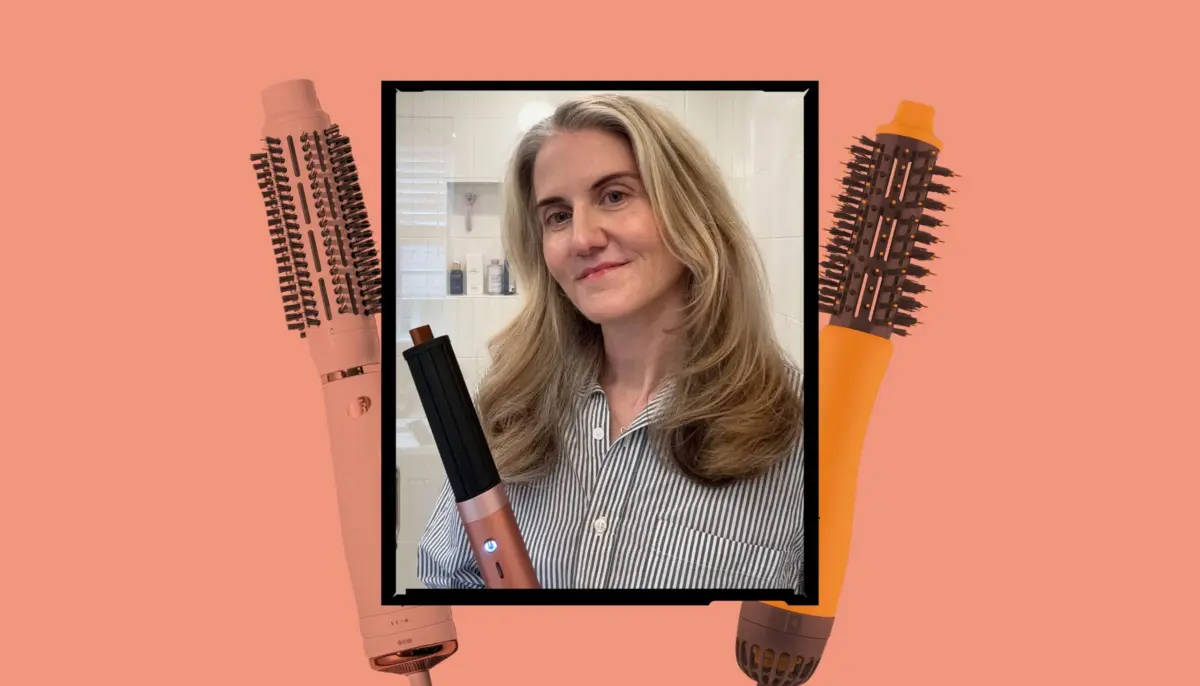
To compile comprehensive reviews of the top blow-dryer brushes, editorial teams enlist a diverse group of editors, writers, industry contributors, and professional stylists. Each participant brings a unique hair type, personal styling background, and specific aesthetic goal to the testing process. Performance is evaluated across four core criteria: efficacy, versatility, ease of use, and overall value.
Our staff and testers
Selecting beauty products is an inherently personal endeavor, whether a consumer is searching for a targeted face cream to combat dryness, a nail treatment for a weekly self-care routine, or the latest innovative hair tool to hit the market. Editorial teams strive to ensure that all recommendations are thoroughly vetted and broadly applicable, recognizing that a diverse staff and an expansive network of external testers and industry experts are indispensable to achieving that standard.
By maintaining a team that spans a wide spectrum of ages, skin tones, hair textures, genders, and professional backgrounds, reviewers can fairly and accurately assess how beauty products perform across diverse real-world conditions.