That historical parallel carries personal weight for figures like early retirement advocate Mr. Money Mustache, whose early career was boosted by the dot-com boom before the subsequent crash nearly derailed his job stability and citizenship application. Addressing questions from anxious investors about the current economic landscape, financial commentators are taking these concerns to public platforms, including presentations at events like Camp FI Midwest and upcoming appearances at the Bogleheads conference. While financial media outlets frequently spin alarming tales about overvalued markets, towering national debt, geopolitical conflicts, and technological disruption, a broader historical perspective suggests that fear-mongering often overlooks the fundamental drivers of human progress.

Will the AI Bubble Ruin Our Retirement?
Achieving long-term financial independence and spending over two decades in retirement brings a certain level of comfort, yet the underlying anxieties of the general public remain remarkably consistent across generations. Conversations with worried observers often highlight a familiar refrain: how can anyone sleep at night with everything happening in the world?
A look back two decades to 2006 reveals a strikingly similar catalog of worries. Back then, headlines were dominated by geopolitical tensions involving polarizing leaders, wars in the Middle East, escalating national debt, inflation, and a housing bubble threatening an overvalued stock market. There were also widespread fears that jobs would be permanently outsourced to emerging economies, alongside intense debates over "peak oil" and the looming exhaustion of fossil fuel supplies.

Yet, looking back at the subsequent twenty years provides crucial context. Despite the severe disruption of the Great Financial Crisis—triggered by irrational exuberance in housing prices and complex mortgage leverage—the broader market demonstrated remarkable resilience. A historical investment in the broader market weathered not only the 2008 crash but also the subsequent pandemic-related downturn of 2020, ultimately yielding substantial long-term growth. Globally, living standards improved significantly over the same period: extreme poverty rates dropped dramatically, infant mortality was cut in half, and clean energy adoption surged as solar technology became vastly cheaper and electric vehicle adoption expanded.
This historical trajectory challenges the assumption that the future is uniquely doomed by current anxieties. While contemporary observers worry that the U.S. national debt has reached a tipping point, that the AI bubble is insurmountable, or that autonomous superintelligence will displace humanity, economic history suggests that prosperity does not originate from financial systems or computerized market numbers. True prosperity stems from productivity.

Productivity, Prosperity, and Human Happiness
The foundational mechanics of capitalism are inherently choppy, prone to wild swings and periodic corrections. However, beneath the volatile waves of the financial markets, real people continue to perform real work and develop genuine innovations. The financial system and the concept of an economy are merely human inventions. If a system experiences a severe failure due to fluctuating numbers, society has repeatedly demonstrated the capacity to adapt, restructure, and resume productive labor.
Economic growth, a higher standard of living, and the feasibility of early retirement are all anchored in high productivity. Once a society achieves a certain baseline standard of living, human happiness tends to plateau along that specific economic dimension. In developed nations, those minimum requirements were surpassed decades ago, shifting the focus of human fulfillment toward non-financial factors.

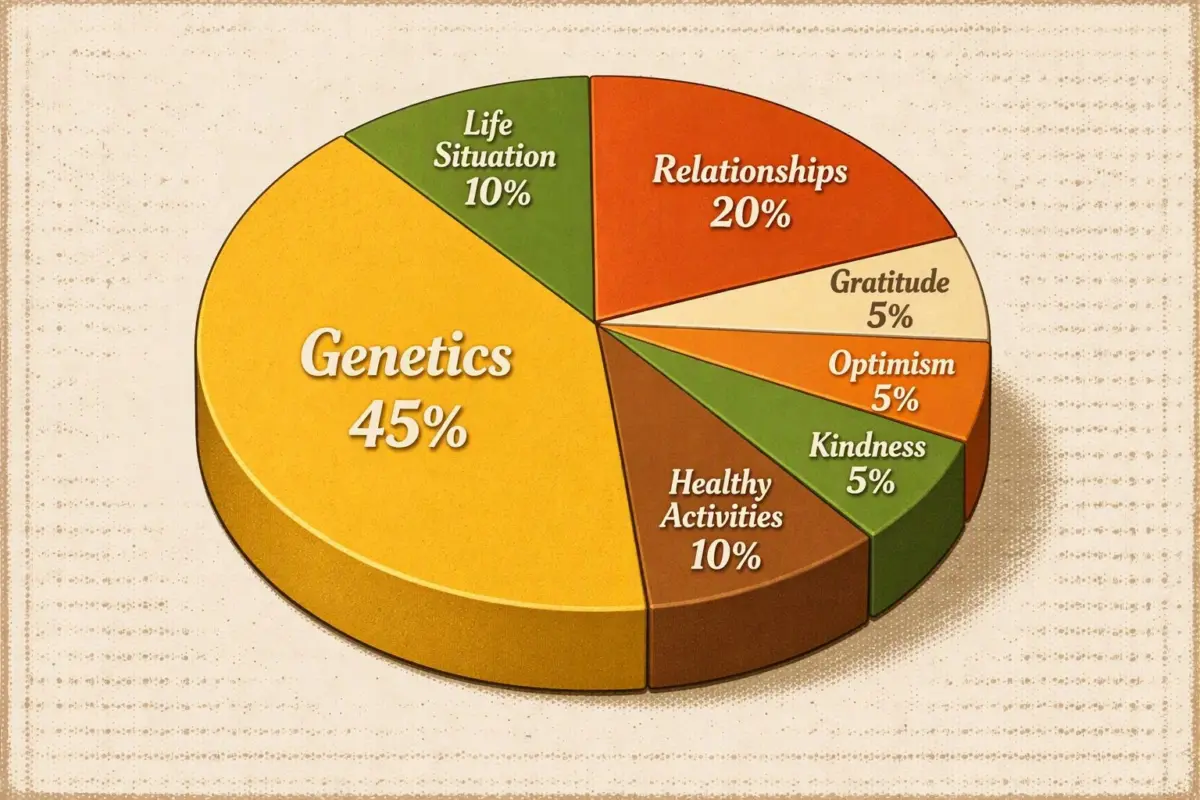
Psychological and sociological observations suggest that overall life satisfaction is driven by a combination of factors, many of which remain entirely within an individual’s control. While innate temperament plays a role, conscious choices—such as cultivating strong personal relationships, practicing gratitude and optimism, and engaging in regular outdoor and physical activities—have a profound impact on daily well-being. Despite this understanding, financial anxiety persists even among those who have achieved financial independence, pointing to a deeper psychological root cause.
Confronting Fear Itself
Human beings are, at their core, sophisticated danger-detection machines. This pervasive background fear is an evolutionary trait designed to protect individuals from immediate physical threats. However, this detection machinery has a quirk: once genuine physical dangers are mitigated, the mind continues searching for new sources of worry, effectively moving the goalposts.

When immediate concerns regarding food scarcity, shelter, and physical safety are resolved, individuals frequently pivot to social anxieties, community standing, or increasingly abstract financial worries. These can range from comparing one’s wealth to others to fretting over tax strategies, estate planning, or government-mandated required minimum distributions for those who have accumulated substantial savings.
Overcoming this pervasive cycle of fear requires a degree of self-awareness and rational evaluation. Examining personal history—such as childhood experiences with financial scarcity or past trauma—often explains why these emotional responses persist despite a secure present reality. Identifying specific fears by playing out the worst-case scenario often reveals that the imagined catastrophe is manageable. Taking decisive action helps bridge the gap between the unfamiliar and the familiar, fostering resilience and adaptability.

Furthermore, managing one’s mental diet by filtering out the relentless stream of sensationalized news stories can dramatically alter an individual’s outlook. Human beings are biologically wired to solve problems actively using their bodies and minds, ideally in dynamic outdoor environments. Realigning daily habits with fundamental human needs—such as regular movement, continuous learning, and positive social engagement—reduces anxiety more effectively than avoiding speculative financial risks. Surrounding oneself with optimistic, productive peers reinforces a mindset focused on living a fulfilling life rather than anticipating ruin.
Everything Is an Experiment
Applying an experimental mindset to major life changes—whether relocating to a new home, pursuing a new career path, or entering early retirement—transforms uncertainty from a source of dread into an opportunity for discovery. This same perspective applies directly to the current technological shift surrounding Artificial Intelligence.

Rather than succumbing to doom-scrolling and ominous media narratives, understanding the underlying technology reveals its potential. AI functions essentially as a cognitive tool designed to boost efficiency, mirroring the historical impact of industrial machinery or digital communication. While such technological leaps inevitably displace certain entry-level office and administrative roles, they simultaneously reduce the costs of essential services and catalyze the creation of entirely new industries, much like the advent of the internet and mobile applications.
While the economic rewards of such innovations often concentrate among asset owners and shareholders, the broader trajectory of human ingenuity remains focused on problem-solving and efficiency. Artificial Intelligence, like any other major disruption, presents an opportunity for deliberate choice. Individuals can choose to view technological advancement as a catalyst for continuous learning and personal growth rather than an existential threat, keeping in mind that meaningful progress and personal fulfillment invariably lie on the other side of fear.