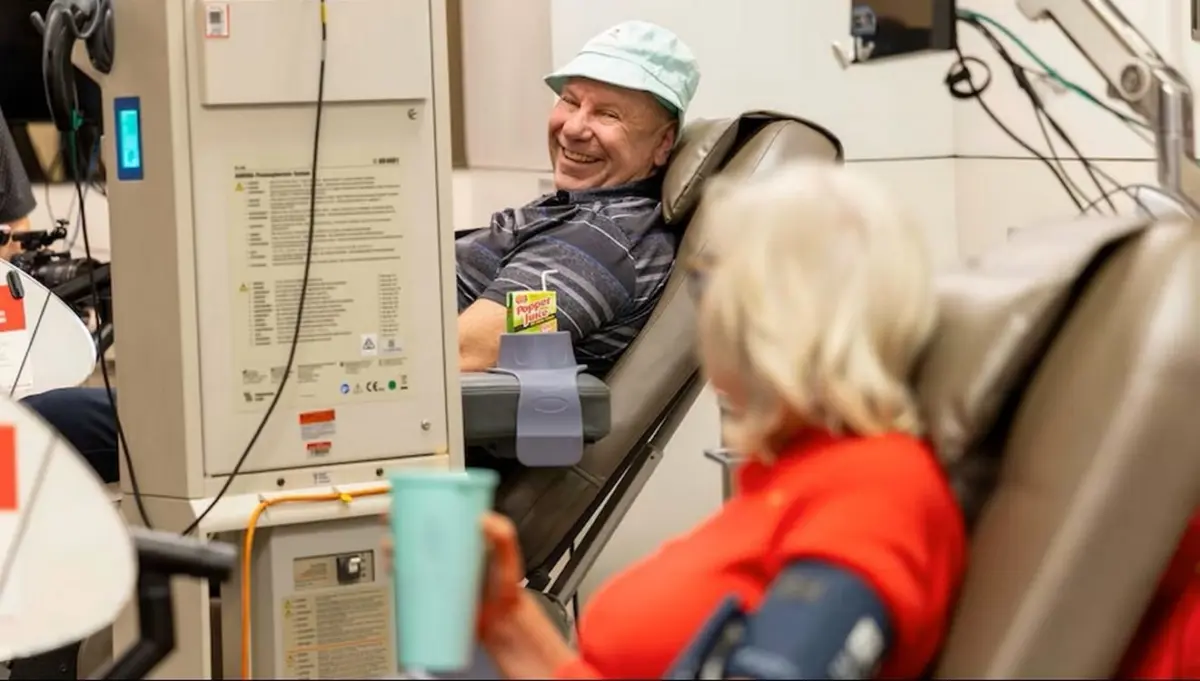
Pictured in snapshots enjoying lighthearted moments, sharing jokes with clinic staff, and sipping a traditional post-donation juice box, Bergman’s achievement is far more than a personal travel adventure. His blood possesses biological characteristics that make it exceptionally precious to the national healthcare system, placing him among an elite and critical group of medical contributors in the Southern Hemisphere.
The extraordinary journey began simply enough while Bergman was thousands of miles away from his home base in Victoria. During a vacation in Perth, Western Australia, he decided to drop by a local blood bank to maintain his routine schedule. Standing inside the facility, struck by the novelty of contributing to a community on the opposite side of the continent, a creative idea sparked in his mind. He began to wonder what it would be like to turn his lifelong commitment to helping others into a comprehensive tour of the country.
"When I went past the blood bank there and donated there, I just thought, ‘Well, I’m on holiday here, what a good way to see Australia,’" Bergman recalled in an interview with Australian public broadcaster ABC News.
What started as a spontaneous holiday thought gradually transformed into a dedicated hemo-marathon. Over the course of his mission, Bergman traveled extensively, visiting facilities in major metropolitan hubs and remote regional outposts alike. His travels took him up the length of Australia’s sun-drenched eastern coast, across the vast expanse of the continent to Western Australia, and northward into the tropical climate of Darwin.
Looking back on the logistical and geographical scope of his endeavor, Bergman noted that the journey opened doors to parts of the country he otherwise would likely never have witnessed. The venture allowed him to experience the diverse landscapes, climates, and communities of the land down under, meeting local healthcare workers and fellow donors in every state and territory. Yet, despite the thousands of kilometers logged and the dozens of cities visited, not every stop went entirely according to plan.
Among the countless memories forged along the road, Bergman singled out one particularly ironic visit as his most memorable. Upon arriving in the regional Western Australian city of Albany, eager to check another center off his comprehensive list, he was politely turned away by medical staff because he had arrived with what he described as "a sniffle." Even a dedicated nationwide traveler cannot outrun a common cold, reminding him of the strict health and safety protocols that protect the national blood supply.
The logistical challenge of visiting all 85 centers culminated in the nation’s capital. For his final, landmark donation, Bergman traveled to Canberra to visit the Australian Red Cross Lifeblood center. In a notable show of solidarity and national recognition, he was accompanied by Sam Mostyn, the representative of the Crown in Australia. Together, they sat side by side to give blood in tandem, bringing a fittingly prestigious close to an unprecedented domestic journey.
Behind the tourism, the scenic flights, and the highway miles lies a profoundly serious medical necessity. Bergman is one of only approximately 150 individuals in all of Australia known to carry the anti-D antibody within their blood plasma. This specialized antibody is a vital resource in modern obstetrics, utilized to manufacture specialized injections given to pregnant mothers whose newborns are at risk of developing hemolytic disease of the newborn.
This dangerous and potentially life-threatening medical condition arises when a mother and her developing infant possess incompatible blood types. If an incompatibility exists, the mother’s immune system can mistakenly identify the baby’s developing red blood cells as foreign invaders, mounting an immune response that attacks the infant. The administration of anti-D immunoglobulin prevents this immune reaction from occurring, safeguarding the health and survival of countless newborns across the country. Because synthetic alternatives cannot replicate these specific human antibodies, individuals like Bergman play an irreplaceable role in maternal and infant healthcare.
Throughout his remarkable marathon, Bergman’s donations directly aided patients from virtually every corner of Australia, quietly saving lives behind the scenes while he pursued his goal of visiting every clinic. Reflecting on the impact of his multi-year endeavor, Bergman expressed a quiet sense of fulfillment, noting that it was simply "nice to know" he had contributed a small part to supporting the broader national community.
Public health organizations continue to emphasize the constant, everyday necessity of maintaining adequate blood reserves across the nation. According to data provided by Australian Red Cross Lifeblood, approximately one in three Australians will require donated blood or blood products at some point during their lifetime. Whether supporting routine surgeries, treating trauma victims, managing chronic illnesses, or providing specialized antibodies for vulnerable newborns, the demand for voluntary contributions never ceases.
With his marathon officially completed, Bergman’s historic contribution stands as a testament to the power of individual dedication, transforming a routine civic duty into an inspiring cross-country mission of community care.