Operating what is almost certainly China’s first wheelchair skateboarding training center in his home city of Nanchang, Xie is once again breaking records and challenging societal perceptions of disability. Yet, the path that led him to this sunlit courtyard filled with curves and gentle gradients was forged through profound adversity, resilience, and an unwavering personal philosophy: that if you carry on through the storm, you will surely see the rainbow.
The storm that reshaped Xie’s life struck when he was just 19 years old. While participating in a geology internship field trip, he suffered a devastating fall from a tree he was climbing. The accident resulted in severe damage to his thoracic vertebrae, leaving him permanently paralyzed from the waist down. In the immediate aftermath, confronted with a sudden and radical alteration of his reality, Xie saw no future for himself. He retreated entirely from the world, languishing at home for eight agonizing years without ever stepping foot outside alone.
During those dark years, his mother assumed the full, unyielding responsibility of caring for her paraplegic son. Though Xie had always promised her that he would eventually develop some form of independence, it was her death in the year 2000 that served as a profound emotional catalyst. Her passing transformed his long-standing promise from a distant aspiration into an urgent, inescapable necessity.
The turning point toward his modern athletic journey occurred in 2004, when he attended a spinal cord injury meetup. There, he witnessed another attendee perform a remarkable feat of balance: lifting a wheelchair entirely onto its back wheels to execute a stationary wheelie. Captivated by the display of control, Xie began scouring the internet for instructional content. He mostly studied foreign videos online that demonstrated advanced wheelchair maneuvers, such as navigating up and down flights of stairs, and resolved to master them himself.
The learning curve was steep and unforgiving. Plenty of nasty falls followed as he pushed his physical limits, testing the precise physics of balance and momentum. But Xie’s persistence paid off in monumental fashion. By 2012, he stood before an official observer from Guinness World Records, shaking hands after completing the longest-ever wheelchair wheelie—an astonishing continuous distance of 25.8 kilometers, or approximately 16 miles.
Far from resting on his laurels, Xie used that milestone as a springboard for even greater endurance challenges over the subsequent decade. He successfully summited the towering, nearly 6,000-foot Mount Huangshan four separate times, a grueling test of upper-body strength and psychological fortitude. Furthermore, he completed 32 marathons around the globe, including the iconic and demanding New York City Marathon.
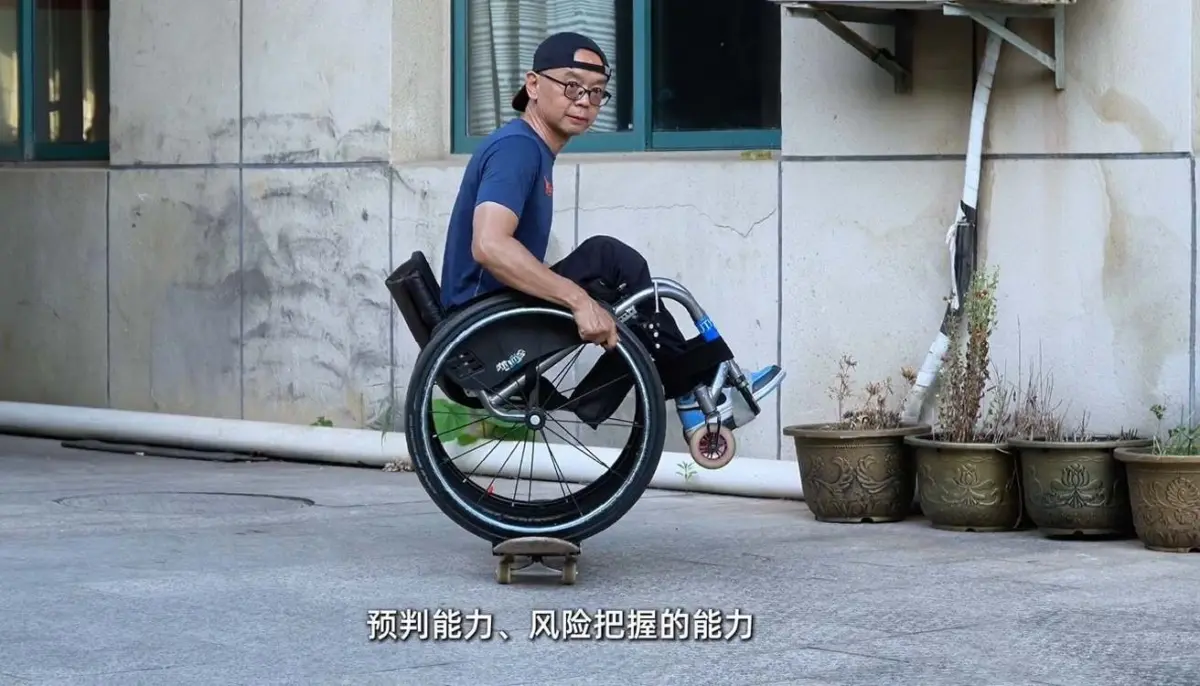
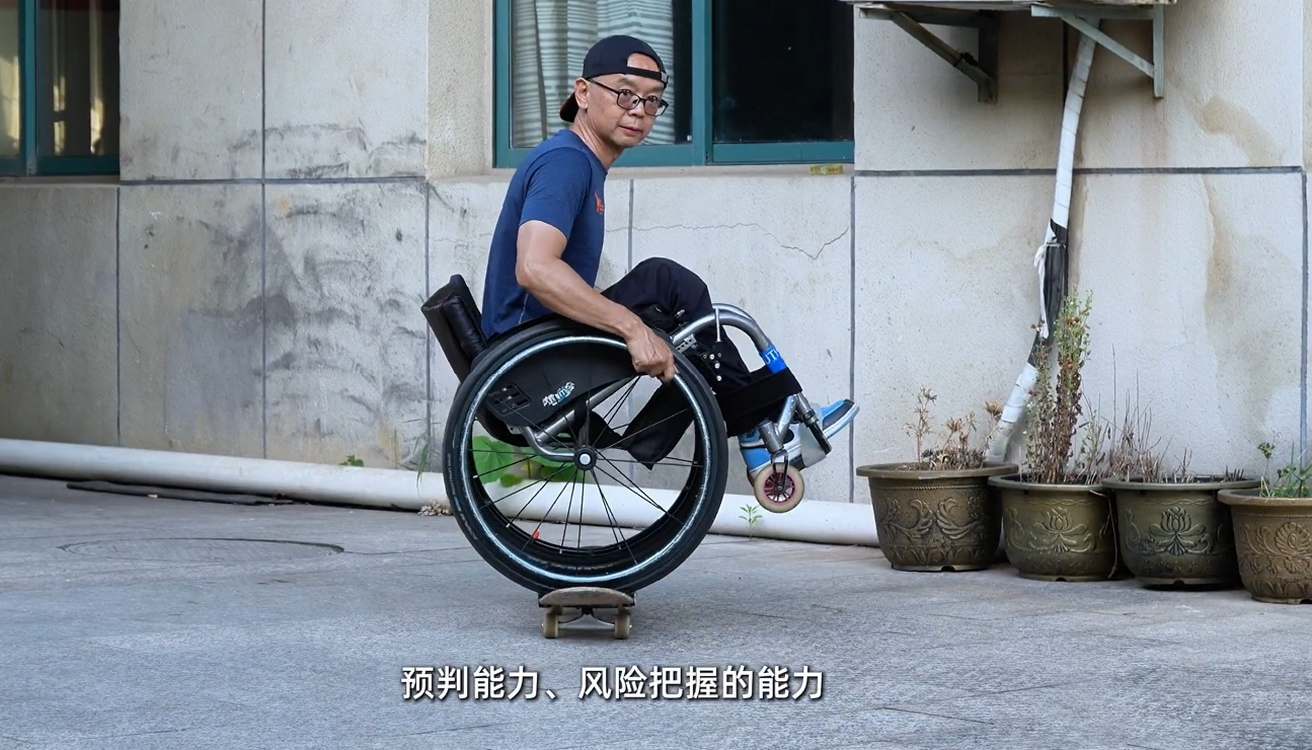
It was in 2014 that Xie first encountered the concept of wheelchair skateboarding. Eager to explore a new dimension of movement, he cleverly engineered a solution by attaching metal rails onto a standard skateboard. These rails prevented his wheelchair’s wheels from simply rolling off the board, allowing him to use the wheels to press left and right against the rails, mimicking the footwork and weight distribution of a traditional skater.
Even for an athlete of Xie’s caliber, the discipline proved extraordinarily difficult. Balancing the dynamics of a wheelchair atop a moving skateboard required an entirely new level of coordination, and he temporarily put the pursuit on hold to focus heavily on his marathon career.
However, the ambition never truly faded. Last November, Xie discovered an ideal training base in Nanchang featuring a courtyard with precisely the right architectural elements—a series of curves and gentle gradients that provided the perfect testing ground to resume practicing wheelchair skateboarding.
After mastering the technique and documenting his progress through viral online videos that captured widespread public attention, Xie decided to expand his mission beyond personal achievement. He opened a sports rehabilitation clinic named the Nanchang City Hope House, specifically designed for individuals living with spinal cord injuries and mobility impairments. Through the clinic, he promotes the physical and mental benefits of adaptive athletics, explaining that coordinated activities of this nature help build essential musculature, strengthen cardiovascular health, and fortify the immune system.
Looking ahead, Xie harbors an even larger ambition for the community he serves. One day, he hopes to organize and host China’s first-ever wheelchair skateboard competition, a pioneering event that would give adaptive athletes a competitive platform on a national scale. He modestly describes the ambitious undertaking as a "small goal I’m pursuing," embodying the same quiet tenacity that carried him out of isolation decades ago and onto the forefront of athletic innovation.