
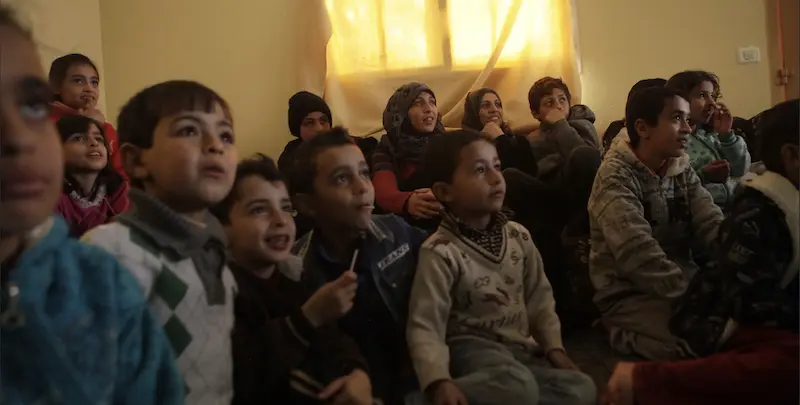
Since the beginning of the hostilities, the vast majority of Gaza’s cultural centers have sustained heavy structural damage or been reduced to rubble. Educational and artistic programs that once served as vital creative outlets for youth have ground to a halt. The educational sector has faced catastrophic disruption, with most schools destroyed entirely and the few remaining structures repurposed as overcrowded shelters for displaced families. Hundreds of thousands of children have been locked out of formal classrooms for nearly three years, growing up amid an atmosphere of intense isolation and trauma.
Against this bleak backdrop, grassroots initiatives have emerged in attempts to restore a semblance of normalcy and routine. Among them is Haws Cinema, a passionate independent project spearheaded by sisters Shaimaa and Safaa Dhabban.
The initiative’s genesis was rooted in a deeply personal family tradition. Shaimaa recalls that she and her sister shared a lifelong love for animated films, often gathering together every day after school during their childhood to watch them. Living through an unprecedented period of terror and confinement, the sisters began to wonder if that shared comfort could be extended to the wider community of children in Gaza. The core objective was to take an intimate childhood passion and scale it into a communal environment, offering something radically different from the daily realities of war.
The sisters’ personal backgrounds heavily influenced the trajectory of the project. Shaimaa graduated from university with a degree in information technology and worked as a graphic designer before the outbreak of the war. Safaa pursued a degree in English and translation, cultivating a hobby of translating movies and television programs since she was 16 years old. Before the conflict, Safaa also managed a small online business specializing in Korean food. Today, she is raising twin daughters as a single mother, having lost her husband during the early weeks of the war. For both women, Haws Cinema functions simultaneously as a labor of community love, a modest source of vital income, and an urgent intervention to give children a temporary psychological reprieve from the constant drone of warplanes and harrowing news cycles.
Bringing the vision to life required overcoming monumental physical obstacles. Before any technical equipment could be set up, the sisters had to address the immediate physical barriers choking the area. Their initial labor had nothing to do with selecting projectors or configuring sound systems; it began with clearing heavy debris by hand. Because heavy machinery was unavailable and access routes were blocked, Shaimaa and Safaa spent months physically removing rubble from the pathway leading to the cinema space.
Securing a reliable power supply presented a continuous, daily battle. While solar energy was considered initially, the setup costs proved prohibitively expensive. The sisters subsequently invested in a generator, but frequent mechanical failures forced them to acquire a backup unit. This, in turn, required a steady supply of fuel—a commodity that had grown exceptionally rare and costly across the territory. Furthermore, with local digital infrastructure severely degraded, accessing and downloading films required grueling overnight efforts. Safaa describes staying up through the night, battling intermittent internet connections and frequent dropouts just to secure media files for upcoming screenings.
Preparing the screening room itself demanded resourcefulness and sacrifice. To construct a darkened, enclosed environment, the sisters had to utilize basic materials such as tarpaulins, fabric, and sheet metal. Due to strict blockades regulating the entry of raw materials into Gaza, these simple supplies carried exorbitant price tags. The financial drain of acquiring and maintaining basic infrastructure placed a heavy burden on the sisters’ limited resources, continuously threatening the viability of the project. Even after the doors officially opened, external threats persisted. Shaimaa notes that ongoing shelling frequently damages the physical venue and sensitive equipment alike.
For children who have endured extreme trauma, the curation of films is handled with meticulous care. The selection process reflects a conscious therapeutic philosophy: the right media can help alleviate the psychological wounds of conflict, whereas inappropriate content risks re-traumatizing young minds. Shaimaa explains that they strictly select entertaining, non-violent films, viewing every potential screening in its entirety beforehand to guarantee suitability. The overarching goal extends beyond mere distraction; the sisters aim to support emotional well-being by exposing children to imaginative worlds entirely divorced from their immediate surroundings.
Following the screenings, discussions frequently continue both in person and across social media, where parents and children alike submit film recommendations. During the events, Shaimaa carefully observes the children’s expressions and reactions. Witnessing the visible shift in their demeanor provides reassurance that the initiative is achieving its purpose, even if only temporarily, of displacing the war from their imaginations.
Economic realities, however, present ongoing hurdles. While attendance has been high, Gaza’s collapsed economy and widespread unemployment mean that many families cannot afford even the lowest ticket prices. The breakdown of local transportation networks further restricts attendance, preventing many children from reaching the venue. Despite these economic barriers, the sisters maintain that creating safe recreational spaces is just as essential as any other wartime relief effort. For many children, Haws Cinema provides a rare lifeline; the majority of homes have been destroyed, leaving families without televisions, and even where sets survive, a lack of electricity renders them unusable.
The emotional resonance of the space is reflected in the poignant interactions between the organizers and the young attendees. Shaimaa recalls an instance involving a young boy who insisted on purchasing two tickets for a screening. When asked why, he explained that one ticket was for himself, while the second was dedicated to his brother, who had been killed. They used to watch movies together, he shared, and he did not want to experience the film alone.
Another child expressed a desire to take the cinema screen back to her family’s cramped tent so she could enjoy the films indefinitely, before realizing the physical impossibility of fitting the equipment into their shelter. A young girl told Safaa that she used to watch videos on a small mobile phone until the screen broke, and her father could no longer afford repairs, making the community cinema her only avenue to enjoy the stories she loved.
Looking ahead, Shaimaa and Safaa envision a permanent cultural institution for the youth of Gaza—a dedicated space that can endure long after the war concludes, offering a permanent refuge where children can gather free from the architectural and psychological scars of destruction. For the sisters, every successfully screened film represents a brief victory against despair. When the lights come up and the children return to their tents, shelters, and damaged neighborhoods, the harsh reality of the war remains unchanged. Yet, for roughly ninety minutes, those children share laughter, follow imaginative narratives, and experience a world defined by communal joy rather than conflict. Though Haws Cinema cannot rebuild homes, repair schools, or reverse profound losses, it offers something vital: a fleeting space where childhood is not entirely defined by war.