The incident originated in a quiet Japanese park a decade ago. Young Rika Matsuda, then just seven years old, had recently received a brand-new bicycle. Elated by its speed—which far exceeded that of her previous, much heavier model—she took it out to test its limits. However, the excitement quickly dissolved into panic when she realized mid-ride that the new bicycle’s brakes were entirely non-functional. Speeding uncontrollably and heading straight toward a solid concrete wall, she was powerless to stop.
The inevitable crash sent her flying off the bike and crashing hard against the ground. The impact left her with a painful foot injury that quickly began to discolor, turning a worrying shade of purple as the bruising set in. Amid her tears and disorientation, a man approached her. Matsuda later recalled that he cut an imposing figure—tall, strong, and impeccably dressed in a business suit. For a young child, the man’s authoritative presence and serious demeanor were initially intimidating, raising doubts about whether she could trust him.
However, any apprehension melted away the moment he spoke. “When he said, ‘Are you OK?’ I knew from his kind and gentle voice that he was a very nice man,” Matsuda recalled in her native Japanese to a translator, who subsequently relayed the account to KUOW.
Sensing the girl’s distress and the severity of her injury, the stranger immediately stepped into action. He helped her gently to her feet and escorted her to a nearby public water fountain. There, he carefully washed the fresh cut on her bruised foot, tending to her basic medical needs with reassuring calm. Realizing she needed to contact her family, he lent her his personal mobile phone so she could call her grandfather, who acted as her caretaker.
While they waited patiently for her grandfather to arrive, the stranger sought a way to ease the girl’s mind and distract her from the throbbing pain in her foot. Reaching into his belongings, he produced a crisp, plain sheet of white paper. In a moment that felt cinematic, reminiscent of a classic Japanese film, he began folding the paper, demonstrating the precise techniques required to craft a traditional origami crane.
“He was really good at folding origami, and he taught me the right way to make a clean and beautiful crane,” Matsuda remembered. Looking back, she realized the underlying intention behind the thoughtful gesture: “Maybe he wanted me to think about the paper instead of my foot.”
When Matsuda’s grandfather finally arrived at the park, the stranger assisted in gathering the damaged bicycle and ensuring that the shaken young girl and her caretaker were ready to make the journey home. As the moment of parting arrived, the man handed the newly finished origami crane directly to the girl. He offered no parting words of grand advice, slipped back into complete anonymity, and eventually faded into the background of her childhood memories.
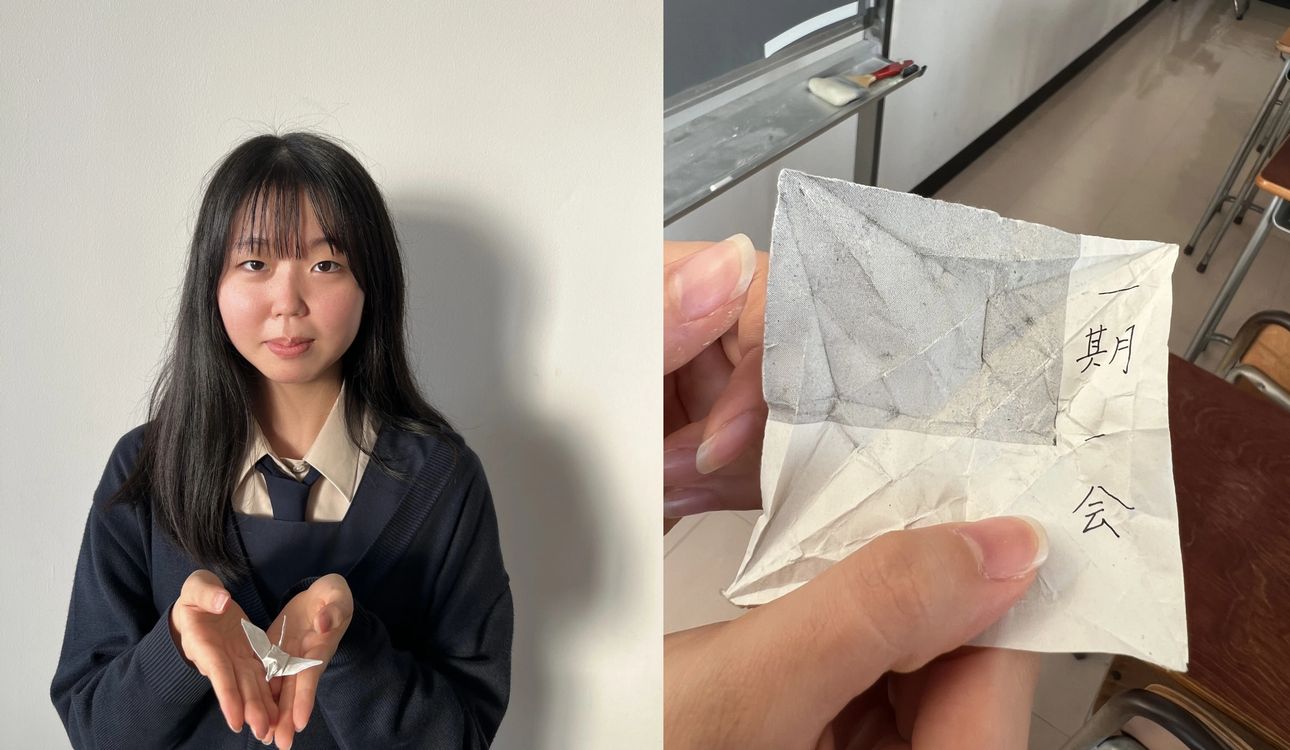
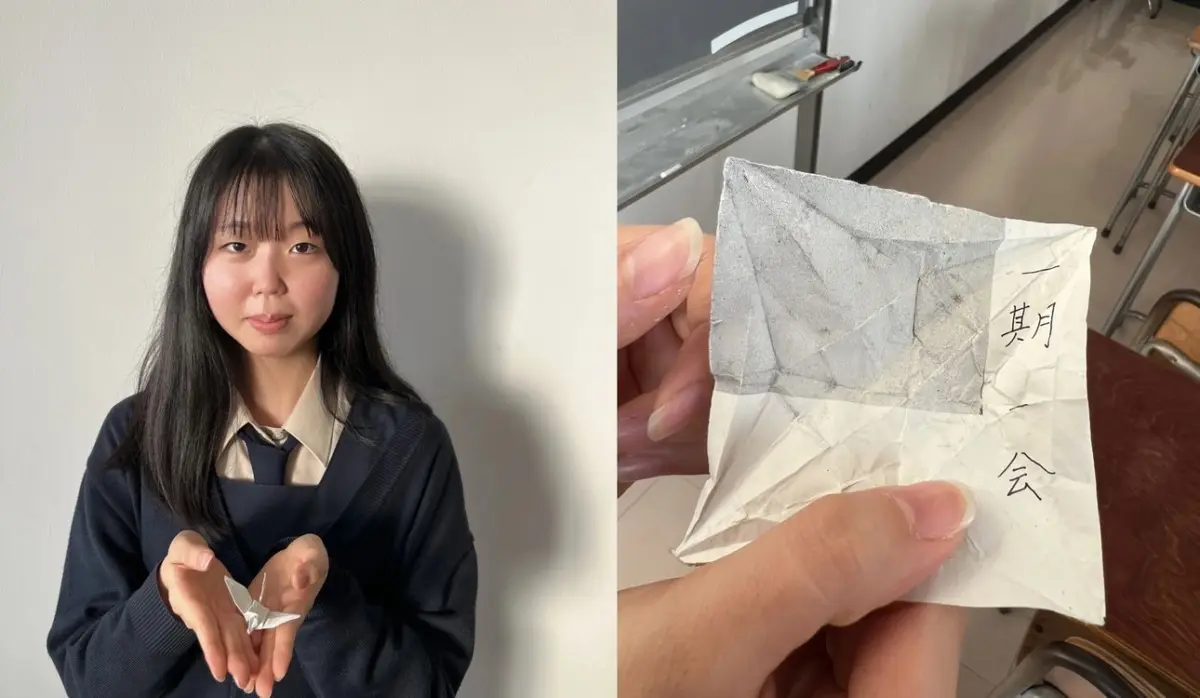
Despite the passage of time, the physical token of the encounter remained. The white paper crane was placed on her desk, serving as a quiet, steadfast fixture in her room. Whenever her eyes drifted toward the delicate paper sculpture, she was instantly reminded of the stranger’s unexpected compassion during one of her most vulnerable childhood moments.
The true depth of the encounter, however, remained hidden within the folds of the paper for an entire decade.
The revelation occurred years later while Matsuda was sitting inside her high school English class. Her teacher, Benjamin Johnson, integrated NPR’s “My Unsung Hero” series into a classroom writing workshop. He instructed each student to reflect upon and document the specific details of a past encounter with a Good Samaritan who had unexpectedly offered help during a time of need. Tasked with finding a meaningful personal example, Matsuda immediately thought of the man from the park and the white paper crane that had sat on her desk for ten years.
Though a full decade had elapsed, muddying some of the finer details of her childhood recollection, the core memory of the man, his gentle voice, and the paper crane remained vivid. As she contemplated the assignment in class, a sudden and powerful intuition seized her. She was struck by an overwhelming urge to unfold the origami work to inspect the interior of the paper, wondering if the stranger might have left a hidden message inside.
The trip home from school that afternoon was marked by an unusual sense of urgency. Upon rushing into her room, she carefully and deliberately unfolded the delicate white paper, discovering—just as her premonition had suggested—a secret message inscribed on the inner surface.
Written in traditional Japanese calligraphy were two characters, representing a well-known cultural idiom that carries profound philosophical weight about the transient nature of human relationships.
Reflecting on the discovery through her translator, Matsuda noted the timeless wisdom of the phrase. “We should treasure each time we cross paths with someone because it might never happen again,” she explained, summarizing the idiom’s essence as a reminder to simply “cherish the moment.”
Unfolding the crane and reading the hidden inscription provided a profound new layer of appreciation for the encounter. “Then I realized even more how kind and how nice of a man he was,” Matsuda said, recognizing him as a true unsung hero whose quiet gesture of empathy echoed across ten years to teach her a lasting lesson about human connection.