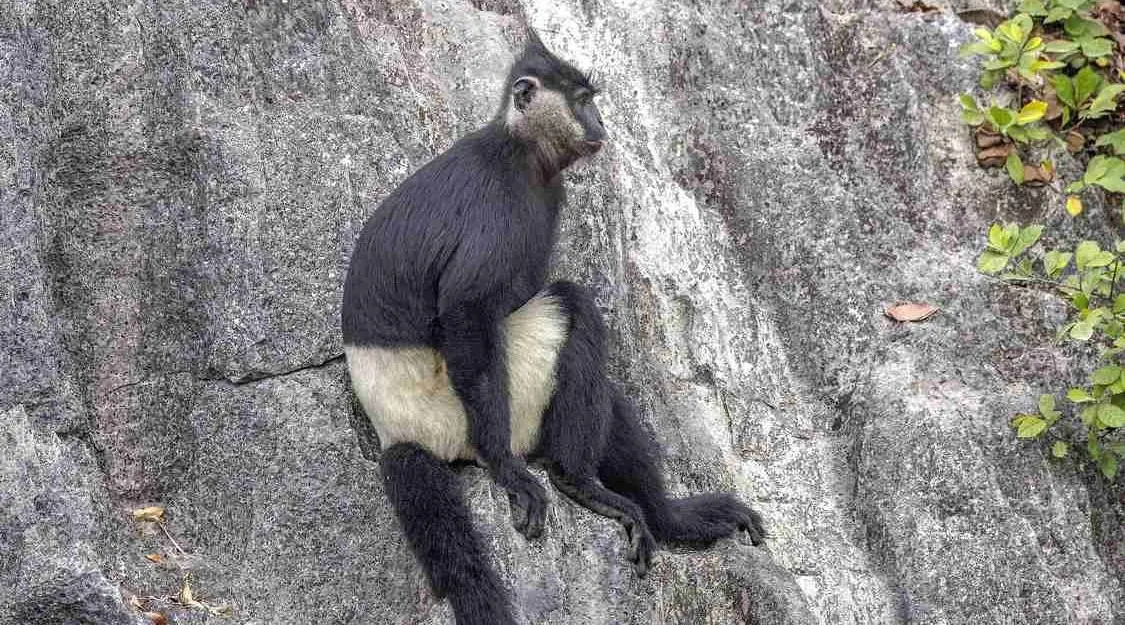
Spanning approximately 7,500 acres of dramatic karst limestone escarpments and pristine native forests, the newly established Kim Bang Delacour’s Langur Habitat Conservation Area represents a monumental stride forward in regional wildlife management. Named after the pioneering French-American ornithologist and biologist Jean Théodore Delacour, who first identified the distinct species, Delacour’s langur (Trachypithecus delacouri) currently hangs on by a devastatingly fragile thread. Wildlife experts estimate that the entire global population may be reduced to roughly 17 fragmented groups, totaling just over or under 250 individual animals surviving in the wild.
While several national parks are already spread across the narrow stretch of northern Vietnam where these striking, black-and-white leaf-eating monkeys make their home, their geographic boundaries do not always neatly overlap with the primates’ actual ranges. Recognizing this perilous gap in protection, local authorities in Ninh Binh Province, alongside regional governing bodies, are taking this vital extra step to carve out safe territory specifically tailored to the ecological needs of Delacour’s langur as the species faces its most desperate historical hour.
According to reports from Vietnam’s DTI News, the newly designated reserve covers a total area of 3,182 hectares—equivalent to nearly 7,860 acres—spanning the administrative wards of Ly Thuong Kiet, Tam Chuc, and Nguyen Uy. The territory encompasses the broader Tam Chuc region, which is globally renowned for its dreamy, UNESCO-recognized landscapes characterized by flat, sprawling rice paddies, lazy winding rivers, and towering limestone pinnacles cloaked in deep, emerald-green tropical jungle. This extraordinary topography, while visually stunning to travelers, also provides the sheer cliff faces and deep forest cover that are absolutely mandatory for the survival of limestone-dwelling langurs.
Under the strict operational guidelines outlined for the conservation area, 4,400 acres of the reserve will be designated for strict, highly guarded protection explicitly tailored to shelter the species from external threats and habitat degradation. Furthermore, an additional 3,500 acres have been singled out specifically for intensive ecological restoration, allowing degraded forest patches to recover, heal, and ultimately expand the available living space for the struggling primates. Beyond these carefully drawn boundaries, planners noted that there is virtually no remaining suitable habitat or existing land-use framework that would allow for a wider buffer zone—making the strict interior management of this specific reserve even more critical for a species currently classified as Critically Endangered by conservation authorities.
Managing a population on the very brink of extinction requires meticulous scientific oversight, particularly given the biological traits of the animals involved. Strict management plans are currently being formulated and implemented to closely monitor the demographic trends and health metrics of this slowly reproducing monkey. Female Delacour’s langurs typically reach sexual maturity at around four years of age. Following a gestation period lasting approximately seven months, mothers will bear a single infant. The maternal bond remains exceptionally strong and prolonged, with young langurs continuing to nurse until they are successfully weaned at roughly 21 months of age. Because of this slow reproductive rate, any loss of adult individuals to disease, habitat loss, or human disruption can deal a devastating blow to a population of just 250 animals.
Beyond providing a heavily guarded sanctuary for the langurs themselves, local authorities have emphasized that the establishment of the reserve will yield broader ecological and socioeconomic benefits for the surrounding communities. Officials stated that the comprehensive project will significantly help improve the overall forest quality across the local wards through enhanced protection measures, active tree-planting initiatives, and ongoing ecological restoration efforts that will heal the landscape following years of regional development and human pressure.
In tandem with these rigorous ecological goals, the project aims to foster a deep sense of environmental stewardship by actively increasing public awareness and encouraging community participation in local conservation activities. By engaging residents directly in the protection of their natural surroundings, the initiative hopes to build a sustainable local framework that ensures human communities and wildlife can coexist harmoniously.
Plans are also underway to gradually develop controlled, low-impact ecotourism within the region. This carefully managed tourism model will be directly linked to ongoing biodiversity protection efforts, serving as a sustainable economic driver that celebrates and promotes the area’s extraordinary natural heritage without compromising the fragile habitats that the langurs rely on for their daily survival. Through these multifaceted actions, regional authorities and conservationists are hoping to turn the tide for one of Vietnam’s most iconic and vulnerable native species.