Researchers from the Society for the Protection of Underground Networks (SPUN) revealed that a staggering 90 percent of mycorrhizal fungi biodiversity hotspots are located outside of currently protected areas. Scientists warn that the ongoing degradation and disruption of these vital subterranean ecosystems could severely undermine global carbon emissions reduction rates, diminish agricultural productivity, and drastically reduce the resilience of terrestrial ecosystems against extreme climate events.
The study, titled "Global hotspots of mycorrhizal fungal richness are poorly protected," represents the first large-scale scientific application of SPUN’s ambitious world-mapping initiative launched in 2021. By analyzing an unprecedented dataset of more than 2.8 billion fungal sequences gathered from 130 countries, researchers successfully constructed high-resolution, predictive biodiversity maps tracking the planet’s underground mycorrhizal communities.
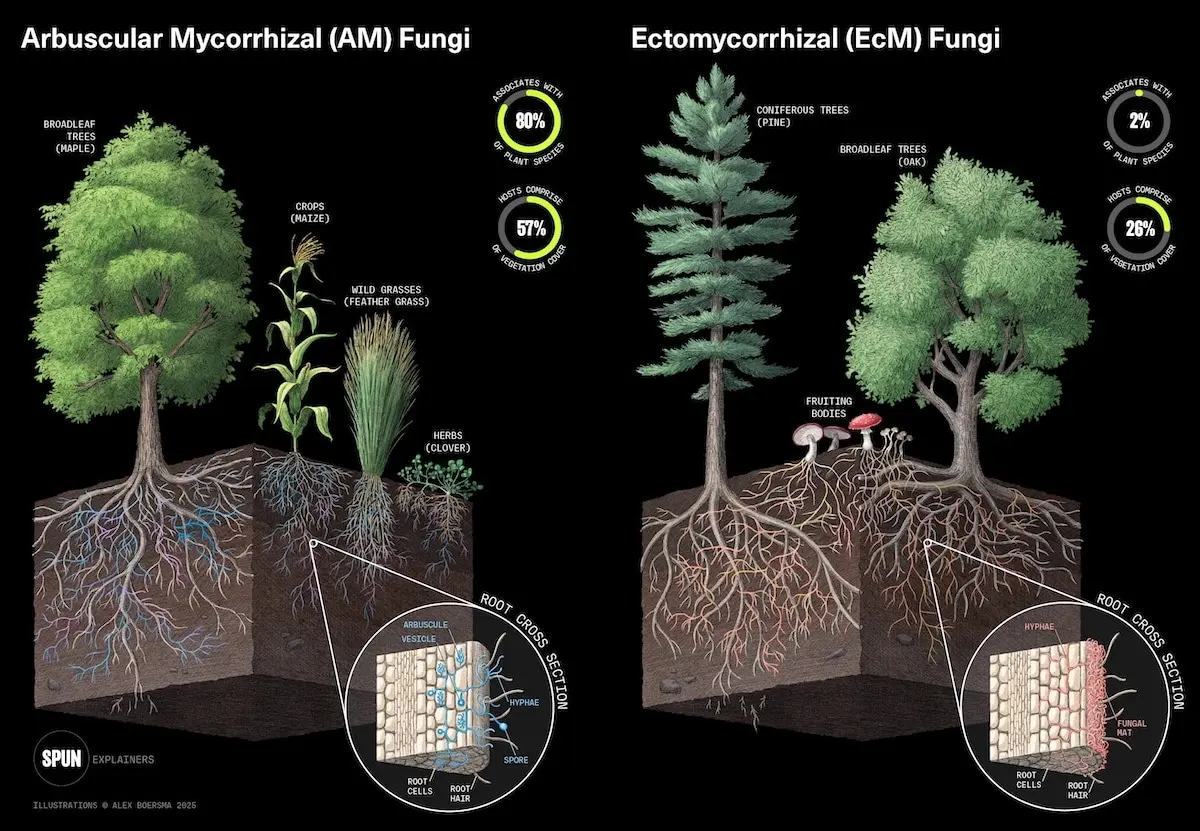
Mycorrhizal fungi perform irreplaceable ecological functions as planetary engineers. These organisms form symbiotic relationships with the vast majority of land plants, cycling essential nutrients, storing massive volumes of carbon, supporting overall plant health, and actively constructing healthy soils.
Dr. Toby Kiers, executive director of SPUN, emphasized the foundational role these organisms have played in the history of life on Earth. Pointing to a period approximately 450 million years ago when the planet was entirely devoid of land plants, Kiers noted that it was through the establishment of these mycorrhizal fungal networks that plants were eventually able to colonize the Earth, ultimately paving the way for the development of terrestrial ecosystems and human life.
"When we disrupt these critical ecosystem engineers, forest regeneration slows, crops fail, and biodiversity above ground begins to unravel," Kiers said. "For centuries, we’ve mapped mountains, forests, and oceans. But these fungi have remained in the dark, despite the extraordinary ways they sustain life on land. This is the first time we’re able to visualize these biodiversity patterns—and it’s clear we are failing to protect underground ecosystems."

The newly developed maps utilize high-resolution data to visualize predicted arbuscular mycorrhizal and ectomycorrhizal biodiversity patterns across subterranean environments, highlighting areas of high species richness and endemism with bright colors. These communities are not evenly distributed; unique fungal clusters thrive in specialized regions across the globe, ranging from West Africa’s Guinean forests and Tasmania’s temperate rainforests to Brazil’s Cerrado savanna.
Despite their critical importance, these organisms have historically been omitted from mainstream climate change strategies, international conservation agendas, and ecological restoration efforts. Mycorrhizal fungi act as the planet’s biological circulatory systems, drawing more than 13 billion tons of carbon annually into global soils—an amount equivalent to roughly one-third of all global fossil fuel emissions.
When these subterranean networks are fractured or destroyed by human activities such as intensive agriculture, deforestation, and industrial development, the stored carbon is often released back into the atmosphere, accelerating both climate change and global biodiversity loss. The study’s findings highlight a profound blind spot in global conservation policy, revealing that a mere 9.5 percent of global fungal biodiversity hotspots reside within existing protected areas.
Dr. Merlin Sheldrake, impact director at SPUN, noted that the new mapping tools help alleviate what he describes as "fungus blindness," equipping conservationists and policymakers to better rise to the environmental challenges of the modern era.
The initiative has garnered support from prominent conservation figures and scientists worldwide, including conservationist Jane Goodall, authors Paul Hawken and Michael Pollan, and Giuliana Furci, founder of the Fungi Foundation. Supporters argue that underground biodiversity must become as fundamental to environmental planning and legal decision-making as satellite imagery is today.
Designed specifically as an actionable resource for decision-makers in policy, law, and environmental planning, the SPUN mapping platform allows researchers, conservation groups, and government officials to identify critical biodiversity hotspots, prioritize environmental interventions, and inform the designation of new protected areas. The platform enables leaders to search for underground ecosystems predicted to house unique, endemic fungal communities and explore opportunities to establish dedicated underground conservation corridors.
Dr. Michael Van Nuland, a lead data scientist at SPUN and lead author of the study, stressed the broad societal stakes of the research. "These maps are more than scientific tools—they can help guide the future of conservation," Van Nuland said. "Food security, water cycles, and climate resilience all depend on safeguarding these underground ecosystems."

The implications of the mapping initiative extend directly into ecological restoration. For decades, restoration projects have focused almost exclusively on aboveground flora and fauna, often overlooking the microscopic foundations required for ecosystems to truly thrive.
Dr. Alex Wegmann, a lead scientist at The Nature Conservancy, noted that historical restoration practices have been dangerously incomplete due to this terrestrial bias. According to Wegmann, the newly established high-resolution maps provide critical quantitative targets for restoration managers, helping them determine what diverse, healthy mycorrhizal communities should look like in specific regions.
While the dataset underlying the maps is already remarkably robust—comprising more than 40,000 specimens representing 95,000 mycorrhizal fungal taxa—it represents a tiny fraction of the living world. Researchers estimate that only about 0.001 percent of the Earth’s surface has been sampled for fungal diversity to date.
To bridge this data gap, an international network of 96 "Underground Explorers" spanning nearly 80 countries, alongside more than 400 collaborating scientists, is actively sampling remote and hard-to-access subterranean ecosystems. Expeditions are currently underway in challenging environments across Bhutan, Mongolia, Ukraine, Pakistan, and other biologically rich regions.
As policymakers and scientists grapple with accelerating environmental degradation, the proponents of the new study hope the findings will fundamentally reshape how humanity approaches planetary stewardship. By bringing the hidden half of terrestrial ecosystems into the light, researchers aim to ensure that the vital networks sustaining life on land are no longer left unprotected.