The grim milestone highlights a persistent and accelerating trajectory of global consumption. As human demand for materials obtained from nature continues to outpace ecological replenishment, scientists, economists, and environmental advocates are warning that the planet’s ecological deficit is accumulating at a dangerous and ultimately unsustainable pace.
Earth Overshoot Day marks the exact point in the calendar year when human demand for ecological resources and services exceeds what Earth’s ecosystems can naturally regenerate within that same year. These resources include everything humanity uses for survival and economic activity, such as food, fiber, timber, freshwater, and space for urban infrastructure, alongside the absorption of carbon dioxide emissions.
First launched in 2006 by political economist, author, and campaigner Andrew Simms in collaboration with the Global Footprint Network, the concept was designed to translate complex ecological metrics into an accessible, hard-hitting calendar date. Since its inception, the date has been calculated and announced annually. Over nearly two decades, the trend has been relentlessly consistent: the date has arrived earlier almost every year, serving as a stark barometer of humanity’s expanding environmental footprint and the rapid depletion of planetary reserves.
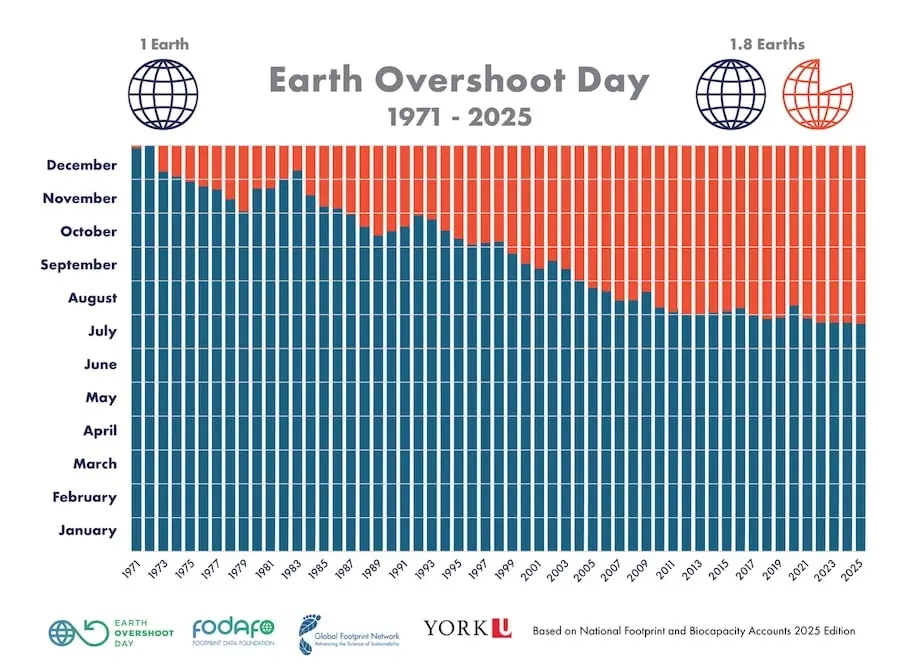
To ensure long-term analytical accuracy, the Global Footprint Network recently recalculated historical Earth Overshoot Days, extending their data models far prior to 2006. These refined retrospective calculations paint a sobering picture of how rapidly industrial and consumer demands have overwhelmed natural systems over the past several decades.
According to these updated figures, Earth Overshoot Day fell as late as December 31 in 1972, meaning humanity was living almost entirely within the planet’s annual ecological budget at the dawn of the modern environmental movement. However, as global populations grew and industrialization expanded worldwide, the date crept progressively earlier, reaching November 3 by 1979.
Although a temporary slowdown in the early 1980s pushed the date back into early December, the respite was short-lived. By 1989, the date had advanced to October 12. It remained stable within the month of October throughout the remainder of the decade, crossing into September on September 25, 1999. By the time Earth Overshoot Day was formally announced to the public in 2006, the revised calculations placed the milestone on August 22.

The acceleration continued into the 21st century. The milestone reached the month of July for the first time in history in 2018. While global economic disruptions temporarily pushed the date back to August in 2020 due to pandemic-related lockdowns and slowdowns, it quickly rebounded to July and has remained there ever since. The previous earliest record was set on July 25, a date reached in both 2022 and 2023.
Reaching the earliest-ever Earth Overshoot Day on July 24 underscores the profound disconnect between human consumption patterns and the finite capacities of the biosphere. Nature simply cannot continue to keep pace with such high, unyielding demands from global markets and societies.
According to the Global Footprint Network, humanity is currently consuming nature at a rate 1.8 times faster than Earth’s ecosystems can regenerate. This means that maintaining our current global lifestyle requires the ecological equivalent of nearly 1.8 Earths. This deficit is driven by the overexploitation of essential natural assets, including the over-extraction of freshwater aquifers, the clear-cutting of ancient forests, and the overfishing of marine ecosystems. Furthermore, this figure accounts for the colossal volume of carbon emissions pumped into the atmosphere—emissions that far exceed what global forests, oceans, and soils can absorb.
Environmental experts emphasize that the danger of Earth Overshoot Day goes beyond the calendar date itself. Even if the date were to stabilize from year to year, the cumulative ecological deficit continues to compound over time. With consumption perpetually outpacing replenishment, ecological pressure mounts across multiple fronts. Scientists point out that humanity has already dangerously pushed past seven of the nine scientifically defined planetary boundaries, crossing critical thresholds that regulate the stability of the Earth system, including ocean acidification, biodiversity loss, and climate change.
The mounting ecological debt has left little room for error, according to prominent members of the scientific and conservation communities.
"We are stretching the limits of how much ecological damage we can get away with. It is now a quarter into the 21st century and we owe the planet at least 22 years of ecological regeneration, even if we stop any further damage now," said Lewis Akenji, a board member of the Global Footprint Network, in a public statement addressing the 2025 results. "If we still want to call this planet home, this level of overshoot calls for a scale of ambition in adaptation and mitigation that should dwarf any previous historical investments we have made, for the sake of our common future."
Despite the alarming trajectory, researchers and analysts stress that it is not too late to change course. The Global Footprint Network has outlined a series of concrete, scalable interventions through its "Power of Possibility" campaign, demonstrating that moving the date of Earth Overshoot Day back into alignment with planetary boundaries is physically and economically achievable.

Among the most impactful measures identified by the organization is the aggressive reduction of global carbon emissions. Halving global carbon emissions alone would shift the Earth Overshoot Date farther into the calendar year by a remarkable three months, single-handedly neutralizing the largest driver of the current ecological deficit.
Other targeted solutions offer substantial improvements. Reducing global food waste by half would push the date back by 13 days, eliminating the vast amounts of water, energy, and land wasted in producing food that is never consumed. Generating at least 75 percent of global electricity from renewable energy sources instead of fossil fuels would push the date back by 26 days. Furthermore, implementing a comprehensive, global-scale Green New Deal framework could shift the date by as much as 42 days by systematically transforming infrastructure, transportation, and industrial production.
These solutions rely on technologies and policy frameworks that already exist. The primary barrier is not a lack of tools, but a lack of coordinated political will and urgency among global leaders and industries.
Mathis Wackernagel, co-founder and board member of the Global Footprint Network, underscored the absolute necessity of decisive action, warning that nature’s ledger cannot be negotiated with indefinitely.
"Because of the nature of physics, overshoot cannot last," Wackernagel said in a statement. "It will end either by deliberate design or dumped-on disaster. It should not be too hard to choose which one is preferable, particularly in light of so many possible choices."