Stony coral tissue loss disease, commonly referred to as SCTLD, has wreaked havoc on marine environments, particularly along the Florida reef tract, sweeping through the region and decimating vulnerable reef-building species at an alarming rate. As researchers race against time to find viable interventions, the discovery and testing of targeted biological treatments represent a critical shift away from chemical treatments and toward harnessing natural marine microbiomes to protect threatened reefs.
The bacterial strain MCH1-7 was first uncovered by scientists from the Smithsonian Marine Station back in 2018. Researchers initially identified the beneficial bacteria on a coral colony that had naturally and successfully resisted a severe local outbreak of stony coral tissue loss disease, suggesting that the strain played an intrinsic role in the coral’s survival.
Scientists have previously tested the bacterial probiotic on adult corals with encouraging preliminary outcomes, but they have now published new research in the journal Frontiers in Marine Science detailing how this probiotic could limit disease spread in younger corals as well. In this latest phase of research, scientists are closely investigating a compound known as tetrabromopyrrole, or TBP, which is naturally produced by the bacteria, to understand how it may successfully protect entire coral colonies from succumbing to the disease.
The connection between the bacterial compound and coral health runs deep in marine ecology, touching on the natural life cycles of reef organisms. According to researchers, TBP serves multiple ecological functions in the marine environment, influencing how coral larvae choose where to settle and grow into new colonies.
"If TBP is a natural settlement cue, and if bacteria that also produce this compound protect corals from disease, it makes sense that larvae would settle where those compounds are being produced," Jennifer Sneed, a marine biologist at the Smithsonian Marine Station, said in a public statement discussing the findings. "More of them would survive to be able to recognize the compound."
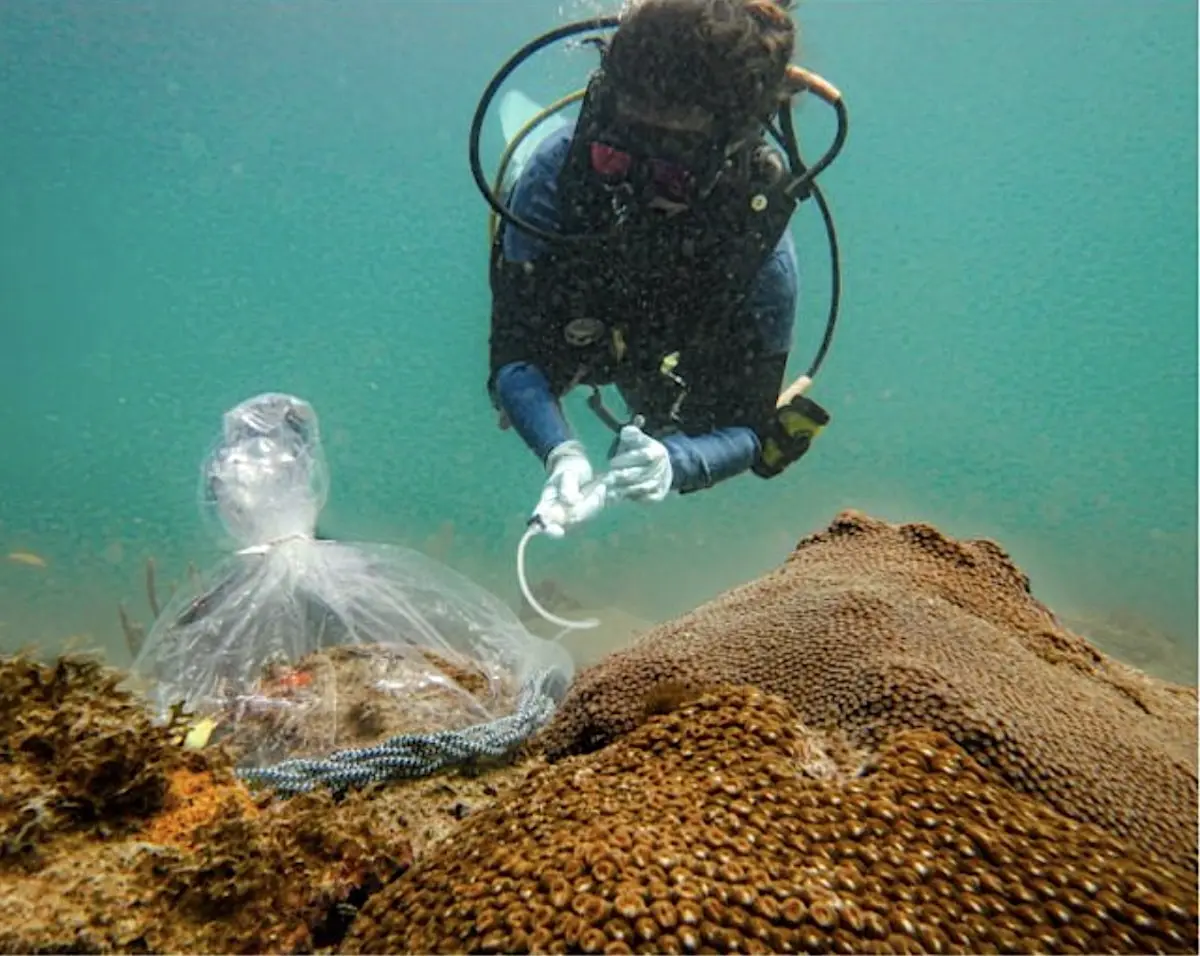
To rigorously test the effectiveness of the compound under realistic marine conditions, researchers applied the probiotic to great star coral, scientifically known as Montastraea cavernosa, utilizing two distinct application methodologies. The first method involved injecting the probiotic into seawater contained inside a weighted bagging system placed directly around the individual coral colony. The second method utilized a concentrated paste applied directly to active disease-related lesions on the coral surface.
The bagging approach allowed the research team to evaluate whether treating the surrounding water could achieve whole-colony treatment effectiveness, protecting healthy tissue from ongoing pathogen exposure. Following the initial interventions, the research team closely monitored the treated corals and systematically tested coral tissue samples over an extended period of two and a half years after the treatment was administered.

The long-term results of the monitoring period provided clear insights into which application strategy held the most practical value for reef restoration efforts. As reporting by Mongabay News highlighted, the great star coral colonies treated via the whole-colony bagging method lost only about seven percent of their tissue from the disease over the course of the study. In stark contrast, untreated control corals lost an average of 35 percent of their total tissue to stony coral tissue loss disease during the same timeframe.
These protective results demonstrated remarkable persistence over the course of the research period, with the whole-colony probiotic treatment successfully slowing the rate of disease spread for a full two and a half years after the initial application. However, the alternative approach involving the direct application of the probiotic paste to individual lesions did not yield similar levels of effectiveness, leading researchers to focus their future recommendations elsewhere.
In response to these findings, the researchers determined a practical way to apply the effective whole-colony probiotic treatment to corals while operating underwater via scuba diving. They further confirmed through their field observations that this specialized deployment method would not disrupt other healthy Caribbean coral species inhabiting the same marine environment, a crucial safety factor that could pave the way for a widely applicable stony coral tissue loss disease treatment for full coral colonies in the future.
Despite the logistical challenges involved in underwater deployment, the scientific team believes the substantial benefits far outweigh the operational hurdles.
"While the whole-colony bagging method does involve more material transport by divers and more time for deployment and retrieval, its performance at treating SCTLD and promoting long-term resistance outweigh these costs and is therefore the recommended application method of those we tested for probiotic treatments such as the McH1–7 strain," the study authors wrote.
The authors of the study have continually stressed that while these findings represent a major step forward, a significant amount of additional research remains necessary to make this potential treatment a clinical reality for widespread reef management. They emphasize that further scientific studies must be conducted to uncover and refine additional treatments capable of addressing the wide variety of other coral species that are similarly affected by the deadly stony coral tissue loss disease across the broader Caribbean and Florida reef tracts.
Researchers remain cautious about framing the discovery as an immediate cure, emphasizing instead that the work lays a solid scientific groundwork for future innovations in marine disease mitigation.
"It’s important to understand that this is the very beginning," Kelly Pitts, the lead author of the study and a researcher at the Smithsonian Marine Station, told Mongabay News. "This is definitely not a cure-all, but we’re definitely moving in the right direction."