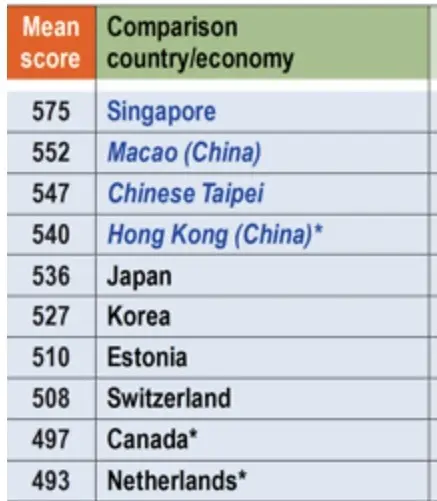
The data regarding international scholastic performance are remarkably clear. According to the Programme for International Student Assessment (PISA), an international organization that evaluates educational systems worldwide, Western nations rarely appear at the very top of the mathematics rankings. Observers must travel down the global leaderboard to the seventh position before encountering a Western country. Furthermore, this dominance extends even further when examining regional powerhouses that occasionally shift in reporting metrics. For instance, in previous comprehensive assessments, China’s major metropolitan areas—specifically Beijing, Shanghai, Jiangsu, and Zhejiang—ranked ahead of Singapore, which itself consistently occupies top-tier global positions.
East Asian education systems demonstrate similarly impressive results in reading comprehension, claiming four of the top five spots globally. This achievement becomes even more formidable when accounting for the linguistic complexity of the region. Writing systems based on logographic characters, such as those utilized in Japan and China, require significantly more time and cognitive effort to master compared to the alphabetic systems foundational to most European languages.
The immediate, most obvious explanation for this sustained scholastic performance is cultural, driven largely by intense academic dedication. Of the six East Asian countries topping the recent PISA mathematics rankings, all but Japan exceed the Organization for Economic Co-operation and Development (OECD) average for weekly hours spent in formal classwork. When factoring in the combined Chinese metropolitan regions, three feature prominently in the top seven worldwide for total study hours. Across many of these high-performing societies, the regular school day is merely the beginning; students routinely transition to evening "cram" schools, known locally by various terms across different nations, to study late into the evening.
Whether this rigorous academic intensity yields a net positive for society remains a subject of intense debate among economists, sociologists, and parents alike. On one side of the argument, a hyper-competitive academic culture can crowd out crucial opportunities for childhood play, socialization, and emotional development. Critics argue that when curriculum requirements drift far from the practical skills demanded by modern job markets, the massive expenditure of time and societal energy can become a net-negative, placing an unnecessary economic and psychological drag on society.
Conversely, it is impossible to ignore the remarkable economic performance of East Asian economies—epitomized by the "Four Asian Tigers" of Hong Kong, Singapore, South Korea, and Taiwan. Their phenomenal rise, particularly in advanced technology manufacturing and global commerce, suggests that a society-wide focus on rigorous math and science education generates substantial economic and structural dividends.
While researchers frequently debate the nuances and relative merits of different educational philosophies—including intriguing outliers like Japan, which achieves extraordinary grades with comparatively fewer study hours than its neighbors—scholars are increasingly examining the historical origins of these cultures. Why did such a powerful, enduring emphasis on educational attainment take root in East Asia centuries ago?
The Keju: 1300 Years of Studying
One of the most compelling explanations for the modern cultural reverence for education points to the profound, long-lasting influence of the Chinese civil service examinations, or the keju. While medieval Europe was establishing decentralized feudal systems characterized by hereditary nobility, the traditional Chinese state was administered by a meritocratic bureaucracy. This administrative apparatus was staffed exclusively by graduates of some of the most grueling, competitive examinations the world has ever witnessed.
Historical texts, such as Ichisada Miyazaki’s seminal study China’s Examination Hell, offer a detailed window into the vast array of benefits and profound costs generated by this institutional framework. Established during the Sui dynasty in 605 CE, the civil service examinations were originally conceived as a political mechanism to bypass and weaken the powerful aristocratic families that held disproportionate sway over the imperial government.
In principle, the examinations were remarkably egalitarian for their era, theoretically open to all men. Theoretically, any male citizen—ranging from the scion of a noble family down to a rural peasant commoner—was permitted to sit for the tests, though women were strictly excluded from participation. In practice, however, the immense financial burden required to sustain years of uninterrupted study meant that only those from relatively well-off backgrounds could realistically pursue the path to success.
Despite these socioeconomic barriers, the system introduced a genuine degree of social mobility, legitimized imperial authority, and effectively centralized state power across a vast geographic empire. Because of these structural advantages, the examination system persisted for thirteen centuries, surviving numerous dynastic overthrows and even foreign conquests, before finally being abolished in the waning days of the Qing dynasty.
The psychological hold of the system was absolute. Even figures like Hong Xiuquan, who suffered a profound psychological breakdown after repeatedly failing local examinations, subsequently convinced himself of elaborate religious identities and launched a massive rebellion that cost millions of lives, yet still felt compelled to establish his own version of the examination system within the territories he commanded. For generations, the exams remained an essential pillar of societal order, even for those who suffered under their immense weight.
What Was it Like Taking the Exams?
Miyazaki’s historical accounts vividly capture the grueling reality of the examination process, which evolved into a multi-tiered labyrinth centered on the rigorous memorization and interpretation of the classical Chinese texts. At the height of the system’s complexity during the late Qing dynasty, candidates navigated three major divisions of tests: provincial, metropolitan, and palace examinations.
The provincial examinations, held nominally every three years, required candidates to be locked inside tiny, isolated cells within massive, labyrinthian examination compounds for three continuous days. Each student was provided with only three wooden boards: one serving as a makeshift bed, one as a bench, and one as a writing desk. Because these vast halls sat empty for long periods between tests, they were frequently dilapidated, forcing examinees to frantically protect their precious answer scrolls from leaking rainwater.
Beyond the harsh physical confinement, test-takers grappled with intense psychological pressure fueled by cultural superstitions. It was widely believed that supernatural forces—specifically ghosts—punished individuals guilty of hidden or unpunished crimes during the testing period. Seducers, swindlers, and those with guilty consciences frequently suffered extreme paranoia, with historical anecdotes documenting nervous breakdowns or suicides during the three days of mandatory isolation.
Other cultural beliefs tied misfortune directly to karma. If a lamp oil container accidentally spilled onto a student’s answer sheets, ruining the calligraphy, it was invariably interpreted not as a simple accident, but as divine retribution for past transgressions, resulting in immediate failure. Society firmly believed that any apparent arbitrariness or unfairness in the grading process reflected the judgment of heaven upon concealed misdeeds rather than mere bad luck.
The few who successfully navigated the provincial trials made the long, expensive journey to the capital for the metropolitan examinations. In the early eras of the keju, passing this stage practically guaranteed a lucrative and prestigious appointment within the imperial bureaucracy. However, because scholars often formed deep loyalties to the senior officials who graded their papers—creating factionalism within the government—rulers eventually instituted palace examinations, judged directly by the emperor himself. This final step ensured that successful graduates directed their ultimate gratitude and loyalty toward the throne rather than individual examiners.
To combat the inevitable temptations of corruption and cheating in a system with such high stakes, authorities implemented extraordinary security measures. Candidates underwent thorough physical searches to prevent the smuggling of concealed reference materials. Examiners were restricted to viewing only a candidate’s assigned seat number rather than their name. In the higher-level tests, trusted scribes meticulously hand-copied every single student’s answer sheet to prevent graders from recognizing distinctive handwriting styles. When administrative scandals did occasionally surface, public outrage was so severe that corrupt examiners faced harsh punishments, including exile or execution.
The mathematics of the system highlighted its staggering competitiveness. To even enter the formal system, candidates had to pass local qualifying exams that featured a brutal pass rate of just one to two percent. Provincial exams typically passed roughly five percent of applicants, while metropolitan exams hovered around fifteen to twenty percent. While the final palace examinations rarely resulted in outright failure—acting more as a ranking mechanism—the precise placement a scholar achieved drastically altered his future career trajectory. Out of more than a hundred thousand initial hopefuls across the empire, only a select dozen might ultimately attain the highest academic classification of jinshi.
Unlike modern educational frameworks where academic sorting occurs primarily in youth, preparation for the imperial exams could consume decades. It was common for successful new graduates to be elderly men with graying hair. In some instances, geriatric test-takers were granted honorary status simply to acknowledge a lifetime of dedication, knowing they had long surpassed the standard retirement age for government office.
Legacy of the Imperial Examination System
Quantifying the exact, direct impact that China’s historic examination system exerts on contemporary educational achievement in East Asia remains a complex task for modern economists and historians. One innovative study utilized natural geographic variations in historical exam intensity—measured by the density of jinshi graduates per capita during the imperial era—and discovered that regions with double the historical concentration of graduates exhibit an approximate 8.5 percent increase in modern educational attainment.
Nevertheless, scholars debate whether direct linear causation can be so easily established. For centuries, China radiated profound cultural influence across its neighbors. Even nations like Japan, which never established a native imperial examination system, enthusiastically adopted myriad elements of Chinese civilization, ranging from writing systems and philosophy to religious traditions. It is highly probable that deep societal attitudes toward learning diffused throughout the region regardless of formal administrative structures.
Regardless of whether a direct institutional lineage can be mapped, the legacy of the keju remains a vital key to understanding modern cultural attitudes. For well over a thousand years, the examination system instilled a societal reverence for education that had no contemporary counterpart in Western Europe until the dawn of the Renaissance.
By tying high government office to intellectual merit rather than hereditary birthright, the system was remarkably progressive for its time. Yet, this intense centralization and suppression of alternative avenues for advancement—such as the military—also brought long-term structural trade-offs. While civilian control over the armed forces fostered internal peace and administrative stability, some historians argue that extreme bureaucratic centralization may have inadvertently discouraged the decentralized, disruptive innovations that later sparked the Industrial Revolution in Europe.
Furthermore, the narrow content of the exams—focused primarily on the exhaustive memorization of classical texts rather than practical governance or empirical science—presents a parallel to modern concerns regarding credentialism. Today, economists frequently question whether the escalating societal obsession with degrees, GPAs, and standardized testing genuinely builds superior human capital, or if it simply represents an expensive, stressful sorting mechanism for labor markets.
As modern societies grapple with the pressures of academic competition, the debate over the true value of relentless testing continues. Whether future generations view the historic keju as an essential precursor to a meritocratic, knowledge-based society or as an exorbitantly wasteful scholastic obstacle course, the institution remains a fascinating testament to the enduring power of education to shape human culture, ambition, and societal structure.