The single biggest factor driving this distinction is practicality. Because modern writing often competes with entertainment and demands immediate utility, content that lacks an obvious, real-world application naturally commands a much narrower audience. Everyone is busy, and individuals navigating the pressures of daily life are typically searching for direct ideas and advice that can immediately change their circumstances. Spending precious time learning about subjects that appear impractical at first glance often feels counterintuitive to people who are looking for quick solutions.
Yet, relying primarily on practical advice may be a fundamental mistake for anyone serious about acquiring lasting knowledge. If the ultimate goal is true usefulness, dedicating most of one’s time to learning specific "tips" and "tricks" is frequently counterproductive. Instead, learners achieve far better and more enduring results when they focus their energy on understanding fundamental principles.
Why Impractical Knowledge is More Efficient
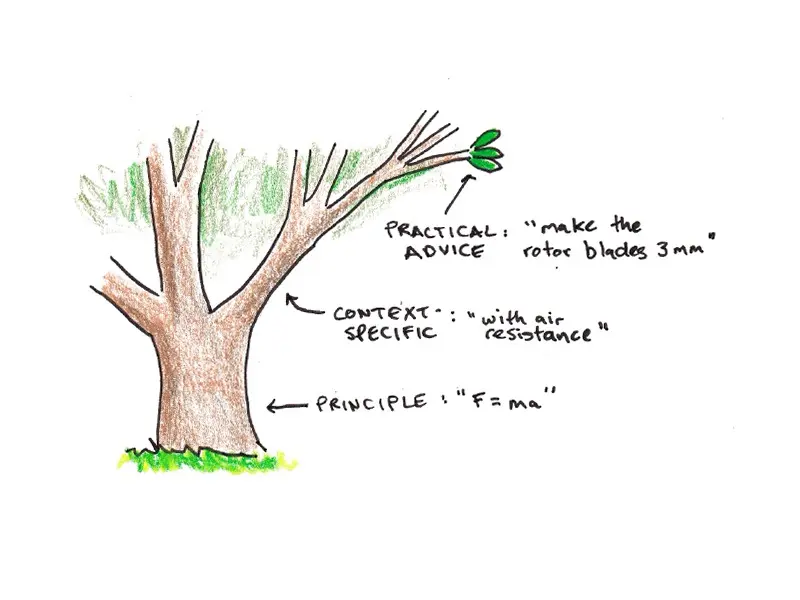
To understand why foundational ideas outperform quick fixes, it helps to visualize knowledge as a tree. At the very base of the tree lie core principles. These are the concepts least contingent on specific states of the world and most universally true. In the physical sciences, this category includes bedrock formulas such as Newton’s second law of motion, or the laws of conservation of momentum and energy.
While these foundational principles are remarkably general, they are often insufficient on their own to solve many of the complex situations people encounter in daily life. Knowing basic physics formulas is not enough, by itself, to design a functional bridge or a rocket ship. As one travels upward from the base, the trunk begins to divide into branching points, which represent the various splits and variations in the state of the physical or social world.
For instance, while it remains a physical truth that heavy and light objects fall at the same speed under ideal conditions, real-world domains diverge. There are environments where air resistance is practically irrelevant—such as dropping a lead ball versus a solid gold ball—and other domains where atmospheric drag becomes a heavily noticeable factor, such as comparing a feather to a rock.
As a learner investigates increasingly specific and concrete situations, the branches divide further and further, ultimately culminating in the leaves of the tree. These leaves represent practical advice. They are the specific tips handed down to individuals who may not understand a domain deeply but simply want to know what immediate actions to take. An example of a leaf might be a directive to shape propeller blades in a very exact geometry to minimize localized air resistance.
Because there are far more leaves on a tree than there are major branches or trunks, and because each individual leaf only covers an incredibly narrow subset of possible environmental states, relying solely on leaves requires memorizing an enormous volume of disconnected advice for every conceivable scenario. To reasonably cover a wide space of possibilities through practical tips alone, a person would need an unmanageable catalog of specialized solutions. Therefore, anyone looking to maximize the breadth of their useful knowledge—meaning the total number of concrete situations their understanding can address—is significantly better off learning lower down the tree, focusing on ideas that are largely independent of hyper-specific contexts.
Practical Domains and Real-World Examples
The tree analogy applies directly to several common areas of personal and professional development. Consider the widespread goal of getting physically fit. In this domain, the leaves represent a specific workout routine or schedule that an individual decides to follow. Moving slightly further down the primary branches leads to fundamental principles such as progressive muscular overload and physiological recovery. Deeper still, approaching the trunk, lie the foundational sciences of energy metabolism, muscle physiology, and cardiac mechanics.
Following a rigid, pre-made workout plan can be effective, provided the individual’s personal physical condition closely matches the profile of the person for whom the plan was originally designed. However, a routine engineered for a twenty-year-old competitive athlete will likely fail—and could even prove hazardous—if applied to a fifty-five-year-old recovering from a chronic joint injury. In contrast, an understanding of basic physiological principles remains applicable across vastly different contexts, helping individuals steer themselves toward more appropriate routines on entirely different branches of the knowledge tree.
A similar dynamic unfolds in the realm of entrepreneurship. The leaves of a business venture are specific tactical maneuvers, such as purchasing targeted social media advertisements or cold-calling purchasing managers at mid-sized firms. If an entrepreneur operates in a niche that precisely mirrors the environment of the person who gave that advice, those tactics might yield immediate results.
If the business context differs even slightly, however, those specific tactics can easily backfire. Entrepreneurs are better served by studying concepts closer to the trunk, such as the mid-level principles of product-market fit, minimum viable products, and systematic market research, or bedrock economic concepts like supply and demand.
The same principle holds true for the study of effective learning itself. For a student preparing for a high-stakes academic test, advice on how to pass that specific exam represents the leaves of the tree. Moving down the branches reveals moderately broader strategies for tackling multiple-choice questions or organizing study materials. At the trunk lie universal cognitive principles such as the spacing effect and retrieval practice. While these bedrock principles leave some ambiguity regarding how to handle a specific upcoming test, they remain universally reliable across nearly every academic discipline.
Addressing Common Objections
Skeptics frequently raise objections to the idea of prioritizing foundational principles over practical tips. One common concern is that principles alone are rarely sufficient to constrain decision-making in real-world scenarios. Learning a deep, abstract principle rarely hands a person a turnkey solution for an immediate, complex problem because too many concurrent variables are at play.
This criticism is valid, but it does not negate the efficiency of principles. Principles simply require supplementation with specific contextual knowledge to arrive at the correct answer. Returning to the arboreal analogy, finding a small bird in a large tree becomes much easier if someone points out the correct general section, even if they cannot pinpoint the exact leaf. Knowing that the bird is on the third branch from the right narrows the search dramatically, whereas knowing only that the bird is on a specific leaf is useless unless the searcher happens to inspect that exact leaf first. Specific advice only has value when it happens to match the exact conditions of the observer.
Another frequent objection is that theoretical principles often fail to accurately describe the messy reality of the world, offering elegant abstractions that do not translate into direct utility. This situation typically arises in domains where foundational principles remain largely undiscovered or fail to fully constrain a complex problem. In fields like physics and engineering, where principles strongly dictate practical outcomes, the rationale for studying fundamentals is absolute. In domains where principles only weakly determine practical actions—such as entrepreneurship or foreign language acquisition—foundational ideas are still valuable, but they must be paired with extensive situation-specific guidance.
A final concern is that working upward from fundamental principles can be intellectually intractable, forcing learners to rely entirely on practical advice out of sheer necessity. As learners move closer to the trunk, the cognitive effort required to map out branching points and ultimate outcomes increases significantly. This complexity explains why hierarchical domains exist in the first place. For highly complicated fields, people occasionally require higher-level knowledge to make fundamental principles actionable. Nevertheless, because the explanatory span of a single principle is so broad, foundational learning remains vastly more efficient over the long term.
Implications for Lifelong Learners
The underlying thesis that learning principles is more efficient than gathering practical advice is itself a deep principle, carrying clear consequences for how people consume information. Modern bookstores and online platforms overflow with practical guides promising rapid results in productivity, dietary weight loss, or personal finance. Many of these offerings function purely as leaves on the tree—offering a new fifteen-day weight loss regimen, a specific author’s daily writing habits, or a strict budget plan designed for early retirement.
For an individual reading only a single book on an unfamiliar topic, a practical guide might occasionally suffice, provided their personal circumstances align perfectly with the author’s narrative. However, anyone planning to read widely across multiple subjects should avoid starting with the leaves. When studying a field with an established academic foundation, learners should consult textbooks or objective introductory guides that clearly outline the trunk of the discipline.
Making it a personal maxim to master the trunks of various domains ensures that when practical, real-world problems eventually arise, the foundational heavy lifting has already been accomplished.