
Fiction
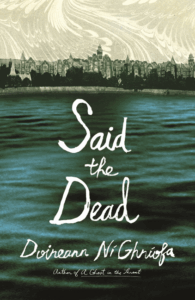
At the top of this week’s fiction list is Doireann Ní Ghríofa’s Said the Dead, published by Biblioasis. The novel has drawn widespread critical acclaim, securing seven rave reviews alongside one positive notice. Critics have praised the book for its unique stylistic approach, with Joelle Egan of Booklist describing it as an “[an] emotionally charged, genre-bending work of history and fiction.” Egan noted that by “blending documented history with imaginative reconstruction, Ní Ghríofa reverently portrays women deprived of freedom and agency, caught between a burgeoning women’s rights movement and the quagmire of paternalism.” Readers seeking an early look at the author’s prose can explore an excerpt published by Literary Hub, which delves into the secrets that old buildings keep.
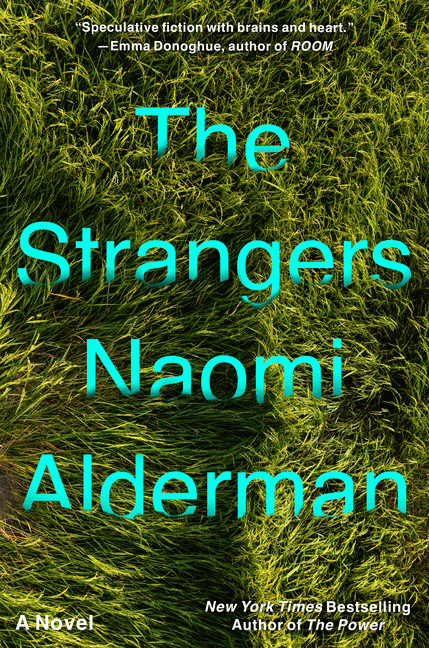
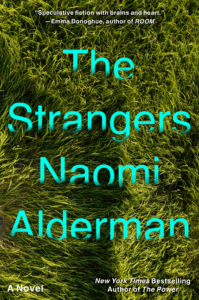
Coming in second place is The Strangers by Naomi Alderman, published by Little Brown and Company. Alderman’s latest work has sparked robust discussion among critics, earning five rave reviews balanced by one mixed review and one pan. Reviewers have lauded the book’s emotional depth and its adroit handling of contemporary themes. Writing for The Guardian, Keiran Goddard called the novel “a remarkably successful evocation of loss,” adding that “Alderman handles the fairly obvious political allegories with a lightness of touch that prevents them from collapsing into polemic.” Goddard ultimately hailed the release as “a deeply moving and wise book.”
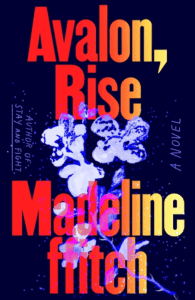
Madeline ffitch’s Avalon, Rise, published by Farrar, Straus and Giroux, claims the third spot on the fiction list with three rave reviews and two positive notices. Publishers Weekly characterized the novel as “biting yet stirring,” observing that, “As ffitch movingly shows, people discover their love for each other once they’re forced to fight. It’s a triumph.”
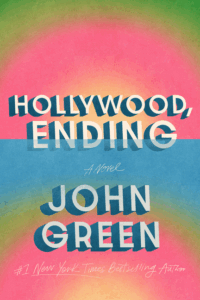
John Green returns to the literary spotlight with Hollywood, Ending, published by Dutton, which has earned three rave reviews and one positive response. Known widely for his beloved young adult classics, Green’s latest work applies his signature emotional intelligence to a more mature canvas. In her review for Slate, Laura Miller noted that the book “has the remarkable warmth that made his young-adult books beloved contemporary classics.” Miller added that the novel is “hilariously frank and profane” and contains “moments that come as close as Green has ever gotten to savage,” while emphasizing that “at heart, though, he’s a tender writer whose abiding concern through all his work is what it takes to remain decent in a ruthless and impersonal world.”
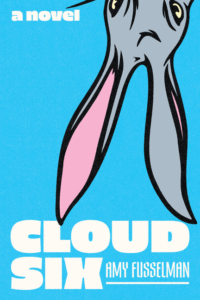
Rounding out the fiction selections is Amy Fusselman’s Cloud Six, published by Catapult, which secured three rave reviews and one mixed review. Writing for the Los Angeles Review of Books, Zachary Smolar examined the book’s complex stylistic maneuvers, observing that “these high-wire tricks, which in a lesser work might cause the novel to collapse under the weight of its own shtick, are successful here because the absurdity has a purpose.” Smolar added, “Fusselman wants us as hopelessly disoriented as the new arrivals to Widdershins’s realm so she can remind us of what she told us at the book’s outset: she is here for us… If heaven is an author who understands humanity, in all its flaws and its beauty, and still has mercy, then here, Fusselman has proven herself divine.”
Nonfiction
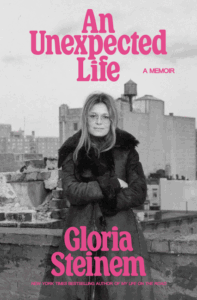
On the nonfiction side, Gloria Steinem’s memoir An Unexpected Life, published by Random House, leads the category with four rave reviews, one positive review, and one mixed review. The book offers readers a fresh perspective on a heavily documented life. Emma Brockes, writing for The Guardian, noted that while Steinem’s backstory is well-traversed, “What I found interesting in the book were Steinem’s asides about the cost of pursuing the life she chose.” Brockes reflected on Steinem’s enduring legacy, writing, “As we enter the post-Steinem era—a statement that seems outlandish, given the length and ardour of her service—it’s a pleasure, simply, to spend time in her company, and her role as an elder is one she takes seriously.”
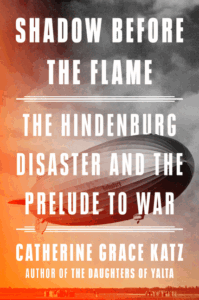
Catherine Grace Katz’s historical exploration Shadow Before the Flame: The Hindenburg Disaster and the Prelude to War, published by Viking, has captured significant attention with three rave reviews, two positive notices, and one mixed review. Coleen Mondor of Booklist praised the rigorous research behind the project, noting, “By the time the narrative reaches that night, Katz has introduced readers to many of the passengers, so their final moments come across as remarkably poignant. A well-researched title certain to thrill fans of WWII and aviation history.”
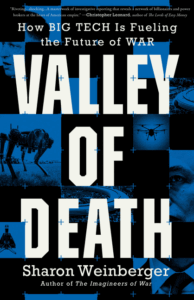
Security and defense also feature prominently in Sharon Weinberger’s Valley of Death: How Big Tech Is Fueling the Future of War, published by Little Brown and Company. The book has earned three rave reviews and two positive notices. James Pekoll of Booklist described the work as “wonderfully terrifying,” emphasizing that it is “extensively detailed and exquisitely sourced and all the more impressive given that Weinberger wrote it while recovering from spinal cancer.” Pekoll called it “a crucial read for everyone concerned about our national security in this uncertain age.”
Music and cultural criticism fans will find much to ponder in Chuck Klosterman’s Rock: A Mainstream Alternative History of Alternative Mainstream Music, published by Da Capo, which received two rave reviews and two positive notices. Jeremy McDonagh of PopMatters highlighted the intellectual playfulness of Klosterman’s thesis, writing, “This is the great pleasure of Rock. Klosterman isn’t asking whether a song is inherently rebellious or conservative… Chuck Klosterman’s treatment of punk is especially revealing.” McDonagh concluded that “the best thing about Rock* is that its seriousness never quite overwhelms Chuck Klosterman’s humor. It is an elaborate joke about the history of music that gradually becomes a joke about our confidence in history itself.”

Finally, Charles Spencer’s memoir Swan Song: Diana, my Sister, published by Penguin, rounds out the nonfiction list with two rave reviews, one positive review, and two mixed reviews. Alexandra Jacobs of The New York Times described the book as “elegant and reproving,” noting that it is “most compelling as a postcard from the siblings’ nursery, where their bond was solidified.” Jacobs added that “even with all its bitterness toward bad actors, like the deceptive Diana interviewer Martin Bashir, this is a lyrical book that delights in moments of the British absurd.”