According to Yun’s father, the smartest person he knew was his youngest sister, Aunt D. In the late 1960s, Aunt D. had immigrated to the United States from South Korea entirely by herself, eventually securing what her brother proudly referred to as a “steady” job with the federal government. While her exact duties remained somewhat vague to her family, the tangible perks were crystal clear to Yun’s father: good benefits, guaranteed annual pay increases, and, most importantly, ironclad job security. As he frequently reminded his family, nobody could fire her.
That emphasis on absolute job security stemmed from a stark contrast in her parents’ own professional lives. A combination of linguistic barriers and personal temperament had forced Yun’s father into the unpredictable world of self-employment. In the early days of his career in America, he taught tae kwon do classes until late into the night, handling every single dollar he earned. He would carefully unfold the wrinkled bills and occasional checks handed to him by his students. Meanwhile, Yun’s mother, whom he sent for a year after establishing himself in the United States, worked grueling shifts on the production line of a frozen pizza factory and waited tables. They toiled endlessly until they finally saved enough capital to purchase a small business of their own.
For her parents, the American dream was defined by the relentless hustle. It did not matter if they were physically exhausted, battling illness, or weighed down by sadness; stopping was never an option. Having survived the devastation of the Korean War as children, they carried a deep, ingrained understanding that life could turn sideways with terrifying speed. They operated under the harsh reality that there was no safety net waiting to catch them in America—and by extension, no safety net for Yun or her sister. In stark contrast, Aunt D., with her secure office job, comprehensive health insurance, and paid personal days, occupied a summit on a socioeconomic ladder they had never been taught how to climb.
Consequently, the words “be smart” continued to ring in Yun’s ears, making the prospect of pursuing a career as a writer feel like a direct contradiction of that foundational advice.
Following the practical blueprint laid out by her Aunt D., Yun naturally gravitated toward a government career immediately after college. By her late twenties, she was living what her parents proudly and frequently referred to as “a very smart life.” She had earned a graduate degree, purchased her own apartment in Brooklyn, and married a young man from a well-established family. Most importantly, she secured a lucrative position at a major cultural institution in New York City. If she suffered an injury, health insurance covered her medical bills. If her roof sustained damage, homeowner’s insurance stepped in. Unlike her hardworking parents, she never physically touched her money; instead, her wealth grew quietly and invisibly in savings accounts, individual retirement accounts, mutual funds, and real estate appreciation. Within less than a decade, she had successfully insulated herself from the exact financial precarity her parents had spent their adult lives desperately trying to outrun.
Yet, that hard-won safety and institutional stability came at a steep personal cost. Yun’s demanding position required her to remain in the office between twelve and fourteen hours a day, six to seven days a week. She consumed nearly all of her meals at her desk, watching personal friendships gradually dissolve as she missed phone calls and continually canceled social plans under the pressure of endlessly looming deadlines. While many of her colleagues openly complained about the brutal hours, Yun dug in her heels, drawing upon the lessons instilled by her parents to place the professional hustle above all else. They had repeatedly reminded her, even well into adulthood, that immigrants needed to be demonstrably smarter and work harder than everyone else—not merely to achieve success in America, but simply to be viewed in a positive, acceptable light.
It was perhaps telling, then, that the single activity Yun carved out for herself during her strictly limited free time was a creative writing class. She had enrolled on a sudden whim, weary of carrying a latent desire to write since her late teens without ever mustering the effort to try. The class met on Saturday afternoons inside a community center characterized by water-damaged ceilings and peeling mint-green walls. She would frequently report to her demanding office job on Saturday mornings, rush to the community center for the afternoon workshop, and immediately return to the office afterward. Despite the grueling schedule, she never missed a single class or writing assignment. She grew deeply fond of her teacher and classmates—the kind of vibrant, eccentric characters for whom New York City is internationally famous. Among them were a retired locksmith whose imaginative stories invariably featured cat burglars, a quiet dental hygienist whose encyclopedic knowledge of literature rivaled that of a university English professor, and a pair of Goth teenagers whose tender romance blossomed right before the class’s eyes. Above all, Yun discovered that writing possessed a powerful generative quality; the more she wrote, the more compelled she felt to continue.
Back at her corporate desk, Yun began daydreaming about an entirely different existence—one where creative writing sat at the core of her days rather than lingering at the exhausted periphery of her energy. Yet, the paternal warning to “be smart” echoed relentlessly in her mind. Attempting to forge a path as a writer felt entirely antithetical to that wisdom. Furthermore, it felt like a direct rejection of her parents’ sacrifices and values, which had successfully established the groundwork for her adult stability.
Nonetheless, when faced with the impending prospect of renewing her three-year employment contract or leaping into an uncertain life centered entirely on writing, Yun surprised both herself and everyone in her orbit by choosing the latter. She admits she cannot claim she made the leap purely out of boundless bravery, fiery passion, or stubborn self-will. The blunt truth was that she was profoundly exhausted, and she knew with absolute certainty that enduring three more years at her job would feel like serving a thirty-year sentence.
Initial reactions from her professional circle were far from encouraging. When she casually informed a colleague of her intention to return to graduate school to pursue a Master of Fine Arts in creative writing, the coworker looked at her with a mixture of confusion and alarm, asking, “Are you sure?” with an emphasis that made Yun feel as though she belonged in a psychiatric facility.

Although she was far from certain, Yun plunged ahead anyway, determined to act swiftly before her courage dissolved completely. Looking back, she counts herself fortunate that a rapid sequence of life changes unfolded, leaving virtually no mental breathing room for second-guessing. Within a span of nine months, she applied to M.F.A. programs, resigned from her secure job, sold her Brooklyn apartment, and relocated from New York to Western Massachusetts to begin graduate school. At the time, she genuinely believed that choosing a literary life was the single riskiest gamble she had ever taken—and perhaps the riskiest she ever would take. The terrifying prospect of enduring frequent rejections and facing extremely low odds of publication failed to deter her, largely because she did not yet fully grasp the true nature of the industry’s volatility.
That illusion shifted years later. In 2022, during the high-profile U.S. Department of Justice antitrust trial aimed at blocking Penguin Random House from acquiring Simon & Schuster, the publisher’s then-CEO, Markus Dohle, made a remarkably candid admission on the stand. "Everything is random in publishing," Dohle testified. "Success is random. Bestsellers are random. So that is why we are the Random House!"
For Yun, who by then had authored two well-received and commercially successful novels, Dohle’s blunt declaration unnerved her and countless fellow authors by officially acknowledging the heavy element of sheer luck governing the literary marketplace. This revelation was deeply unsettling, primarily because the concept of random success flew directly in the face of everything she had been taught. Her parents had labored as intensely as humanly possible to secure their success, but Dohle’s remarks highlighted an uncomfortable truth: hard work and meticulous effort do not always translate neatly into commercial triumph within the publishing industry.
If effort guaranteed outcome, every author who successfully wrote and published a book would automatically achieve bestseller status—an obvious falsehood. One only needed to look at authors whose books debuted on Tuesday, September 11, 2001, or during the chaotic opening months of the COVID-19 pandemic, only to watch the fruits of their deep emotional labor and years of writing disappear into a deeply preoccupied and traumatized world.
As a mid-career author, Yun now fully understands the myriad forces entirely outside a writer’s control that dictate whether a book successfully reaches readers’ hands. Often, the disruptive factor does not require a world-altering catastrophe like a terrorist attack or a global pandemic. The "randomness" described by publishing executives manifests in countless quieter ways. One of her close friends lost their dedicated editor to corporate downsizing and subsequently watched their once-coveted manuscript get passed from one indifferent staff member to another in a desperate, stalled search for an internal champion. Another friend—a serious, thoughtful, and dignified writer—essentially set their career ablaze on social media through exhaustive promotional stunts, yet utterly failed to move the needle on book sales. Then there remains the enduring mystery of established, veteran authors with proven track records of bestsellers whose latest releases receive the exact same enviable media spotlight and promotional resources as their previous hits, yet inexplicably "underperform"—the polite industry euphemism for tanking—and rapidly vanish from bookstore shelves.
In essence, writers maintain strict control over the blank page, but the broader business of literature remains subject to mysterious forces that even publishing houses struggle to predict or manage. And yet, armies of writers—published and unpublished, established and emerging, celebrated and unknown, triumphant and struggling—continue to engage in this beautiful, heartbreaking, hopeful, and inherently risky endeavor where success is never guaranteed by intellect or industry. For a recovering, first-generation, Type A, mildly obsessive-compulsive immigrant, Yun notes, this reality reads like a recurring nightmare.
Yet, more than twenty years after choosing this precarious path, she continues to write. She does so because the profound risks associated with writing ultimately pale in comparison to its rewards: the singular wave of accomplishment that washes over her when she crafts a story entirely her own, solves a complex structural narrative problem that a younger version of herself would have abandoned, or answers an existential question that could only be resolved through the act of writing about it.
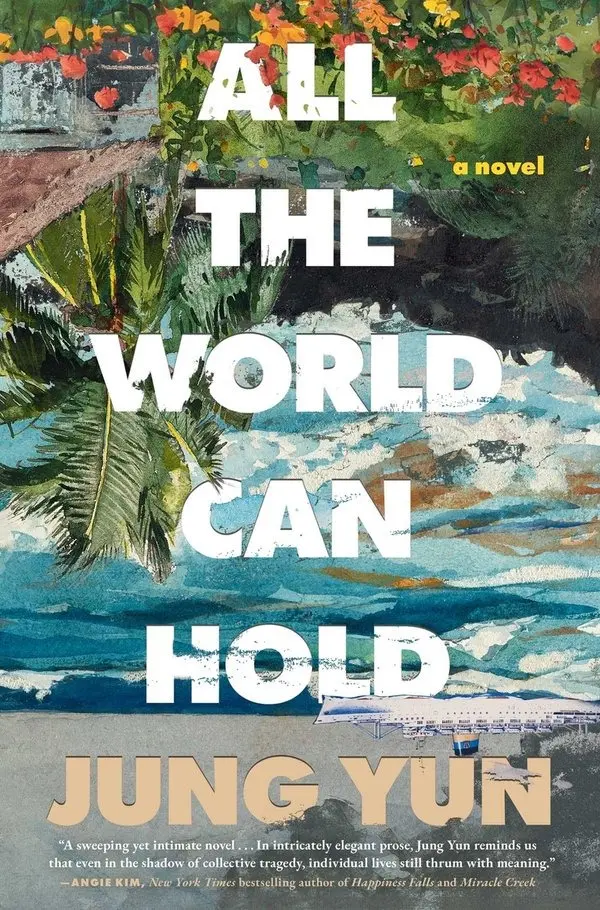
Yun experienced all of these conflicting emotions while working on her latest novel, All the World Can Hold, a book decades in the making. One of her primary creative hurdles early on was figuring out how to construct a narrative about fictional characters desperately fleeing their troubled, empty lives in the immediate aftermath of September 11, without inadvertently minimizing the immense loss of real human lives on that tragic day. Complicating matters further were the bizarre personal circumstances of her own post-9/11 experience, which oddly transpired during a weeklong cruise to Bermuda aboard the exact ocean liner used as the floating set for the iconic ABC television series The Love Boat. She wrestled endlessly with how to incorporate a setting that felt personally meaningful yet utterly absurd into a serious novel about a heartbreaking and tender historical era, all without accidentally transforming the story into an unintended farce.
She lost count of how many times she abandoned and restarted the manuscript, plagued by deep-seated fears that she lacked the capability to pull it off. Ultimately, she relied on the disciplined muscle memory of her former life in New York, forcing herself back into her desk chair every single morning to do the hard labor of writing because she knew the answers would not reveal themselves any other way. Whether her creative efforts ultimately succeeded or failed, she acknowledges, rests entirely in the hands of the reading public. But she takes profound solace in knowing she completed a story she believes in deeply—a reward she once doubted she would ever earn.
With the passage of time, Yun has grown to view each new book she attempts not merely as a project, but as an entirely separate life waiting to be born, shaped, and lived. Adopting this perspective has helped her realize that her parents’ core values may have actually prepared her for a life of writing far more than she ever previously appreciated. After all, those same parents left their homeland behind in their thirties, crossed a vast ocean, and completely reinvented themselves in a foreign country that offered the promise of opportunity only in exchange for a steep and daunting cost. What drove them, she reflects, if not a wild, almost reckless belief in the audacious possibility of a life that might ultimately prove to be well worth the risk?