Today marks a monumental anniversary in the history of English literature and global satire. On this day in 1726, Jonathan Swift’s timeless masterpiece, Gulliver’s Travels, was first published anonymously in London. Two hundred and ninety years later, the labyrinthine voyages of Lemuel Gulliver remain a cornerstone of speculative fiction, political critique, and philosophical inquiry. Swift’s biting observations on human folly, institutional corruption, and the absurdity of political posturing continue to resonate just as sharply today as they did in the early eighteenth century.
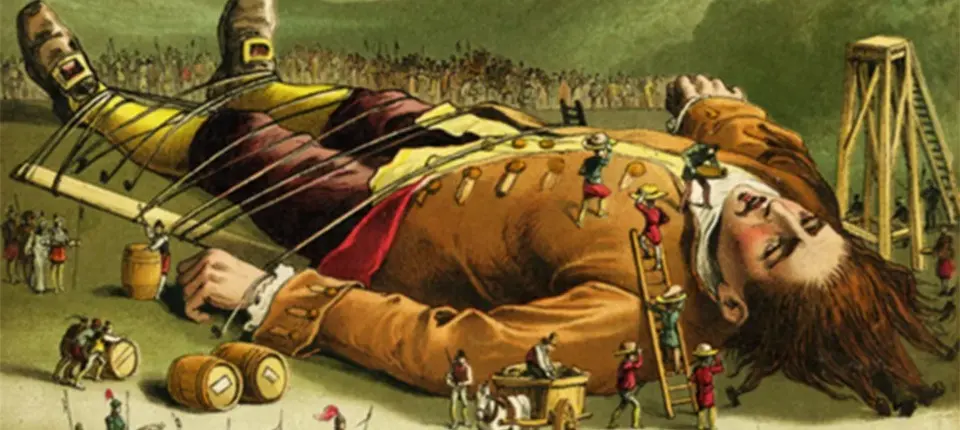
When Gulliver’s Travels—originally titled Travels into Several Remote Nations of the World. In Four Parts. By Lemuel Gulliver, First a Surgeon, and then a Captain of Several Ships—first reached readers in October 1726, it was an immediate sensation. The reading public and literary circles of London were captivated by the sheer imagination of the narrative, which followed its unassuming narrator from the shores of Lilliput, where he is a giant among tiny politicians obsessed with trivial court intrigues, to Brobdingnag, where he finds himself a miniature curiosity in a land governed by reason and giant benevolence.
Swift’s narrative did not stop at physical scale. In the subsequent parts of the book, Gulliver encounters the floating island of Laputa, where inhabitants are so consumed by abstract mathematics and theoretical science that they neglect the practical needs of daily life, and finally the land of the Houyhnhnms, a society of rational, noble horses contrasted with the Yahoos—vile, human-like creatures that embody the absolute worst of base human impulses. Through these fantastical journeys, Swift crafted a savage critique of contemporary European politics, religious sectarianism, scientific hubris, and the very concept of human rationality.
Although published under a pseudonym—with the fictional Captain Lemuel Gulliver presented as the actual author—the satirical intent of the work was quickly recognized by contemporaries, even if many readers initially mistook the book for a genuine travel memoir. Swift, a master ironist who had previously skewered political and religious establishments with works like A Tale of a Tub and The Drapier’s Letters, used the guise of travel literature to bypass censorship and deliver a profound meditation on the limitations of human reason.
Over the centuries, Gulliver’s Travels has undergone countless interpretations. While it has often been bowdlerized and adapted as a children’s adventure story—largely focusing on the whimsical imagery of the miniature inhabitants of Lilliput—scholars and serious readers have consistently returned to its darker, more misanthropic later sections. The final book, detailing Gulliver’s agonizing realization of his kinship with the Yahoos upon returning to human society, challenges readers to confront uncomfortable truths about cruelty, pride, and the destructive nature of societal conflict.
As we celebrate the anniversary of its debut on this October day, the literary internet continues to reflect on how Swift’s visionary creation set a high-water mark for speculative satire. Writers and critics across digital platforms are revisiting the text to examine how its themes of political factionalism, scientific detachment, and societal alienation persist in the modern era. From academic journals to cultural blogs, the conversation surrounding Swift’s masterpiece demonstrates that great literature possesses a unique capacity to transcend its historical moment, offering a mirror to each succeeding generation.
As today’s literary discussions show, the appetite for thoughtful engagement with foundational texts remains as robust as ever. Whether through deep-dive critical essays, fresh examinations of historical publication milestones, or creative responses from contemporary authors, the digital literary landscape continues to find endless inspiration in the rich heritage of books that challenge, provoke, and endure.