
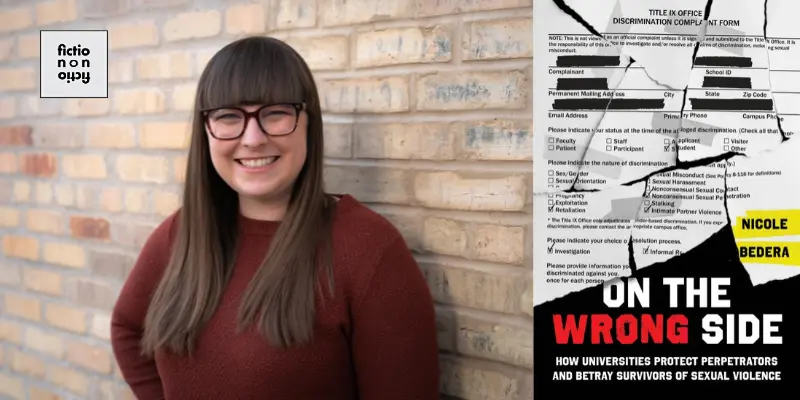
The discussion also explored the history of Title IX, the federal civil rights law that forbids discrimination on the basis of sex, and traced how sexual violence eventually came to fall under its legal framework. Bedera considered how the effectiveness of Title IX has fluctuated dramatically since its establishment in 1972, particularly under the Trump administration. She detailed how regulatory shifts during that administration’s first term made it significantly easier for universities to avoid accountability.
Furthermore, Bedera discussed the institutional incentives universities have for mishandling sexual violence cases, explaining why administrators frequently insist on framing such incidents as isolated anomalies rather than acknowledging systemic problems. The sociologist also addressed widespread misconceptions about sexual violence and Title IX investigations, drawing on her extensive firsthand experience as a victim advocate and her fieldwork conducted inside an anonymized Title IX office. Toward the end of the conversation, she reflected on how Title IX might be reimagined as a state agency to achieve greater effectiveness and read selections from On the Wrong Side.
The Cornell 7 Case: A Typical Institutional Response
The interview opened with a discussion of the case known as the Cornell 7, which has drawn intense public scrutiny. The case has captured national attention in part because none of the alleged perpetrators have faced criminal charges, and the universities involved have failed to issue significant disciplinary punishments. The conversation also touched upon parallel developments at the University of Chicago, where similar controversies have gained momentum in the wake of the Cornell disclosures.
In the opening chapters of On the Wrong Side, Bedera examines how women who have survived sexual assault frequently meet with Title IX officers, only to be told that no meaningful action can be taken. Survivors often find that their paperwork is shuffled indefinitely and that they are quietly discouraged from pursuing formal complaints. When asked whether the intense public attention surrounding the Cornell case would serve as a game-changer or whether it represented a typical situation, Bedera offered a sobering assessment.
"It should be, but I will say that it only is if we decide to make it one," Bedera said. "This is a very typical case for a university, and no matter what we’re seeing in public, I can almost guarantee that the conversation happening at Cornell behind closed doors is school administrators being defensive, saying that people just don’t understand their process, don’t understand what a good job that they did."
Bedera noted that during the academic year she conducted her fieldwork, the university she observed experienced a massive public scandal involving the murder of a female student, alongside several other homicides within the campus community. Despite intense local scrutiny, when she asked school administrators if they intended to change their policies in the wake of such a profound institutional failure, their response was defensive.
"They said, ‘No, we think our process works just fine,’" Bedera recalled. "Actually, they blamed the victim and said, ‘If only she had used it better.’ That’s really how schools tend to respond in these moments. We’ve already seen some of that response from Cornell, certainly from the police and the DA’s office, making it sound that if Jane Doe just would have reported better, everything would have gone fine, so we really have to push back on that."
Addressing whether the Cornell case is atypical, Bedera emphasized that the only truly unusual aspect is that the survivor, Jane Doe, managed to navigate the entire Title IX process to completion. Many survivors find the ordeal too arduous to finish, dropping out of the process because they are actively discouraged from pursuing investigations or because the administrative burden interferes too severely with their education.
"That’s the only thing that makes this case exceptional," Bedera said. "Aside from that, the way that Cornell responded to Jane Doe could have been at the university that I studied. I’ve heard from so many readers, ‘I can tell you were at my school,’ and I wasn’t. So it really is very, very widespread."
The Evolution of Title IX and Systemic Discrimination
To understand how modern universities handle sexual violence, the conversation turned to the legal history of Title IX. Enacted in 1972 as part of the education amendments of the Civil Rights Act, the law originally sought to combat pervasive gender and racial discrimination within educational institutions.
Bedera explained that Title IX consists of a single, concise sentence prohibiting sex discrimination in federally funded schools. However, the law did not initially include explicit enforcement mechanisms or detailed definitions of compliance. For years, the federal government failed to issue comprehensive regulations, leaving the courts to define the scope and application of the statute.
The crucial turning point came with the landmark 1980 court case Alexander v. Yale, which legally recognized sexual violence as a form of sex discrimination under Title IX. Bedera pointed out that the legal rationale in Alexander v. Yale was rooted in the systemic impact of trauma on an educational environment. The court found that widespread sexual violence severely compromised victims’ ability to fully participate in their education. Furthermore, the litigation argued that even women on campus who had not personally experienced assault suffered diminished educational experiences because they had to alter their daily behavior—such as avoiding office hours with professors or scheduling classes earlier in the day to avoid walking across campus at night—out of fear.
"When we’re talking about sexual violence, we tend to talk about it from a criminal framework with an individual perpetrator and an individual victim, but under Title IX, we’re talking about it from a systemic framework, which says that as long as this is happening here, this school is not equal, it is discriminating against women in particular," Bedera explained.
For decades, many universities resisted gender equity. Many institutions had historically operated as men-only spaces and were reluctant to integrate or comply with federal anti-discrimination mandates. It was not until approximately 2001 that the federal government began issuing explicit guidance directing schools to establish reporting mechanisms for sex discrimination and sexual violence. Even then, widespread institutional compliance remained elusive, prompting successive administrations to issue further "dear colleague" letters reminding universities of their legal obligations.
The contemporary era of Title IX enforcement began during the Obama administration, when the Department of Education initiated investigations into dozens of high-profile, elite universities for failing to establish required Title IX programs. This aggressive oversight thrust Title IX into the national spotlight, turning it into a fiercely debated political issue. According to Bedera, universities responded by building elaborate bureaucratic apparatuses designed to project an image of compliance while preserving internal discretion.
Internal Disciplinary Systems Versus Criminal Courts
The interview also addressed a common question surrounding campus disciplinary systems: why universities handle sexual misconduct internally rather than leaving the matter entirely to the criminal justice system. Bedera clarified that the fundamental legal argument for university-led disciplinary systems is that educational institutions have an affirmative obligation to prevent discrimination and ensure that students can pursue their education without disruption.
The stakes of these internal processes have drawn intense public scrutiny, particularly in cases like Jane Doe’s lawsuit against Cornell, which alleged that some of the accused perpetrators were merely assigned to write reflective essays.
The landscape shifted significantly during the first Trump administration, when Education Secretary Betsy DeVos introduced revised Title IX regulations. Critics argued that these rules weakened survivor protections and made it substantially easier for universities to evade accountability. Bedera noted that while experts initially focused on specific, highly controversial provisions—such as a rule allowing accused individuals to exclude confessions of misconduct from evidence if they chose not to attend live hearings—the practical reality has proven even more systemic.
Rather than merely altering procedural rules, the regulatory shift signaled to universities that federal oversight and accountability measures were effectively suspended. Bedera observed during her 2018–2019 fieldwork that institutions quickly realized they had a free hand to maintain or even expand restrictive practices, knowing that federal regulators were no longer scrutinizing their handling of complaints.
"The specific provisions of the regulation have ended up mattering a lot less because schools now know that they have carte blanche to do whatever they want," Bedera said.
She rejected the notion that universities would inherently handle cases better if federal regulations permitted them to do so. Instead, Bedera argued that institutions have consistently resisted accountability, and that regulatory rollbacks under the Trump administration provided an official framework for schools to roll back protections and prioritize institutional self-preservation over survivor equity.