

At the same time, long-term retirees are finding themselves eyeing expensive properties and other high-spending behaviors as portfolios swell. Yet, this rapid wealth accumulation has sparked a broader debate across the financial world: Is the current market rally a reflection of sustainable economic strength, or is it a bubble driven by technological euphoria?
The question weighs heavily on individual investors navigating the modern financial landscape. One reader recently voiced a common concern via email, asking whether the market’s heavy reliance on artificial intelligence hype makes it vulnerable to a severe future crash and how that might impact retirement security.

To address these anxieties, financial observers often point back to the fundamental definition of a stock. Essentially, a share of stock is a business arrangement that functions much like a rental house. When an investor owns a rental property, they are entitled to collect rent. After covering operating expenses, the remaining amount constitutes the profit.
If the average market price of rental properties in a specific neighborhood surges while tenants continue paying the exact same monthly rent, the higher valuation looks impressive on paper. However, that paper gain holds little practical meaning unless the property is sold, at which point the investor would likely have to pay a similarly inflated price for a replacement property.
An investor’s actual income remains unchanged unless they can make the rental business more profitable through strategic improvements, such as adding a basement apartment or streamlining expenses. When that property is eventually sold to another buyer, the purchase price should theoretically reflect that future stream of income.

For instance, a property generating $24,000 annually in net rent and selling for $240,000 carries a price-to-earnings, or P/E, ratio of 10. If a buyer agrees to pay $480,000 for that same property, the transaction occurs at a P/E ratio of 20, representing a windfall for the seller but a much narrower margin for the incoming investor.
A strikingly similar dynamic has unfolded in the broader stock market. An investment of $100,000 placed into the market in 2019 with dividends reinvested would have grown to roughly $256,960 today, marking a 157 percent gain. Over that same period, however, the underlying share of company earnings generated by that basket of stocks rose from $5,290 to $7,540, a modest 42 percent increase.
Consequently, the overall market’s P/E ratio has expanded from approximately 20 to roughly 30. Stock investors today find themselves in the position of real estate buyers facing doubled property prices while rental income creeps upward at a much slower pace. While owning stocks remains profitable over the long term, basic mathematics dictates that future returns purchased at today’s elevated P/E ratios will likely be lower than if those assets were acquired at a discount.

The Role of Earnings Growth and the "Magnificent Seven"
Of course, valuations can remain justified if underlying earnings are poised for dramatic expansion. A real estate investor might willingly pay an inflated price for a property if a major corporate campus is scheduled for construction nearby, signaling a guaranteed surge in future rental demand.
Similarly, individual stock prices often climb when concrete good news alters a company’s financial outlook. During the COVID-19 pandemic, consumer demand for home exercise equipment drove temporary surges in companies like Peloton, before reality and normal sales volumes restored share prices to previous levels.
Yet, when the entire market rises uniformly, economists look closer at whether broad economic growth expectations justify the shift. In the current market cycle, the numbers reveal a stark concentration of growth. Approximately three-quarters of the S&P 500’s recent gains can be traced directly to just seven dominant technology corporations: Apple, Nvidia, Microsoft, Amazon, Google, Meta, and Tesla.
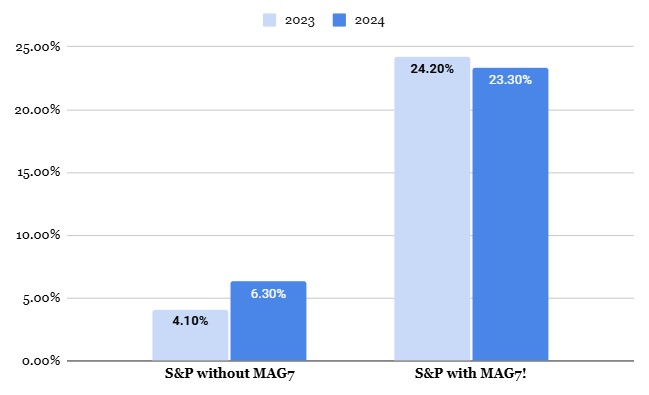
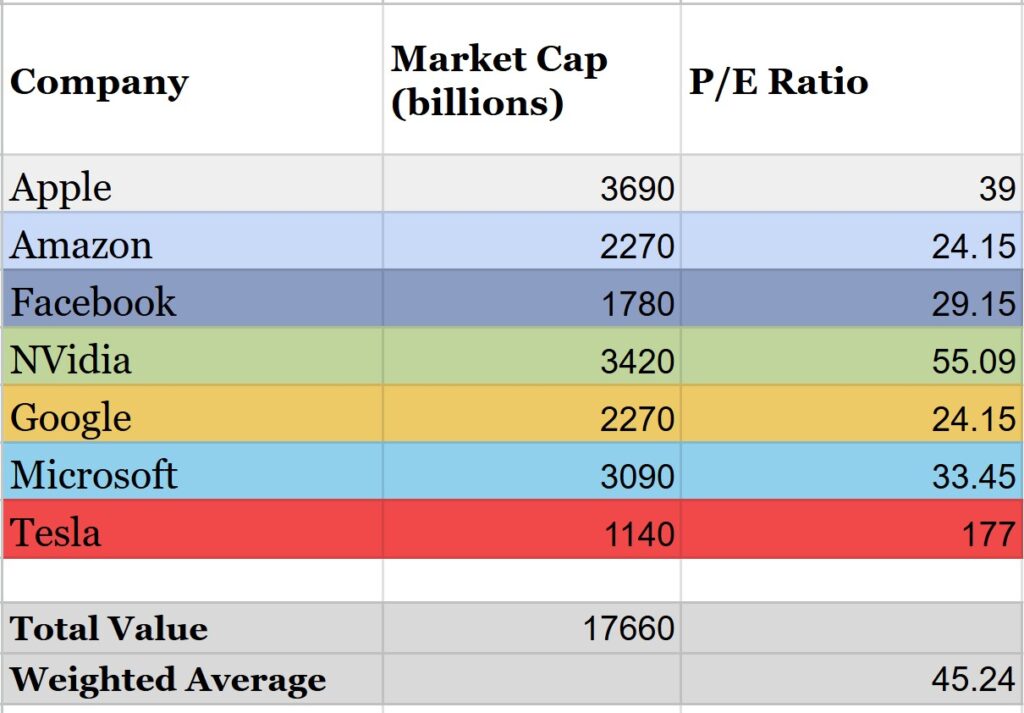
Often referred to as the "Magnificent Seven," these tech giants command a massive share of the overall market value—exceeding $17.66 trillion, or more than 25 percent of the entire market. They also trade at significantly higher P/E ratios, averaging around 45. Excluding these seven companies and examining the remaining 493 firms in the index reveals a much more moderate P/E ratio of 20.
This divergence indicates that while investors anticipate a generally stable U.S. economy, they are betting heavily that the largest technology enterprises will capture vastly accelerated growth in the years ahead.
Artificial Intelligence and the Infrastructure Boom
The driving force behind this tech-heavy boom is the rapid advancement of artificial intelligence. Recent breakthroughs have enabled software to exhibit human-like reasoning across an expanding array of complex fields, sparking a corporate frenzy across the business sector.
Six of the Magnificent Seven companies are currently committing hundreds of billions of dollars to construct massive warehouses filled with specialized supercomputers. Meanwhile, the seventh member, Nvidia, supplies the hardware, capturing immense revenues as surging demand allows for high profit margins and unprecedented shipping volumes.
Beyond the initial infrastructure layer, industries across the economy hope this technology will permanently elevate productivity and corporate profitability. Modern AI tools can now process entire legal documents, analyze source code to identify and patch vulnerabilities, diagnose medical conditions from skin photographs, design pharmaceutical compounds, and power humanoid robotic laborers.
The underlying premise is the arrival of an expansive workforce of intelligent systems capable of working continuously, effectively eliminating humanity’s historical constraints of finite labor and intelligence. While many analysts agree this technological shift will materialize, the precise timeline remains uncertain, and valuations reflect immense optimism about future corporate profits.

At the same time, economists debate potential risks, including capital cost overruns, intense market competition, and broader societal disruptions if automation alters employment landscapes on a massive scale.
Historical Norms and Long-Term Projections
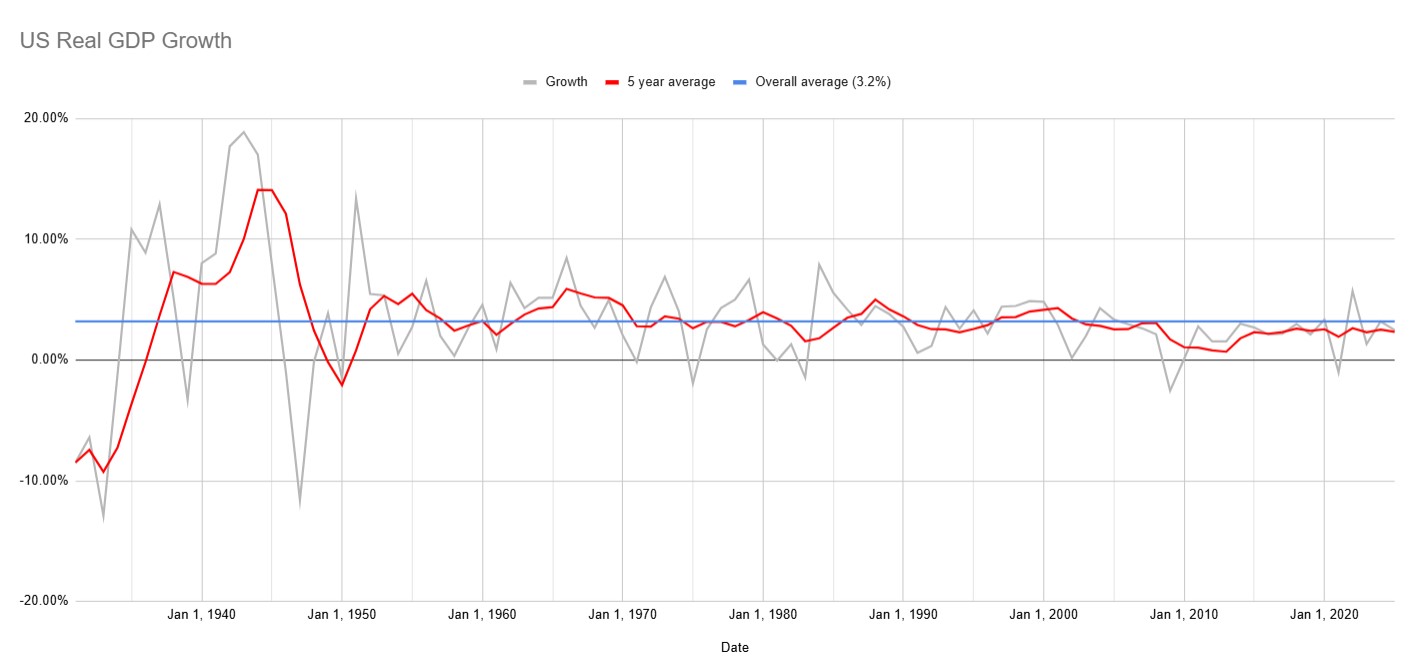
While the future remains difficult to predict, historical patterns offer valuable context. Over decades, U.S. economic growth has maintained a remarkably steady average of roughly 3 percent annually after adjusting for inflation. Interestingly, recent decades have actually experienced slightly slower-than-average economic growth, providing further analytical contrast to current stock valuations.
Financial institutions regularly weigh these macroeconomic indicators to forecast future performance. Vanguard, a cornerstone of the index fund industry, routinely publishes ten-year annualized return projections. In recent updates, Vanguard models have projected that international equities and fixed-income bonds could potentially outperform U.S. stocks over the coming decade.
This projection is supported by valuation disparities, such as international equity funds trading at significantly lower P/E ratios near 16, representing a substantial discount compared to domestic markets. However, financial analysts note that similar projections from recent years have often underestimated the domestic concentration of technology and artificial intelligence momentum.
Other market veterans have adopted defensive stances amid high valuations. Berkshire Hathaway, led by Warren Buffett, has maintained substantial reserves of uninvested cash while signaling that genuine market bargains are increasingly scarce.
Similarly, long-term investment strategies often balance portfolios across multiple asset classes—including international stocks and bonds—to manage volatility, even if domestic equities have dominated recent performance cycles. Meanwhile, individual decisions regarding liabilities, such as whether to pay down high-interest mortgages rather than directing surplus cash entirely into equities, continue to depend on personal financial philosophies as much as mathematical models.
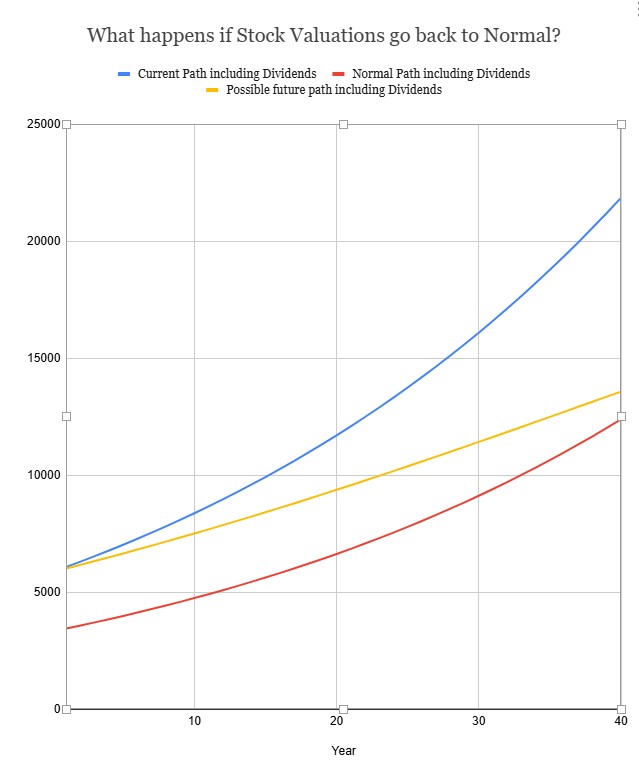
Ultimately, financial commentators frequently return to foundational principles: maintaining a steady investment schedule, tuning out daily media noise, and focusing on long-term goals rather than attempting to time market fluctuations.