
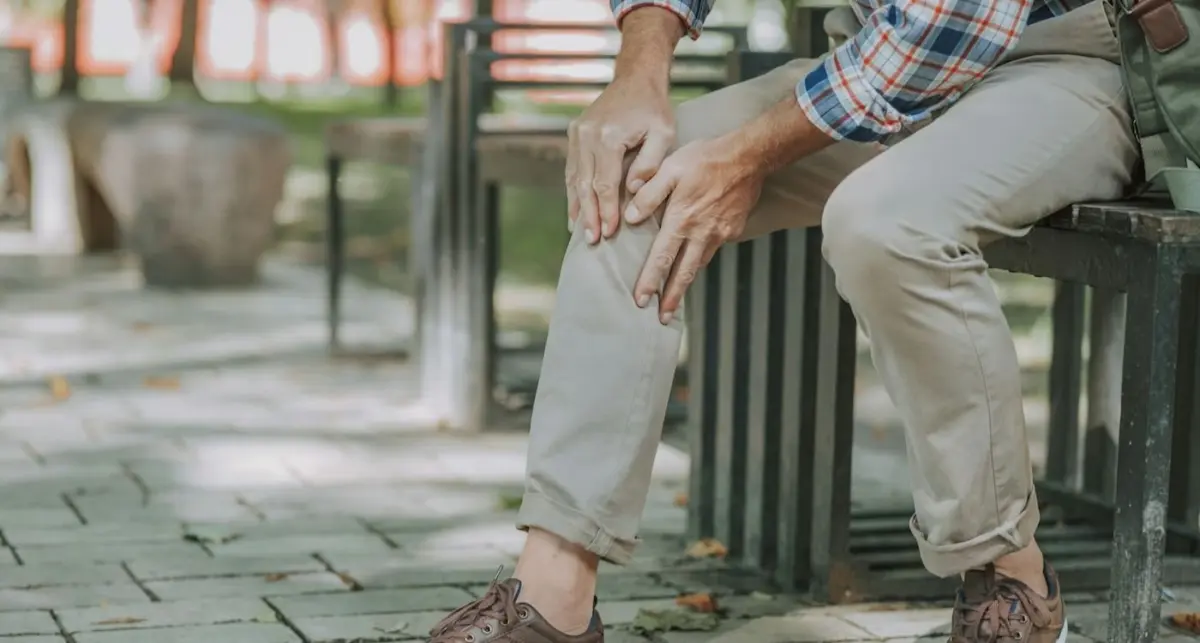
Nearly a quarter of people over the age of 40 experience painful osteoarthritis due to degrading joint-cushioning cartilage, and there is currently no way of reversing this damage. For millions of patients worldwide, the standard medical course of action is limited to managing chronic pain with medication and, eventually, undergoing invasive joint replacement surgery.
Now, a collaborative team of researchers from the University of Utah, New York University, and Stanford University is demonstrating the potential for an entirely different kind of intervention: personalized gait retraining.
By making a small, calculated adjustment to the angle of their feet while walking, participants in a rigorous year-long randomized control trial experienced pain relief equivalent to pharmaceutical treatments. Critically, those participants also showed less knee cartilage degradation over that period compared to a control group that received a placebo treatment.
Published on August 13 in The Lancet Rheumatology, these findings stem from what researchers believe is the first placebo-controlled study to demonstrate the clinical effectiveness of a biomechanical intervention for osteoarthritis.
“We’ve known that for people with osteoarthritis, higher loads in their knee accelerate progression, and that changing the foot angle can reduce knee load,” said Scott Uhlrich, an assistant professor of mechanical engineering at the University of Utah. “But there have not been randomized, placebo-controlled studies to show that they’re effective.”
A Personalized Approach to Gait Retraining
With funding and support from the National Institutes of Health, the research team focused specifically on patients suffering from mild-to-moderate osteoarthritis in the medial compartment of the knee—the inside of the leg. This specific area tends to bear significantly more body weight during movement than the lateral, or outside, compartment.
This form of osteoarthritis is by far the most common, but the ideal foot angle for reducing load on the medial side of the knee differs substantially from person to person. A patient’s optimal angle depends entirely on their natural gait and the intricate mechanical ways their body moves when they attempt to adopt a new walking pattern.
“Previous trials prescribed the same intervention to all individuals, resulting in some individuals not reducing, or even increasing, their joint loading,” Uhlrich explained. “We used a personalized approach to selecting each individual’s new walking pattern, which improved how much individuals could offload their knee and likely contributed to the positive effect on pain and cartilage that we saw.”
To achieve this level of personalization, participants underwent a thorough diagnostic intake process during their first two visits to the laboratory. They received a baseline magnetic resonance imaging (MRI) scan of their knee joints and practiced walking on a specialized pressure-sensitive treadmill while high-speed motion-capture cameras recorded the exact mechanics of their walking gait.
This advanced diagnostic setup allowed researchers to determine whether turning a specific patient’s toes slightly inward or outward would reduce mechanical joint load more effectively. It also helped them calculate whether a minor five-degree or ten-degree adjustment would be optimal for that individual’s unique skeletal structure and movement profile.
Following the initial intake sessions, half of the 68 participants were assigned to a sham treatment control group to account for and control the placebo effect. This control group was prescribed foot angles that were actually identical to their natural, habitual gait, ensuring that neither the patients nor the evaluators knew who was receiving the active biomechanical intervention.
After following their assigned walking protocols for a full year, all participants returned to report their subjective experience of knee pain and underwent a second MRI scan to quantitatively assess the structural damage—or lack thereof—to their knee cartilage.
“The reported decrease in pain over the placebo group was somewhere between what you’d expect from an over-the-counter medication, like ibuprofen, and a narcotic like oxycontin,” Uhlrich said. “With the MRIs, we also saw slower degradation of a marker of cartilage health in the intervention group, which was quite exciting.”
Beyond the hard quantitative measurements of effectiveness gathered by the research instruments, participants in the study expressed overwhelming enthusiasm for both the non-invasive approach and its tangible results. One participant noted the profound lifestyle impact of the therapy, stating, “I don’t have to take a drug or wear a device… it’s just a part of my body now that will be with me for the rest of my days, so that I’m thrilled with.”
The ability of participants to adhere to the biomechanical intervention over long stretches of time represents one of its most promising advantages for long-term chronic disease management.
“Especially for people in their 30s, 40s or 50s, osteoarthritis could mean decades of pain management before they’re recommended for a joint replacement,” Uhlrich said. “This intervention could help fill that large treatment gap.”
How the Study Was Conducted
To ensure participants could successfully master and maintain their new walking patterns outside of a laboratory setting, the study incorporated a structured training protocol. Participants from both the active and control groups returned to the lab for six weekly training sessions. During these sessions, they received real-time biofeedback—gentle vibrations delivered from a specialized device worn on the shin—that helped them maintain the prescribed foot angle while walking on the laboratory treadmill.
Following the completion of the six-week active training period, participants were encouraged to practice their newly adjusted gait for at least 20 minutes a day until the movement became completely natural and habitual. Periodic check-in visits throughout the remainder of the year-long trial demonstrated remarkable compliance, showing that participants were adhering to their prescribed foot angles within an average margin of just one degree.
However, the research team emphasized that before this intervention can be widely deployed in standard clinical practice, the gait retraining process will need to be streamlined. The goal is for the method to eventually be easily prescribed within standard physical therapy clinics, allowing patients to complete their retraining while taking a simple walk around their own neighborhoods.
The research team noted that individuals interested in participating in future clinical studies can contact Scott Uhlrich’s Movement Bioengineering Lab at the University of Utah for more information.