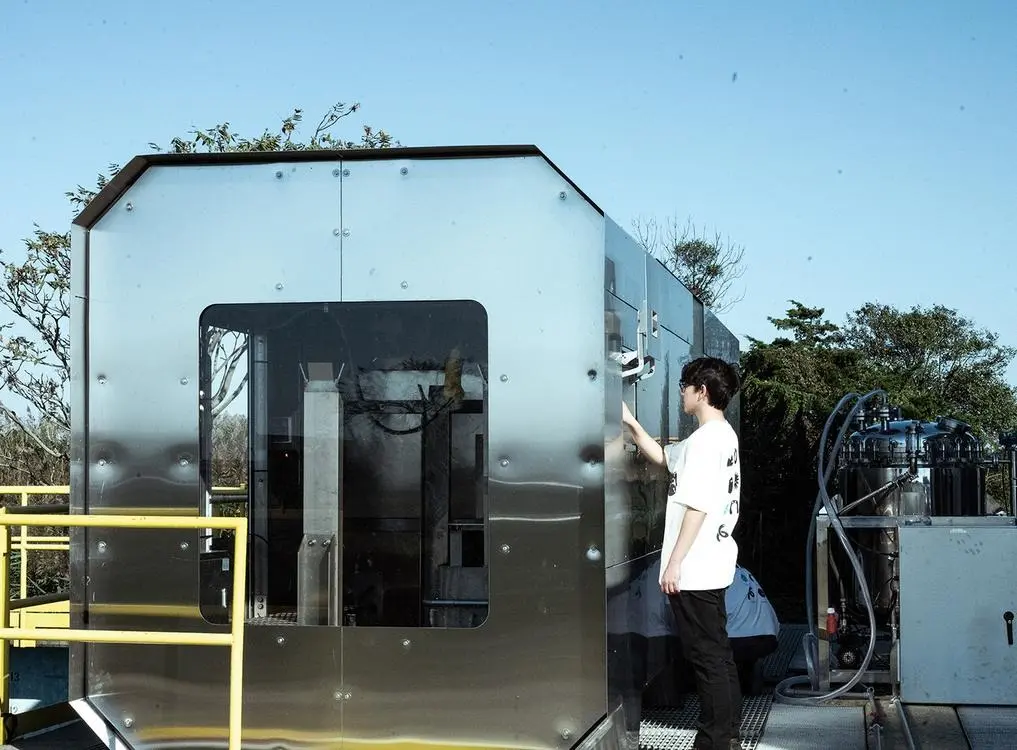
The innovative filtering system mimics hydrophobic plants found in nature. These natural organisms completely shed water on contact while simultaneously attracting and capturing microplastic particles. As wastewater flows through the device, the water moves onward while the microscopic plastic pollutants are effectively removed. Once trapped, these particles can be easily collected and sent to a recycling facility for proper processing and disposal, turning a previously untreatable waste stream into manageable material.
The Atlantic County Utilities Authority (ACUA) in New Jersey opted to take proactive measures, stating that it is crucial for public safety that microplastics be removed from water through existing processing streams. Although no federal regulations currently exist mandating that public utilities remove these specific contaminants, the ACUA decided not to wait for a mandate to be passed.
Microplastics accumulate in municipal wastewater systems through a variety of everyday sources, including the discharge from residential washing machines, heavy rainfall washing urban debris into storm drains, and general littering. Most existing wastewater treatment facilities across the country are engineered primarily to handle human sewage, solid waste, heavy metals, and other well-understood biological and chemical contaminants. Microplastics, however, present a unique and stubborn challenge for these legacy systems because of their microscopic size and persistence.
Matt DeNafo, president of the ACUA, emphasized the urgency of addressing the problem at the municipal level. Because the utility discharges treated water directly into the ocean, leaving microplastics unaddressed means actively returning the pollutants to the natural environment. DeNafo pointed out that these particles ultimately find their way into the marine life humans consume and even into the water people use for bathing, transforming an environmental nuisance into a direct concern for human health.
To combat this, the ACUA partnered with PolyGone Systems, a green technology startup founded by Princeton University graduates Nathanial Banks and Yidian Liu. The collaboration takes the form of a two-year pilot program designed to test whether the startup’s large filtration system can successfully clean up this specific source of pollution in Atlantic City, a municipality of 40,000 residents.
Banks, who serves as the co-founder and CEO of PolyGone Systems, reflected on the significance of the deployment. He noted that the installation marks a new era for treatment innovation, demonstrating that engineers can build large, scalable systems requiring very small amounts of material and low energy to treat highly challenging contaminants. Having the first system of its kind in the world operating in Atlantic County, he added, is a remarkable achievement for the young company.
Laboratory tests conducted prior to the deployment showed that an early prototype of the device could remove an impressive 98 percent of microplastic particles from wastewater. The ongoing pilot program in Atlantic City will focus heavily on replicating this high level of efficiency at a true commercial scale, providing vital data for future municipal implementations.
Interestingly, both Banks and Liu pursued architecture studies during their time at Princeton rather than traditional environmental engineering. Liu noted that the most enjoyable and fulfilling part of the entire development process was designing the large physical device itself, blending spatial design principles with ecological engineering to create a functional industrial installation.
As researchers look back from the vantage point of future decades, society may view microplastics as one of the greatest environmental crises of modern times. Unlike previous industrial challenges, the comparison highlights a stark difference in scale and permanence. The mass deforestation of the industrial era can eventually be reversed as forests are given the opportunity to regrow. Similarly, while the pollution generated by the coal-fired revolution was severely debilitating to both human and environmental health, its toxic effects were comparatively limited to the immediate vicinity of coal mines and power plants.
Microplastics, in contrast, have been found virtually anywhere researchers have looked for them. They have been detected at the bottom of the Mariana Trench, at the highest summit of Mount Everest, and inside nearly every human organ examined, from the brain to the placenta, often accumulating in quantities surpassing a gram or more per individual.
Encouragingly, communities and innovators across the globe are not waiting for someone else to solve the problem. Numerous independent inventions, technological innovations, and local successes in the field of microplastic filtering and removal continue to emerge. Beyond their commercial-scale deployment in New Jersey, Banks and Liu are actively exploring ways to scale down their proprietary technology for residential uses, bringing filtration capabilities directly to households. Meanwhile, eco-conscious California has also become home to one of their commercial-scale installations.
As the two-year pilot program in Atlantic City moves forward, the partnership between young entrepreneurs and a forward-thinking utility on the Jersey Shore offers a promising model for municipalities worldwide seeking practical defenses against an invisible pollutant.