For those who have managed to tune out the daily market drama, the contemporary AI narrative boils down to a rapid technological leap, massive capital expenditures by major tech players, and soaring stock valuations. Yet, beneath the excitement lies a palpable anxiety. Investors worry that while artificial intelligence is undoubtedly a transformative invention, the market mania surrounding it is happening too fast and too furiously, threatening to trigger a modern, magnified version of the early 2000s dot-com crash.

This boom-and-bust cycle holds a particular resonance for early retirement advocates who navigated the internet boom of the turn of the millennium—an era that initially launched careers and retirement ambitions before an ensuing market correction nearly derailed personal financial stability and legal standing. As questions mount regarding this latest investment cycle, financial commentators are once again taking to conference stages—from Camp FI Midwest to upcoming gatherings like the Bogleheads conference—to address whether current economic anxieties are justified or merely a repeat of historical panics.
Putting Market Booms and Busts Into Historical Perspective
Reaching milestone anniversaries in retirement often brings a certain comfort with market volatility, yet the underlying anxiety of friends and observers remains remarkably consistent across decades. Conversations about whether it is possible to sleep at night amid global uncertainties usually elicit a laundry list of contemporary worries. Today, that list includes geopolitical tensions involving figures like Vladimir Putin, lingering inflation, soaring national debts, ongoing conflicts in Ukraine and the Middle East, and, of course, the looming specter of the AI bubble alongside fears that automation will render human labor obsolete.

However, a retrospective look reveals that these anxieties are merely updated versions of old refrains. Twenty years ago, during the mid-2000s, investors wrestled with a similarly daunting roster of concerns. Back then, public anxiety centered on political leaders like George W. Bush and Saddam Hussein, ongoing conflicts in Iraq, national debt, inflation, and a vastly overvalued housing market. Instead of fearing artificial intelligence taking human jobs, the workforce worried about outsourcing to India and China. There was even widespread panic over "Peak Oil"—the persistent theory that global fossil fuel consumption would inevitably outstrip dwindling supplies and plunge civilization into crisis, an outcome averted as technological advancements shifted energy dynamics entirely.
Despite the heavy gloom of 2006, the subsequent decades unfolded in ways that few Cassandras predicted. Even the Great Financial Crisis of 2008—sparked by irrational exuberance in housing prices and overly complex financial leverage, culminating in the steepest market downturn since the Great Depression—ultimately appeared as a minor dip on a long-term growth chart. A significant investment in the broader market during the mid-2000s would still have multiplied substantially over the following twenty years, comfortably absorbing subsequent disruptions like the 2020 pandemic crash.

Simultaneously, the broader world experienced remarkable, measurable progress. Over a twenty-year span, the global share of people living in extreme poverty dropped dramatically, while infant mortality rates were cut in half. Clean energy transitioned from a fringe concept to a dominant economic force as solar panel costs plummeted, allowing solar generation to surge globally. Meanwhile, sales of electric vehicles transitioned from a statistical zero to a substantial share of worldwide automotive sales.
Productivity Versus the Financial System
This historical resilience points to a fundamental truth often overlooked by financial doom-mongers: true prosperity does not originate from the financial system or the daily fluctuations of the stock market, which are ultimately reflections of numbers on computer screens. At its core, real prosperity stems entirely from human productivity.

The capitalist system is inherently choppy, prone to wild cyclical swings and periodic panics. Yet beneath the surface waves, real people continue to perform real work, invent new tools, and solve complex problems. The concept of an economy or a financial framework is merely another human invention. If a financial system experiences a severe correction because market participants lose confidence in prevailing valuations, society simply recalibrates the underlying metrics and resumes productive labor—a recovery mechanism demonstrated repeatedly, most notably following the 2008 crash.
Society retains every foundational tool ever invented to boost productivity. Standard of living, economic growth, and the viability of early retirement all flow directly from high productivity rather than speculative market sentiment. Furthermore, once a society achieves a certain baseline standard of living, human happiness largely plateaus along that economic dimension. Developed nations surpassed those minimum material requirements decades ago, shifting the primary drivers of fulfillment toward non-financial factors.

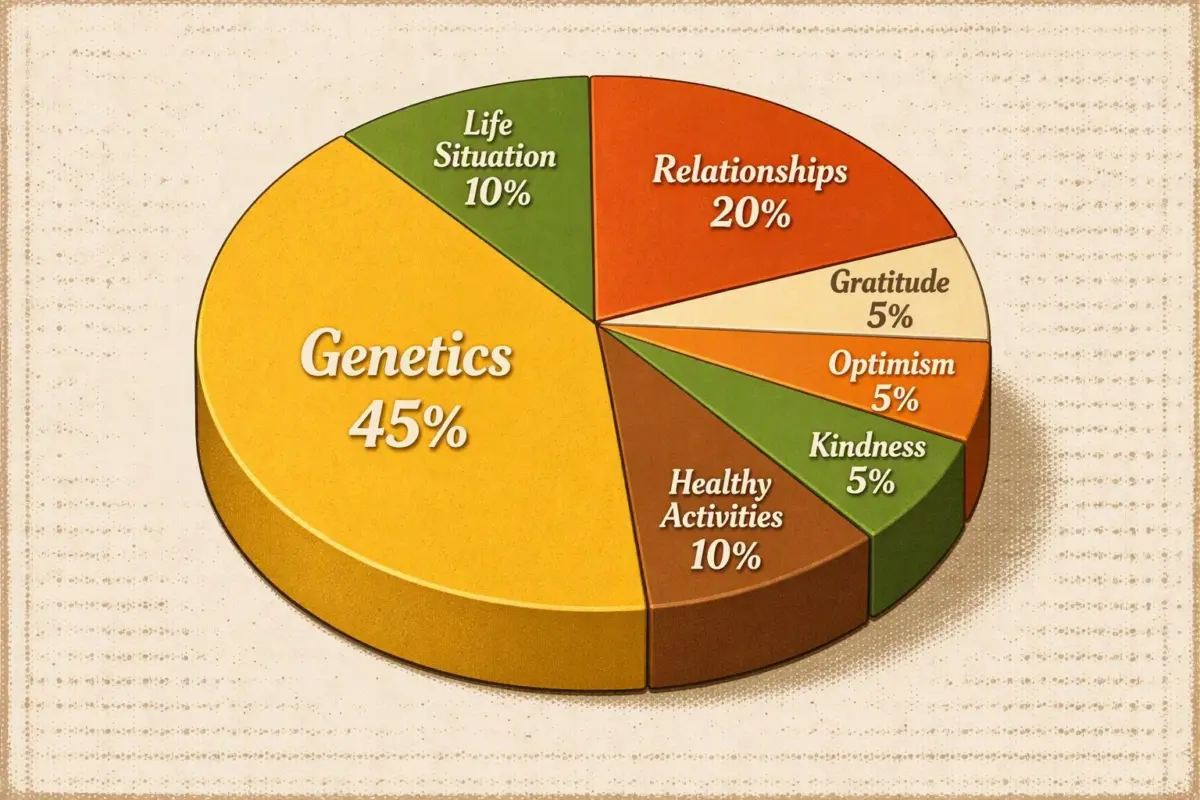
Psychological research and human experience suggest that overall life satisfaction is anchored heavily by personal factors largely outside of financial markets. While innate temperament plays a substantial role, daily choices—such as cultivating close relationships, practicing gratitude and optimism, and maintaining active, outdoor lifestyles—exert a far greater influence on personal happiness than investment portfolios.
Understanding and Combating the Psychology of Fear
Despite historical evidence demonstrating that long-term progress consistently outpaces short-term panics, many individuals remain trapped in a cycle of anticipatory fear. Human beings evolved primarily as danger-detection machines, utilizing background anxiety as an evolutionary mechanism to protect against physical threats and scarcity.

However, this detection machinery comes with a systemic flaw: when immediate physical dangers are resolved, the human brain continues scanning the horizon for new threats, effectively shifting the goalposts of anxiety. Once survival and basic food security are guaranteed, people pivot to worrying about social acceptance, followed by financial comparisons, neighborhood property values, tax strategies, and eventually complex administrative hurdles like Required Minimum Distributions for accumulated retirement wealth.
Combating this pervasive fear requires self-awareness and rational analysis. Examining personal history often reveals the roots of financial anxiety—whether stemming from family scarcity mentalities during childhood, generational echoes of the Great Depression, or broader experiences of trauma. Identifying the specific contours of a fear, including evaluating the realistic worst-case scenario, usually demonstrates that catastrophic outcomes are highly improbable.

Taking concrete action remains one of the most effective antidotes to anxiety. Action transforms the unfamiliar into the familiar, fostering resilience and the adaptability required to navigate shifting circumstances. By intentionally reducing consumption of sensationalized daily news—which disproportionately highlights alarming stories to capture attention—individuals can redirect their mental energy toward positive behaviors, physical health, and constructive problem-solving.
Surrounding oneself with optimistic, productive peers further reinforces a resilient mindset. Within communities focused on financial independence and intentional living, the cultural emphasis centers on designing a fulfilling life and supporting others rather than fixating on speculative risks.

Viewing Technological Shifts as Experiments
This philosophy of resilience applies directly to contemporary concerns surrounding artificial intelligence. Rather than viewing technological disruption through a lens of inevitable doom, framing major shifts as ongoing experiments alters the psychological dynamic entirely.
Technology history demonstrates that innovations invariably bring both disruption and opportunity. Artificial intelligence functions essentially as a cognitive tool, capable of dramatically boosting human efficiency, productivity, and broad-based prosperity. Much like the advent of the internet and subsequent mobile revolutions, AI will inevitably displace certain entry-level administrative and technical roles while simultaneously lowering service costs and catalyzing entirely new industries.

While the economic rewards of such technological leaps frequently concentrate among capital owners and shareholders—benefiting the broader base of long-term investors—the fundamental nature of technological progress remains an invitation to adapt. Artificial intelligence, like every economic wave before it, offers a choice: to retreat into reactionary fear or to utilize the shift as a catalyst for continuous learning, proactive adaptation, and a more engaged approach to modern life.