
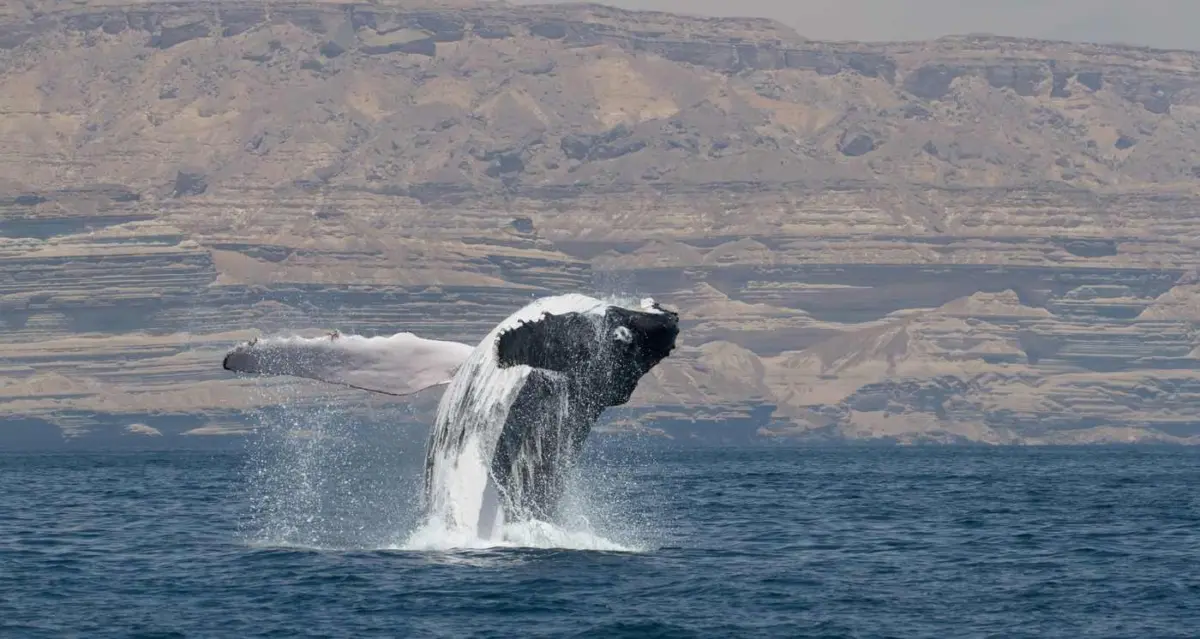
For years, anyone with direct field experience working with Arabian Sea humpbacks understood that they were ecologically distinct. However, until recently, uncertainty remained within the scientific community as to whether this unique divergence was a recent development or a prehistoric evolutionary milestone.
Published in the journal Frontiers in Marine Science, a comprehensive new study leveraging more than 25 years of dedicated whale research in Oman provides robust scientific support for the formal recognition of a fourth subspecies of humpback whale globally.
Led by the Wildlife Conservation Society (WCS) in close cooperation with Omani environmental authorities alongside key local and international research partners, the study undertook a massive comparative genetic analysis. Researchers examined genetic samples collected from Arabian Sea humpback whales and compared them against populations drawn from across the world’s oceans, utilizing mitochondrial DNA sequences sourced from a staggering 2,285 individual animals.
The analytical results revealed remarkably high levels of genetic differentiation between the Arabian Sea population and the three currently recognized humpback whale subspecies located in the North Atlantic, the North Pacific, and the broader Southern Hemisphere. This sharp genetic divergence points directly to very limited gene flow between the Arabian group and other global populations over extended periods.
Furthermore, the research demonstrated that the Arabian Sea population exhibits the lowest overall genetic diversity among all the ocean regions examined by the team. Based on these compelling findings, the study supports the potential recognition of the Arabian Sea population as Megaptera novaeangliae indica, drawing its nomenclature from the type species historically identified in Iraq.
"Arabian Sea humpback whales have long been an enigma to the scientific community," noted Dr. Rita Amaral, the lead author of the study with the Wildlife Conservation Society, reflecting on the significance of the project. "Their ecology is unlike that of any other known humpback whale population, and this new genetic work represents an important milestone in understanding how that uniqueness developed."
Dr. Amaral added that the empirical data clearly demonstrates that the Arabian humpback whales have charted their own distinct evolutionary trajectory for tens of thousands of years, thoroughly supporting their classification as a separate subspecies.
Unlike virtually every other group within their broader racial lineage, Arabian humpbacks do not engage in the traditional seasonal migrations associated with breeding and feeding. Instead, they remain steadfastly anchored to the warm coastal seas off Oman all year round. In fact, they are genetically distinct even from whale populations residing as close by as the nearby Indian Ocean.
This raises a compelling biological question: What environmental and ecological factors explain this strange, sedentary lifestyle?
The study’s authors, drawing upon decades of accumulated field research, explain that seasonal upwellings of deep oceanic nutrients—driven powerfully by the southwest monsoon systems—create hyper-productive marine conditions. These localized environments mimic the high-productivity characteristics typically found in temperate or polar climates, where whales normally must migrate to feed during the summer months.
While typical humpbacks migrate to these cooler, high-latitude waters to feed before returning to the tropics to breed, the unique and reliable upwelling off the coast of Oman allows Arabian Sea humpbacks to bypass this grueling migration cycle entirely. Consequently, they are able to feed locally within tropical latitudes that are otherwise utilized exclusively for breeding and calving activities by other global populations.
This behavioral isolation is further reinforced by auditory evidence. A previous study published for the International Whaling Commission (IWC) in 2018 reviewed the complex acoustic singing patterns of Arabian Sea humpback whales and found that their vocalizations are entirely unique within the species. All male whales belonging to this specific population share identical song patterns that tend to evolve and change progressively over time.
Marine biologists note that populations lacking direct geographic overlap or interpersonal exchange tend to possess distinctly different songs, whereas populations that come into contact frequently share some or all acoustic patterns. The 2018 IWC study discovered zero song overlap between Arabian humpbacks and neighboring Indian Ocean humpback populations, providing yet another powerful line of evidence pointing toward deep populational isolation.
Expanding on these behavioral and acoustic insights, the new genetic analysis reveals that the lineage lines of the Arabian Sea whales diverged from other global groups anywhere between 43,000 and 113,000 years ago, depending on the specific maternal lineages evaluated.
Despite their deep evolutionary roots and unique adaptations, the study’s authors emphasize that this extreme geographic and genetic isolation also renders the population exceptionally vulnerable to modern anthropogenic pressures. Arabian Sea humpback whales face a relentless barrage of threats, including accidental entanglement in commercial and artisanal fishing gear, lethal vessel strikes from heavy maritime traffic, underwater noise pollution, chemical pollution, and natural stressors such as emerging diseases.
Compounding these human-made pressures, broader environmental shifts driven by climate change—such as alterations to regional monsoon cycles and ocean upwelling dynamics—threaten to disrupt the availability of sardines and other critical pelagic prey species upon which the whales depend. The research paper notes that the population remains critically small in number, showing no discernible evidence of demographic recovery or population increase over the past two decades. Without immediate, concerted conservation efforts to actively manage and mitigate these known threats, the subspecies remains at serious risk of regional extirpation.
Regional authorities are acutely aware of the stakes. "The growing body of research on Arabian Sea humpback whales has given Oman an increasingly clear understanding of both the importance of this population and the pressures it faces," said Aida Al Jabri from the Environment Authority of Oman, which contributed significantly to the research initiatives, in an official statement.
Al Jabri emphasized that the mounting body of scientific evidence is actively helping translate academic understanding into concrete policy and practical conservation actions. These efforts include fostering regional cooperation through the framework of the International Whaling Commission, as well as Oman’s ongoing work to explore enhanced legal protection for critical marine habitats through international governance mechanisms, such as the International Maritime Organization’s special protections designated for Particularly Sensitive Sea Areas.