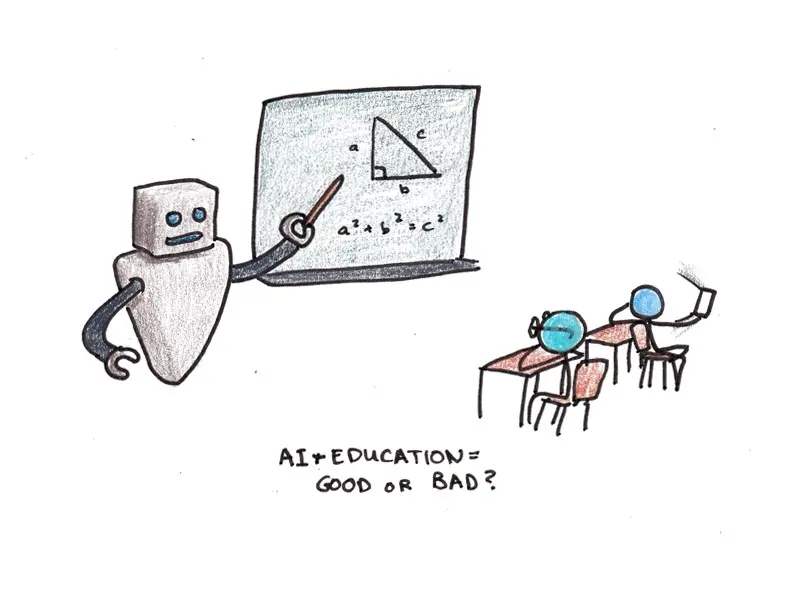
At the same time, the potential opportunities presented by artificial intelligence are vast and difficult to ignore. Beyond its pitfalls, AI offers the promise of accessible, highly patient tutoring, instant explanations for complex concepts, on-demand practice problems, and invaluable assistance in academic and professional research. Adapting a classic phrase to fit the current technological landscape, observers note that when it comes to modern education, this era represents both the best of times and the worst of times.
This tension brings to light a recent essay written by educational commentator Carl Hendrick, who examined fresh findings concerning AI’s impact on learning. In his analysis, Hendrick draws a compelling analogy between the widespread introduction of aviation autopilot systems and the gradual degradation of core pilot skills over time.
Discussing this phenomenon, Hendrick points out that the automated functions in commercial aircraft actually save significantly more lives than they endanger, a reality he believes will eventually mirror the deployment of self-driving technologies. He dismisses the simplistic narrative that machines are inherently bad while humans are purely good, viewing automated systems on the whole as magnificent achievements.
The critical danger, according to Hendrick, lies not in automation itself, but in over-dependency on it. This exact vulnerability manifests when novice learners are given unfettered, unguided access to sophisticated AI chatbots. When faced with high-pressure emergencies, pilots have historically reached instinctively for even more automation rather than less, even when the correct procedural response is to drop down a level and manually fly the aircraft. Translating this risk to modern classrooms, educators warn against allowing students to lean excessively on chatbots at the expense of developing foundational competencies.
Hendrick places the responsibility for this alarming trend squarely on educational institutions rather than the students themselves. Schools have frequently vacillated between adopting a pro-AI stance—encouraging students to utilize artificial intelligence in their assignments provided they appropriately cite the generated outputs—and retreating into traditional language regarding academic honesty in a futile attempt to preserve the status quo.
Clearly, this current posture is entirely untenable. Educational frameworks and instructional design will inevitably have to evolve in response to artificial intelligence. However, the solution does not lie in adopting vague, AI-forward policies that passively accept automated output as a legitimate substitute for genuine student effort. Instead, educators must recognize that AI functions much like calculators and Wikipedia before it: it can serve simultaneously as an extraordinary learning tool and a debilitating crutch.
What is the Right Amount of AI Use for Optimal Learning?
It remains evident that relying on artificial intelligence to complete homework assignments will not foster meaningful learning or long-term retention. Even as software developers celebrate the arrival of advanced coding agents that automate software creation, it is clear that heavily automated "vibe coding" actively impairs an individual’s ability to learn how to write code independently by hand.
Whether this specific trade-off is acceptable within the context of professional productivity is a much more nuanced question. The impact of automated coding assistance on productivity likely depends heavily on the practitioner’s current stage of knowledge acquisition. Beginners who have not yet established a robust mental model of how underlying code functions miss out on vital opportunities to practice foundational skills. Conversely, seasoned experts who understand how to steer and supervise the process may ultimately benefit from the saved effort and increased velocity.
Nevertheless, no expert can deny that if the primary objective is to learn how to write code independently, letting an advanced AI model write the code results in a measurable deficit in learning. What remains an even more compelling question for researchers is whether there exists an optimal threshold or precise timing for AI intervention. While an overreliance on AI is clearly detrimental, educators must consider whether learning could similarly be hindered by maintaining a complete absence of technological help.
Years prior to publishing his comprehensive work on accelerated skill acquisition in Ultralearning, the prevailing academic view championed deep, unassisted problem-solving and the associated mental strain as the definitive pathway to mastering difficult skills. However, subsequent research into broader learning methodologies has complicated that perspective. While deliberate practice through challenging problems remains an essential component of skill acquisition, the cognitive load involved can frequently become overwhelming. Seeking timely assistance—whether through a worked example, a completion problem, or a simple hint to overcome a mental block—can often prove significantly more efficient for learning than allowing a student to flounder indefinitely.
Developing Tentative Guidelines for Artificial Intelligence in Education
Because discussions surrounding pedagogical approaches in educational research typically span decades, artificial intelligence has existed in the mainstream for only a fraction of a moment. Consequently, it will likely take considerable time before a mature, research-backed consensus regarding AI best practices emerges within academic literature. In the interim, educational thinkers have begun formulating tentative guidelines based on existing cognitive science and observations of human learning.
First, learners must acknowledge a fundamental truth: true learning cannot happen from work that an individual does not perform themselves. While AI assistance can either support or hinder the educational journey, delegating an entire task to a chatbot ensures that the underlying skill is never internalized.
Second, learners should avoid turning to artificial intelligence during their initial attempt at a complex problem. For many creative and analytical tasks, wrestling with an initial blank page is essential. Seeking AI assistance at the very beginning of an essay or project inevitably skews the direction of the work, depriving the student of the critical experience required to build personal judgment, formulate independent arguments, and navigate their own research paths.
Third, learners should exercise caution regarding when they seek help, avoiding artificial intelligence on their final unassisted attempt. If a student remains unable to solve a problem despite exhaustive effort, educational research demonstrates that reviewing a worked example, explanation, or direct instruction yields far better outcomes than continuous, unproductive struggle. Turning to AI after an initial failure is sensible, provided the learner subsequently tackles another problem of the same category entirely without AI assistance to cement the knowledge.
Fourth, artificial intelligence should be leveraged to discover alternative perspectives, ideas, and resources. While initiating a project with AI is counterproductive, utilizing the technology’s vast breadth of knowledge to surface overlooked research papers, books, methods, and alternative viewpoints can serve as an immense asset during the exploration phase.
Finally, AI can be exceptionally effective when deployed to diagnose confusion and rectify mistakes. Once a student has completed a genuine initial attempt at solving a problem, reviewing expert-level solutions provides essential feedback. Modern AI systems are increasingly capable of generating accurate expert solutions across numerous domains, helping students precisely pinpoint the source of their errors and conceptual misunderstandings.
Integrating AI into the Practice Loop
Effective learning fundamentally operates as an ongoing practice loop consisting of seeing, doing, and receiving feedback. The initial phase of seeing involves acquiring instruction, reviewing worked examples, or absorbing knowledge to guide the search for a correct answer. The central phase of doing requires independent practice. The final phase of feedback involves gathering relevant signals from the environment to evaluate the effectiveness of that practice.
Artificial intelligence possesses the profound capability to assist with both the instructional entry point and the feedback mechanism of this educational loop. What technology can never replace, however, is the vital middle step: the independent effort of doing the work for oneself.