
This meteoric rise has fundamentally altered net worth calculations across the board. Individuals who felt they were only halfway toward their retirement goals as recently as the COVID-19 era may suddenly find themselves blowing right past the finish line. Meanwhile, retirees who stepped away from the workforce long before the pandemic are finding themselves eyeing expensive properties and navigating the psychological itch of having money burning a hole in their pockets.
Yet, this rapid accumulation of wealth invites a pressing question: Is this real, or is it all part of a bubble or some other sort of financial illusion?

The concern is widespread. As one reader recently wrote in an email to financial commentators, the market appears to be locked in a massive bubble fueled entirely by the hype surrounding Artificial Intelligence. The core anxiety centers on whether this environment makes retirement portfolios acutely vulnerable to a catastrophic future crash.
To address these fears, it helps to examine the foundational mechanics of what a stock actually represents. At its core, a stock is a business arrangement that functions as a much more convenient version of owning a rental house. When an investor owns a rental property, they are entitled to collect rent. After covering operating expenses, the remainder constitutes profit. If the average sale price of rental houses in a given neighborhood surges while tenants continue paying the exact same monthly rent, the higher valuation looks impressive on paper, but it fundamentally changes nothing unless the property is sold—at which point the owner must turn around and pay similarly inflated prices to acquire another rental property.
A landlord’s regular income remains static unless they take steps to make the rental business more profitable, such as adding a basement apartment, performing renovations, or streamlining operational expenses. When that property is eventually sold to another investor, the purchase price ought to be anchored to that future stream of income. For instance, a property generating $2,000 per month—or $24,000 annually—sold for $240,000 represents a price-to-earnings ratio of 10. If a seller manages to convince a buyer to hand over $480,000 for that same house, the transaction occurs at a P/E ratio of 20, marking a phenomenal outcome for the seller but a much tighter margin for the incoming investor.

Translating this dynamic to the broader stock market reveals a parallel reality. An investor who placed $100,000 into the market in 2019 and continuously reinvested dividends would see that balance sit at roughly $256,960 today, marking a 157 percent gain on the original principal. However, over that exact same timeframe, the share of company earnings generated by that $100,000 basket of stocks has grown far more modestly, moving from $5,290 to $7,540, a gain of about 42 percent. Consequently, the overall price-to-earnings ratio of the market has drifted upward from approximately 20 to roughly 30.
Current stock investors find themselves in the exact position of landlords discovering that property values have doubled while rental income has barely budged. This compressed margin makes the underlying business less profitable relative to capital deployed. Basic financial mathematics dictates that future returns derived from assets purchased at today’s higher price-to-earnings ratios should logically be lower than returns captured when those same assets were purchased on sale. Owning stocks or rental properties remains profitable over the long haul, but incoming cash flows as a percentage of portfolio value are inherently tamer.
The Role of Rising Earnings and the Magnificent Seven
Of course, valuation metrics change if earnings expectations shift dramatically upward. Consider a prospective rental home priced higher than current rental rates justify, backed by the concrete knowledge that a massive corporate campus is about to be constructed nearby, signaling rapid rent growth for years to come. In that scenario, paying a premium for future earnings makes rational sense.

This phenomenon explains why individual company stocks rally sharply upon the release of positive corporate news. During the pandemic, consumer demand for indoor exercise equipment caused Peloton sales to surge, prompting investors to extrapolate that temporary lifestyle shift into a permanent economic trend. When reality reasserted itself and sales normalized, the stock price retreated accordingly.
When an entire market scales unprecedented heights, the implication is normally that the broader economy is poised for accelerated growth. Yet, a closer examination of the S&P 500 reveals a more nuanced picture. Approximately three-quarters of the recent market growth has been concentrated in just seven massive technology companies: Apple, Nvidia, Microsoft, Amazon, Alphabet, Meta, and Tesla.
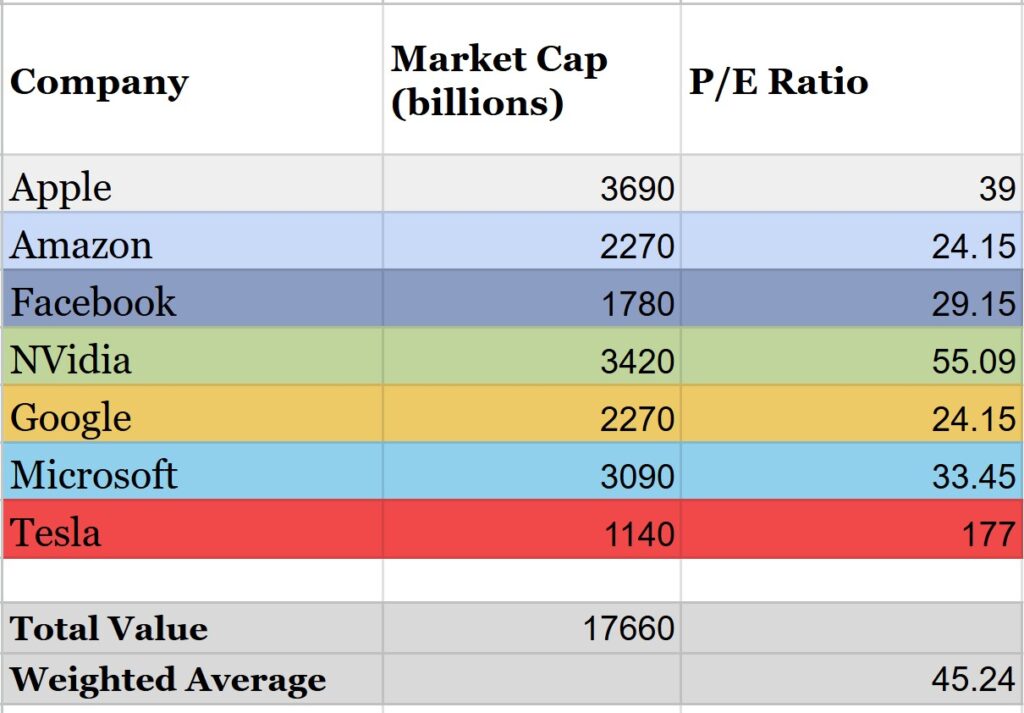
Often dubbed the Magnificent Seven, these high-profile technology firms have enjoyed explosive growth and intense public hype, driving investors to bid up their share prices in anticipation of sustained expansion. Collectively, these seven entities account for more than 25 percent of the entire market’s capitalization, representing a staggering $17.66 trillion, while carrying a weighted average P/E ratio of approximately 45.
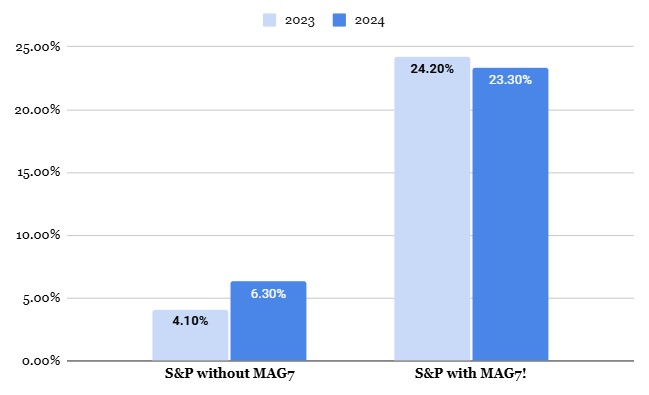
Excluding these seven giants and evaluating the remaining 493 companies reveals a far more moderate P/E ratio of roughly 20. This divergence indicates that while market participants expect the broader United States economy to maintain steady health, they are pricing in exceptionally rapid, outsized growth specifically for the tech sector.
The Artificial Intelligence Frenzy and Economic Realities
The common denominator connecting these dominant technology companies is the recent, unexpected acceleration of Artificial Intelligence capabilities. Software systems are suddenly displaying advanced reasoning across a rapidly expanding array of fields, igniting a frenzy across the global business landscape.
Six of the Magnificent Seven companies are directing hundreds of billions of dollars toward the construction of massive data centers packed with advanced supercomputers. Meanwhile, the seventh member, Nvidia, captures a significant share of those expenditures by manufacturing the specialized hardware that powers these systems, enabling the company to command premium pricing amidst overwhelming global demand.
Beyond this foundational infrastructure layer, industries across the economic spectrum are betting that society has entered a new era of enhanced productivity and expanded profit margins. Modern AI tools can synthesize entire legal documents, analyze software codebases for vulnerabilities, assist in medical diagnostics, and accelerate pharmaceutical research. Proponents argue humanity stands on the verge of integrating an infinite workforce of digital intelligence capable of performing complex labor, effectively removing the historical constraints of finite human time and cognitive bandwidth.
Whether corporate profits will ultimately materialize at the heights forecasted by today’s elevated valuations remains an open question. Potential variables include unexpected infrastructure costs, intensifying competition, regulatory interventions, or broader societal adjustments if automation shifts employment dynamics on a national scale.
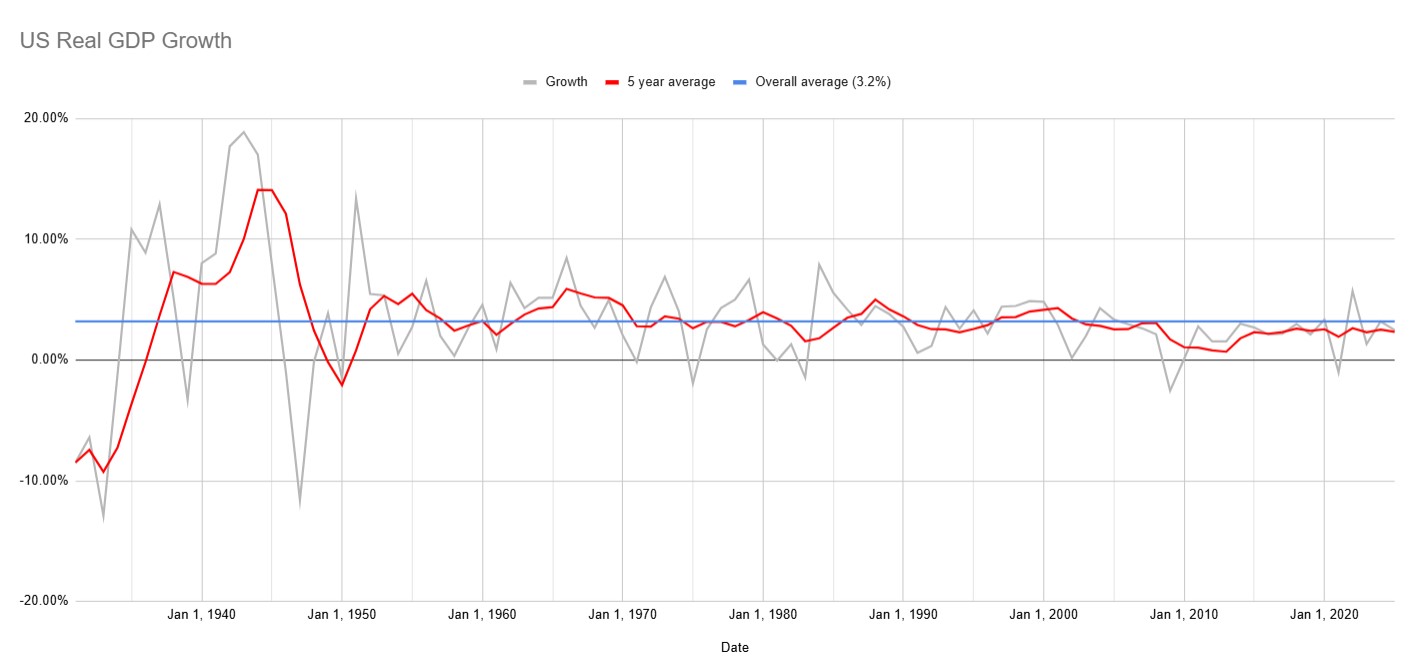
Historically, United States economic growth has maintained a remarkably stable trajectory, averaging roughly three percent annually after adjusting for inflation across decades. Interestingly, recent decades have actually witnessed slightly slower-than-average economic growth, underscoring the disconnect between macroeconomic expansion rates and current stock market pricing multiples.

Strategic Perspectives and Alternative Investments
While the future path of stock valuations remains uncertain, long-term equity ownership has historically generated positive returns, albeit potentially at a slower pace when assets are purchased at peak valuations. Attempting to time market panics and manias by liquidating holdings in pursuit of a lower entry point has historically proven to be an unreliable strategy. Even if stock valuations eventually compress toward historical averages, continuous economic growth and rising corporate earnings support a stable long-term accumulation path.
Looking beyond domestic equities, institutional forecasters regularly evaluate global alternatives. Major financial institutions like Vanguard routinely publish ten-year annualized return projections suggesting that international equities and fixed-income bonds could potentially outperform United States stocks over the coming decade. This perspective is anchored in valuation disparities, noting that international funds often trade at significantly lower price-to-earnings ratios compared to their domestic counterparts. However, forecasters acknowledge that prior predictions favoring international markets have routinely lagged behind the exceptional performance concentrated within the United States technology sector.
Diversified portfolio strategies, such as automated multi-asset allocations utilizing a blend of domestic stocks, international equities, and bonds, aim to balance volatility while maintaining exposure to global growth. Meanwhile, conservative market figures, including Warren Buffett’s Berkshire Hathaway, have maintained substantial cash reserves, signaling that bargains remain scarce and equity valuations across many sectors are elevated relative to historical norms.
For individual homeowners evaluating capital deployment, the decision between aggressively paying down a mortgage versus directing surplus cash into index funds involves balancing guaranteed interest savings against historical equity returns. While maintaining a low-rate mortgage while investing surplus capital has traditionally favored stock market accumulation, rising interest rates and elevated market valuations narrow that margin, leaving room for personal preference regarding debt elimination.
Ultimately, navigating macroeconomic shifts and market booms involves maintaining a long-term perspective, ignoring daily news cycles, and focusing on foundational financial habits. As financial commentators frequently emphasize, excessive worrying yields no measurable return, whereas dedicating time and energy to personal well-being and outdoor pursuits offers a reliable antidote to market volatility.