For those who have tuned out the financial media noise, the modern AI phenomenon can be broken down into rapid technological innovation, massive capital investment in infrastructure, and widespread speculation over its societal impact. The central anxiety among investors is that while artificial intelligence is unquestionably a major technological leap, the mania surrounding it is moving too fast and reaching too high. Many fear a repeat of the dot-com crash of the early 2000s, but on a much larger scale. That particular historic boom launched the early careers of many technology veterans before the ensuing correction threatened jobs and financial stability.

As financial observers and retirement advocates address questions regarding this current investment cycle, comparisons to past booms and busts inevitably arise. Discussions addressing these anxieties have recently taken center stage at financial independence gatherings, such as Camp FI Midwest, and upcoming forums like the Bogleheads conference, highlighting a timeless question: Will the current AI bubble ruin retirement planning for the modern generation?
Twenty Years of Market Worries and Economic Realities
Reflecting on decades of retirement reveals how familiar anxieties truly are. Observers frequently ask how retirees can remain comfortable and sleep at night given the state of the world, citing a continuous stream of modern headlines. Current worries often encompass geopolitical tensions involving prominent leaders, persistent inflation eroding purchasing power, the looming shadow of the AI bubble, soaring national debt, and various international conflicts threatening global stability.

However, these exact categories of anxiety are remarkably similar to those expressed two decades ago. Looking back at the mid-2000s, public discourse was dominated by fears of different leaders, alternative geopolitical conflicts in the Middle East, national debt concerns, and inflation. Back then, the overvalued stock market was attributed to the burgeoning housing bubble rather than an AI bubble, and anxieties about job displacement focused on outsourcing to overseas markets rather than automated intelligence. Society even wrestled with the debate of "peak oil," fearing that fossil fuel use would inevitably outstrip supply—an outcome that ultimately reversed.
Despite the heavy cloud of anxiety present in 2006, the subsequent two decades witnessed the Great Financial Crisis—triggered by irrational exuberance over real estate and high financial leverage—which proved to be the deepest market downturn since the Great Depression. Yet, viewed through the lens of a long-term chart, even that monumental crash appears as a temporary dip in a broader upward trajectory. A historical investment in the broader market weathered both the 2008 financial crash and the 2020 pandemic downturn to generate substantial long-term growth.

Simultaneously, global socioeconomic indicators improved dramatically over the same twenty-year span. Extreme poverty rates dropped significantly, infant mortality rates were cut in half, and clean energy adoption surged as the cost of solar technology plummeted. Electric vehicles transitioned from a novelty to a substantial share of global automotive sales. This historical perspective suggests that focusing energy on an uncertain future is far less productive than recognizing the underlying mechanisms of human progress.
Prosperity, Productivity, and the Roots of Human Happiness
Financial media thrives on crafting cautionary narratives, but alarmists frequently overlook a fundamental economic truth: true prosperity does not originate from financial systems or stock market tickers, which are ultimately numerical representations managed by computers. Instead, economic prosperity stems directly from productivity.

The fundamental lesson of modern capitalism is that while financial markets are inherently volatile and prone to emotional swings, real people perform real work and invent tangible solutions beneath the surface waves of the economy. The concept of an economic system is itself a human invention. If a financial system faces severe disruption, historical precedent demonstrates that societies adapt, rebuild, and continue generating value. The core drivers of standard of living and early retirement feasibility—innovation and productivity—remain intact regardless of market cycles.
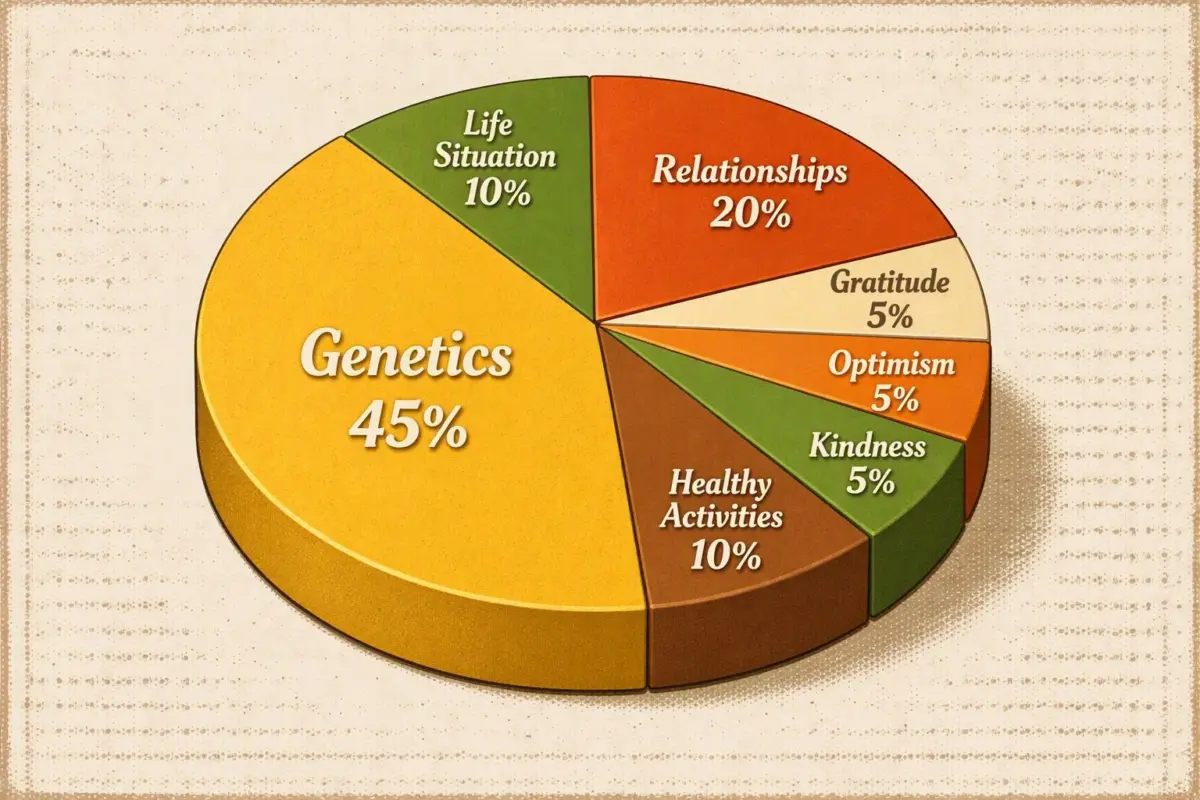
Furthermore, once a society achieves a certain baseline standard of living, human happiness ceases to scale purely with material wealth. Developed nations surpassed those minimum material requirements decades ago, shifting the focus of human satisfaction toward other dimensions. Psychological and sociological observations indicate that non-financial factors—such as genetics, close personal relationships, acts of kindness, optimism, and an active lifestyle—play a dominant role in overall human well-being. Wealth represents only a fraction of an individual’s total life situation.

Confronting Fear Itself and the Mechanics of Worry
Despite historical evidence showing that humanity consistently adapts and prospers, baseline anxiety remains remarkably resilient. Human beings evolved as danger-detection machines, utilizing background fear as an evolutionary trait to protect against physical threats. However, a quirk of this psychological machinery is that when immediate physical dangers are resolved, the mind continues searching for new sources of worry.
Once individuals solve the fundamental challenges of securing food, shelter, and physical safety, they frequently shift their anxieties toward social standing, economic comparisons, or complex financial administration. In advanced stages of financial security, worries migrate toward tax strategies, estate planning, and managing government-mandated withdrawals from retirement accounts.

Combatting this persistent cycle of fear requires active self-awareness and rational evaluation. Understanding personal history—such as childhood experiences with financial scarcity or past trauma—can illuminate why certain anxieties manifest in adulthood. By identifying the specific nature of a fear, examining realistic worst-case scenarios, and taking deliberate action, individuals can replace unfamiliarity with confidence. Taking action fosters resilience, the vital capacity to adapt to changing circumstances.
Additionally, managing one’s mental diet by filtering out sensationalized daily news reporting helps mitigate unwarranted panic. Human beings are biologically wired to solve problems through physical and mental engagement within their external environment. Aligning daily habits with natural human behaviors—such as continuous learning, physical movement, and fostering positive social connections—reduces psychological distress more effectively than passive worry.

Everything is an Experiment: Viewing AI Through an Economic Lens
Approaching life’s transitions through the perspective of an experiment alters how individuals react to change. Whether applied to personal decisions, career shifts, or early retirement, framing milestones as controlled experiments neutralizes the paralyzing effects of fear.
This experimental mindset applies directly to the emergence of Artificial Intelligence. Rather than succumbing to doom-scrolling and apprehension, understanding the underlying utility of AI reframes it as a technological evolution. AI functions effectively as a cognitive tool designed to boost human efficiency, drive productivity, and ultimately generate broader economic prosperity.

Like previous technological revolutions—including the advent of the internet and mobile computing—artificial intelligence will inevitably displace certain routine tasks while simultaneously reducing costs and fostering entirely new industries. While productivity gains frequently concentrate rewards among capital owners and shareholders, the broader economy adapts by reallocating labor toward higher-level problem-solving.
Ultimately, technological shifts like artificial intelligence serve as catalysts for personal choice. Individuals retain the agency to decide whether to view emerging innovations with fear or to leverage them as opportunities for continuous learning, adaptation, and purposeful living.