For observers who remain comfortably tuned out of daily financial market drama, the core narrative of the modern AI wave can be distilled into three fundamental developments: rapid technological breakthroughs, massive capital expenditure by major tech conglomerates, and a parallel wave of societal anxiety regarding future job security and market stability.

Skeptics and cautious investors worry that while artificial intelligence is unquestionably a major technological leap, the financial mania surrounding it is moving too fast and reaching too high. Many fear a replay—or an amplified version—of the dot-com crash of the early 2000s. That particular historical boom propelled many early careers into early retirement before the subsequent correction nearly derailed livelihoods and immigration paths alike.
As financial commentators field countless questions about this investment cycle just as they have through previous booms and busts, discussions on the matter are expanding from online forums to live events. From presentations at gatherings like Camp FI Midwest to upcoming addresses at major financial conferences, the intersection of market valuations and human psychology has taken center stage in retirement planning discussions.

Will the AI Bubble Ruin Our Retirement?
Achieving decades of retirement brings a certain level of comfort with market volatility, yet common questions persist among peers. Observers frequently ask how retirees can remain comfortable and sleep soundly given global instabilities, questioning if current economic pressures should prompt deep concern.
A broad scan of modern news cycles reveals no shortage of anxieties: geopolitical flashpoints involving major world leaders, persistent inflation eroding purchasing power, the looming shadow of the AI bubble, soaring national debt, and various international conflicts threatening broader stability.

However, a historical perspective reveals that these worries are merely updated versions of past anxieties. Twenty years prior, during the mid-2000s, observers wrestled with similarly dire concerns. Back then, headlines featured different geopolitical leaders, Middle Eastern conflicts, ballooning national debt, and inflation. The overvalued stock market of that era generated intense anxiety due to a massive housing bubble rather than an artificial intelligence boom, while job displacement fears centered on outsourcing to overseas markets rather than automated software. There was even widespread debate over "Peak Oil," warning that rising fossil fuel consumption would inevitably outstrip supply—a prediction that ultimately reversed course entirely.
Following the intense anxieties of 2006, the global economy did indeed experience the Great Financial Crisis, driven by irrational exuberance in real estate prices and high leverage in mortgage-backed financial instruments. It marked the most severe economic downturn since the Great Depression. Yet viewed through a decades-long historical lens, even that monumental crash appears as a temporary dip within a broader upward trajectory. Substantial long-term investments through those decades saw remarkable growth, weathering subsequent shocks like the pandemic-era market correction of 2020.

Concurrently, broad global indicators improved significantly over the same twenty-year period. The proportion of the global population living in extreme poverty dropped sharply, child mortality rates were drastically reduced, and clean energy adoption surged. Solar generation expanded exponentially as panel costs plummeted, while electric vehicle adoption climbed from negligible levels to substantial portions of global auto sales.
These developments highlight a recurring pattern: focusing energy on an uncertain future versus maintaining a broader perspective on long-term human progress. This raises the critical question of whether current economic conditions represent a fundamental departure from historical norms. Skeptics point to towering national debt, unprecedented AI valuations, or theoretical risks of runaway superintelligence. Financial media outlets regularly amplify these fears, yet such narratives frequently overlook a fundamental economic truth.

Prosperity Comes From Productivity
At its core, human prosperity does not derive from abstract financial systems or stock market ticker symbols, which represent numbers recorded on digital networks. True prosperity stems directly from productivity.
The fundamental mechanics of capitalism are inherently choppy and prone to wild cyclical swings. Beneath the volatile surface of financial markets, however, real people perform tangible work and develop practical inventions. The concept of an economy or a financial system is itself a human construct. If financial systems experience severe corrections because market participants dislike digital metrics, society possesses the capacity to restructure those metrics and resume productive labor—a mechanism demonstrated repeatedly throughout modern financial history, including during the aftermath of the 2008 crisis.

Society retains every foundational tool ever invented to enhance productivity. Long-term improvements in standard of living, economic growth, and the feasibility of early retirement originate directly from productivity gains.
Beyond economic metrics, once a society achieves a specific threshold of material standard of living, human happiness tends to plateau along that specific dimension. Developed nations surpassed those baseline requirements decades ago, prompting individuals to seek other factors to maximize overall life satisfaction. Wealth ultimately functions as a single component within a broader framework of personal well-being.

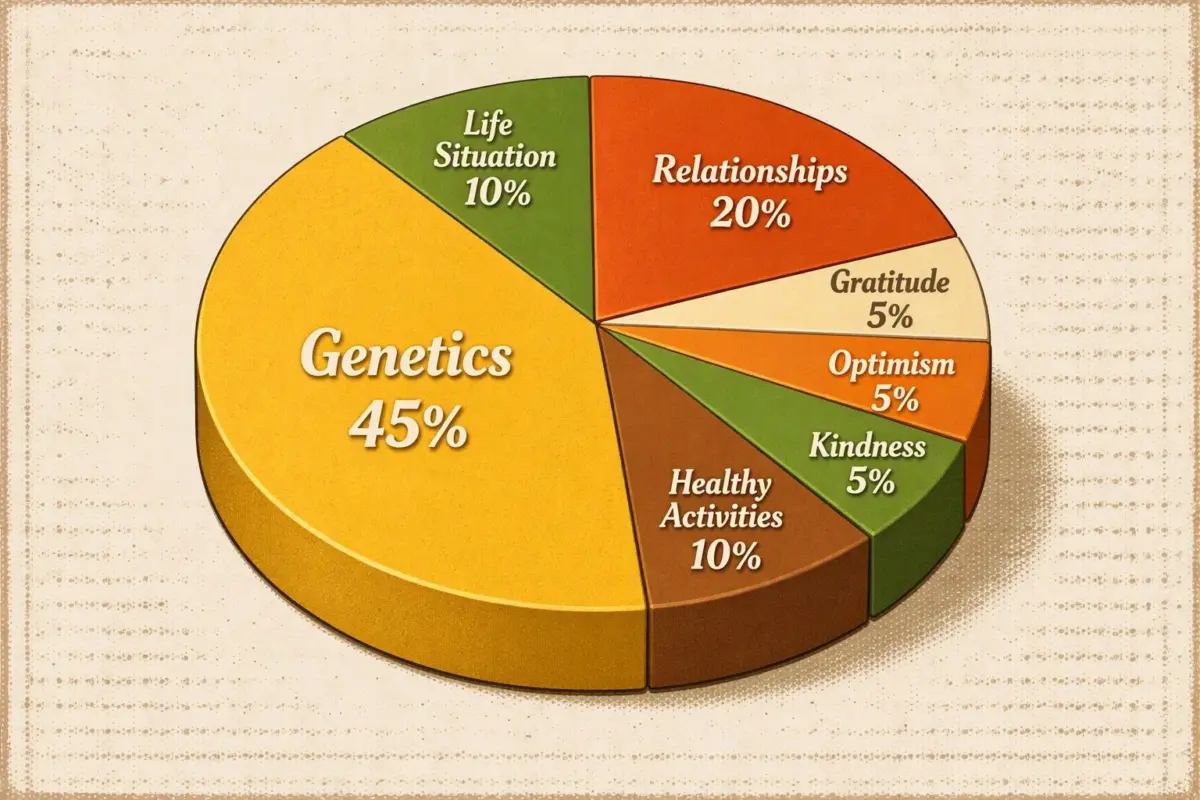
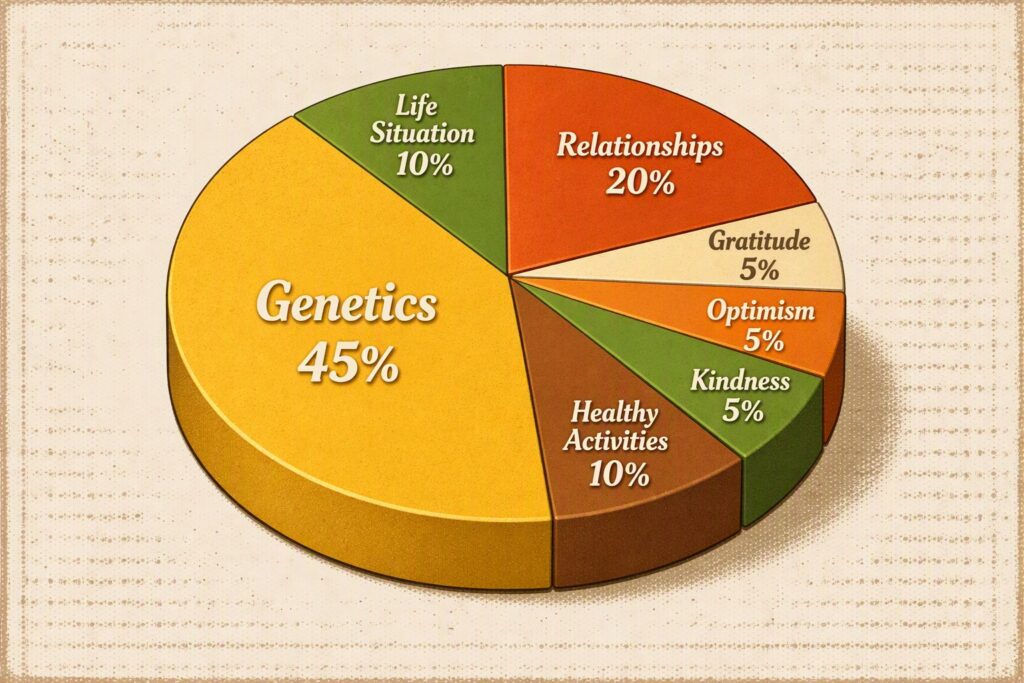
While genetic predisposition plays a significant role in baseline happiness, individuals retain control over critical lifestyle choices. Cultivating strong personal relationships, practicing gratitude, maintaining an optimistic outlook, and engaging in frequent outdoor physical activities exert powerful influences on daily fulfillment.
Despite widespread awareness of these principles, background anxiety regarding the future persists among many individuals. The underlying driver of this phenomenon is often fear itself.

Overcoming the Architecture of Fear
Human beings evolved as sophisticated danger-detection mechanisms. Pervasive background anxiety is an evolutionary trait designed to protect against environmental threats. However, a peculiar characteristic of this psychological machinery is that individuals can adapt to function in high-stress environments, yet once actual dangers subside, the mind continues scanning for new sources of worry, effectively moving the goalposts of anxiety.
When immediate threats regarding physical survival and food scarcity are resolved, worries shift toward social belonging, tribal exclusion, and financial status. Driven by relative comparisons and anchoring biases, escaping poverty fails to completely eliminate anxiety; instead, concerns simply pivot toward acquiring greater wealth, managing complex tax strategies, navigating required minimum distributions, or optimizing estate transfers.
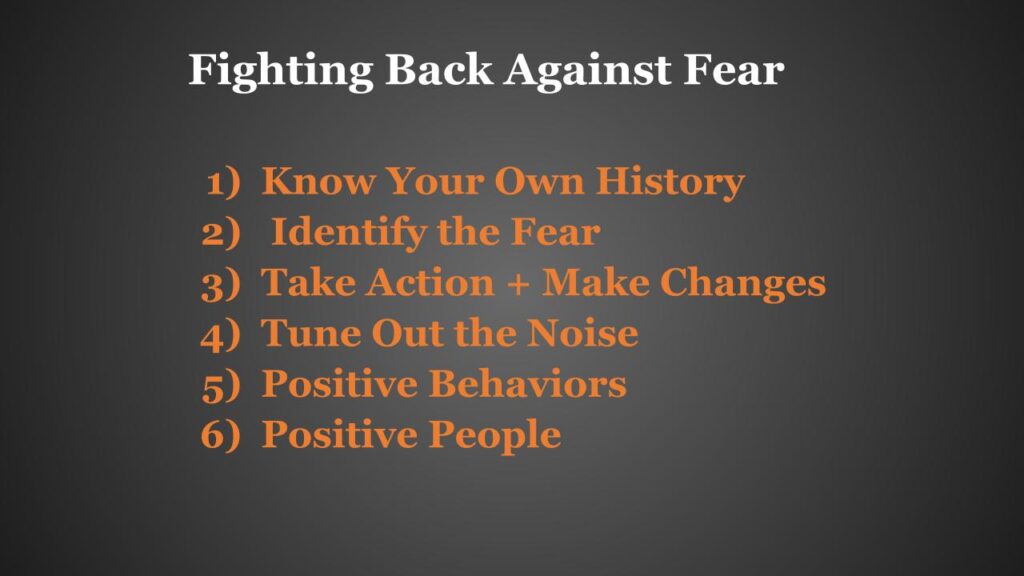
Combatting persistent fear requires self-awareness and rational evaluation. Examining personal history—such as growing up in households influenced by a scarcity mindset passed down through generations affected by historical economic depressions—helps contextualize modern anxieties. Recognizing whether current emotional responses stem from past trauma or an objective assessment of the present is a crucial first step.
Identifying specific fears by tracing worst-case scenarios to their logical conclusions often reveals that feared outcomes are far less catastrophic than anticipated. Taking concrete action serves as a powerful antidote to fear, transforming the unfamiliar into the familiar and building genuine resilience. Developing adaptability across physical, mental, and emotional dimensions diminishes the perceived threat of uncertain future events.

Concurrently, filtering out unnecessary background noise from daily media consumption helps prevent unnecessary psychological distress. News outlets frequently prioritize sensationalized and alarming stories to capture attention. Focusing instead on constructive personal behaviors, physical health, outdoor activity, and positive social circles helps realign daily life with natural human inclinations.
Viewing Technological Shifts as Experiments
Adopting a mindset that treats major life changes—ranging from career transitions to technological revolutions—as experiments can fundamentally alter how individuals perceive uncertainty. Rather than reacting to rapid developments with alarmist doom-scrolling, analyzing the underlying mechanics of new innovations provides clarity.
Artificial intelligence can be viewed pragmatically as a cognitive productivity tool. Much like historical technological leaps that boosted efficiency, AI enhances output and drives long-term prosperity by lowering the cost of complex cognitive tasks.
At the same time, technological shifts inevitably displace certain traditional roles, particularly in entry-level administrative, software, and transportation sectors, while simultaneously catalyzing new industries and reducing service costs—a pattern historically observed during the expansion of the internet and mobile computing revolutions. While the economic rewards of such advancements often concentrate among capital owners and shareholders, the broader technological integration remains a continuous part of economic evolution.

Ultimately, navigating modern economic anxieties and technological shifts requires recognizing that fear is often an internal challenge rather than an external threat. By understanding the root causes of apprehension and focusing on rational problem-solving, individuals can approach an uncertain future with resilience and perspective.