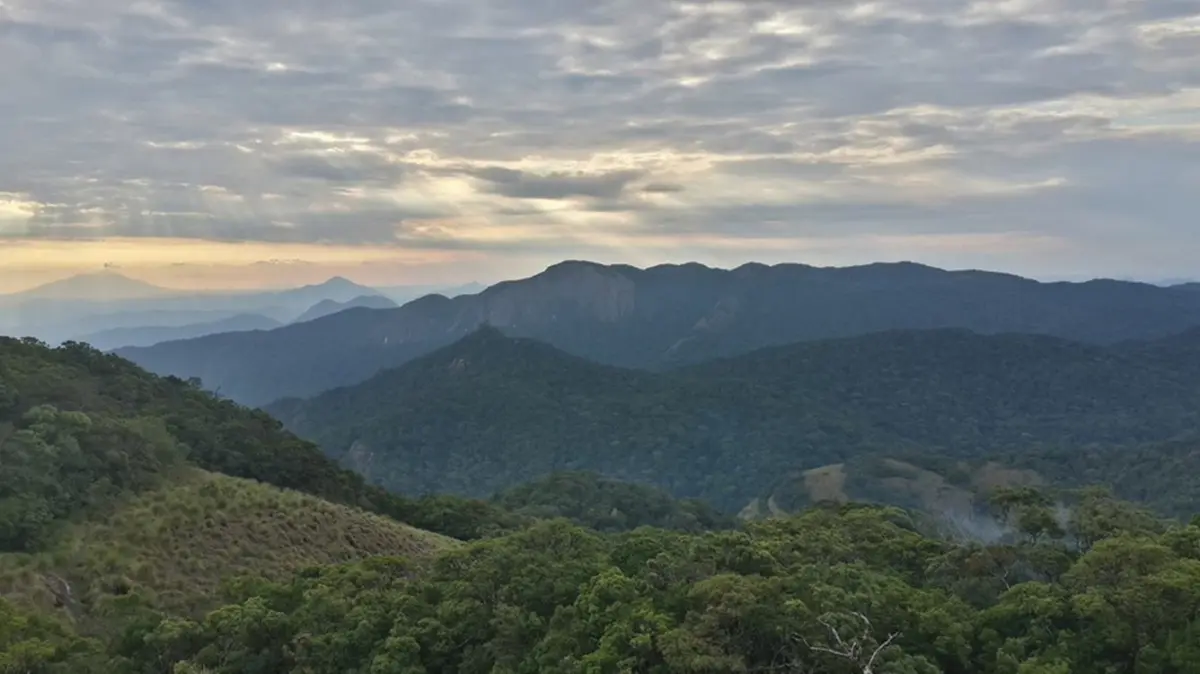
A government decree published on August 24th officially protects one of the wettest and most biologically unique regions in the southern hemisphere. Famously dubbed the “butterfly forest” by renowned naturalist Sir David Attenborough, the newly protected area will safeguard not only the delicate habitat itself but also the more than 200 species of butterflies that call its misty slopes home.
Mount Mabu and its surrounding isolated mountain chain slopes contain remarkably high rates of endemism, a scientific term describing species that are found exclusively in one specific geographic location and nowhere else on Earth. For decades, researchers working in the region have uncovered flora and fauna entirely new to science, establishing the area as a global hotspot for evolutionary study.
News of the government decree was closely followed by conservation platforms like Mongabay, reaching the broader public via researchers whose tireless field work on Mount Mabu has spanned over two decades. Expeditions to the remote mountain chain have yielded numerous scientific discoveries, including the Mount Mabu forest viper, alongside an astonishing variety of endemic butterfly species.
The ecological significance of Mount Mabu and neighboring Mount Namuli first gained widespread international attention in 2013, when naturalist Sir David Attenborough presented the region for the BBC. His description of it as the “butterfly forest” quickly resonated with the public and became an enduring moniker for the misty, secluded highlands.
Julian Bayliss, a prominent researcher whose extensive scientific expeditions have fundamentally shaped our understanding of Mount Mabu’s biodiversity, previously described the ecosystem in a 2014 publication. He noted that the mountains and their surrounding forests represent what is likely the largest continuous block of medium-altitude rainforest in the entire southern African region, prompting long-standing discussions among scientists regarding how best to protect its immense natural riches.
Achieving formal protection for Mount Mabu represents a major milestone in a country that has historically faced immense hurdles in conservation management. As previously reported by the Good News Network, Mozambique endured one of Africa’s longest post-colonial civil wars. Combined with subsequent waves of unchecked poaching, the decades of conflict left many of the nation’s premier parks and wild habitats severely depleted of wildlife.
Today, however, the nation stands stable and at peace, actively working to rebuild its wildlife populations and restore damaged ecosystems. Environmental experts note that while restoring depleted areas is critical, protecting pristine ecosystems like Mount Mabu before they face degradation is an even more powerful conservation strategy.
The official decree, issued jointly by the Ministry of Agriculture, Environment, and Fisheries, explicitly defines the new reserve as an area dedicated to the protection, conservation, and sustainable use of natural resources by local communities. This community-centric approach is widely viewed as a vital component of the region’s long-term environmental strategy.
While a comprehensive community management plan is currently in the works, conservationists express a high degree of optimism regarding the project’s future. Crucially, the mountains have long been treated as sacred spaces by the local communities living in their shadows, fostering a deep cultural respect for the integrity of the forest that predates modern conservation science.
The establishment of the Mount Mabu Community Conservation Area builds upon a broader national trend. Since the conclusion of the civil war, Mozambique has steadily expanded its network of protected spaces. According to data from the country’s official conservation authority, the Administração Nacional das Áreas de Conservação (ANAC), approximately 25 percent of the nation’s total territory is now preserved under various designations, ranging from sustainable-use community areas to strictly protected wilderness zones.
This steady expansion of protected land underscores Mozambique’s broader national commitment to environmental stewardship, complementing other major wildlife restoration initiatives across the country—such as the recent, highly successful multi-animal translocation effort to restore the local rhinoceros population.
As the newly formed Mount Mabu Community Conservation Area transitions from a legal decree into an active, community-managed reserve, researchers and conservationists alike look toward the future with renewed hope for southern Africa’s premier butterfly forest and the countless unique species sheltered within its canopy.